A mouthwash contains 22.5% (v/v) alcohol. If the bottle of mouthwash contains 355 mL, what is the volume, in milliliters, of alcohol?
Ch.9 Solutions
Timberlake14th EditionChemistry: An Introduction to General, Organic, and Biological ChemistryISBN: 9781292472249당신이 사용하는 게 아니라요?교과서 변경
9장, 문제 41c
Calculate the grams or milliliters of solute needed to prepare the following:
c. 250. mL of a 10.0% (v/v) acetic acid solution
검증된 단계별 안내1
Understand the problem: A 10.0% (v/v) solution means that 10.0 mL of solute (acetic acid) is present in every 100 mL of solution. You are tasked with determining how many milliliters of acetic acid are needed to prepare 250. mL of this solution.
Set up the proportion based on the definition of percent by volume: \( \frac{\text{Volume of solute (mL)}}{\text{Volume of solution (mL)}} = \frac{10.0}{100} \).
Substitute the given total solution volume (250. mL) into the proportion: \( \frac{\text{Volume of solute (mL)}}{250.} = \frac{10.0}{100} \).
Solve for the volume of solute (mL) by multiplying both sides of the equation by 250.: \( \text{Volume of solute (mL)} = \frac{10.0}{100} \times 250. \).
Perform the calculation to find the volume of acetic acid needed. The result will be in milliliters, as the problem specifies a (v/v) solution.

비슷한 문제에 대한 검증된 영상 답변:
이 영상 해법은 위 문제에 도움이 된다고 튜터들이 추천한 것입니다.
영상 길이:
3m주요 개념
질문에 올바르게 답하기 위해 반드시 이해해야 하는 핵심 개념들은 다음과 같습니다.
Concentration
Concentration refers to the amount of solute present in a given volume of solution. In this case, a 10.0% (v/v) acetic acid solution means that there are 10 milliliters of acetic acid in every 100 milliliters of the solution. Understanding concentration is crucial for calculating the required volume or mass of solute needed to achieve a specific solution concentration.
추천 영상:
가이드 코스
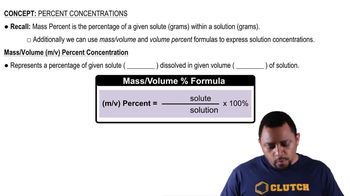
Percent Concentrations Concept 1
Volume and Volume Percent
Volume percent (v/v) is a way to express the concentration of a solution, indicating the volume of solute divided by the total volume of the solution, multiplied by 100. For a 10.0% (v/v) acetic acid solution, this means that 10 mL of acetic acid is present in 100 mL of solution. This concept is essential for determining how much acetic acid is needed to prepare a specific volume of solution.
추천 영상:
가이드 코스
Percent Concentrations Concept 1
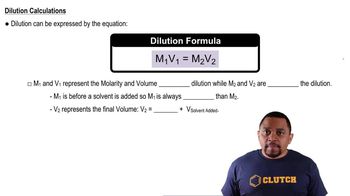
Dilution
Dilution is the process of reducing the concentration of a solute in a solution, typically by adding more solvent. In preparing a solution, understanding how to dilute a concentrated solution to achieve the desired concentration is important. For the given problem, knowing how to calculate the amount of acetic acid needed for a 250 mL solution at 10.0% (v/v) involves applying dilution principles.
추천 영상:
가이드 코스
Dilutions
관련 실천
교과서 질문
1145
views
교과서 질문
A patient receives 100. mL of 20.% (m/v) mannitol solution every hour.
b. How many grams of mannitol does the patient receive in 12 h?
920
views
교과서 질문
Calculate the mass/volume percent (m/v) for the solute in each of the following:
a. 75 g of Na2SO4 in 250 mL of Na2SO4 solution
1360
views
교과서 질문
Determine the final volume, in milliliters, of each of the following:
b. a 2.0% (m/v) LiCl solution prepared from 50.0 mL of a 10.0% (m/v) LiCl solution
2747
views
교과서 질문
What is the difference between a 10.0% (v/v) methanol (CH4O) solution and a 10.0% (m/m) methanol solution?
1713
views
교과서 질문
A patient needs 100. g of glucose in the next 12 h. How many liters of a 5% (m/v) glucose solution must be given?
1211
views