Ch.9 Solutions
Timberlake - Chemistry: An Introduction to General, Organic, and Biological Chemistry 14th Edition
Timberlake14th EditionChemistry: An Introduction to General, Organic, and Biological ChemistryISBN: 9781292472249당신이 사용하는 게 아니라요?교과서 변경
9장, 문제 37a

Calculate the mass/volume percent (m/v) for the solute in each of the following:
a. 75 g of Na2SO4 in 250 mL of Na2SO4 solution

검증된 단계별 안내
1
Step 1: Understand the formula for mass/volume percent (m/v). It is defined as: mass (g)volume (mL) × 100. This formula expresses the concentration of a solute in a solution as a percentage.
Step 2: Identify the given values in the problem. The mass of the solute (Na₂SO₄) is 75 g, and the volume of the solution is 250 mL.
Step 3: Substitute the given values into the formula. Replace 'mass' with 75 g and 'volume' with 250 mL in the formula: 75250 × 100.
Step 4: Perform the division in the numerator to calculate the fraction. Divide 75 by 250 to get the decimal value.
Step 5: Multiply the result from Step 4 by 100 to convert the decimal into a percentage. This will give you the mass/volume percent (m/v) of Na₂SO₄ in the solution.

비슷한 문제에 대한 검증된 영상 답변:

이 영상 해법은 위 문제에 도움이 된다고 튜터들이 추천한 것입니다.
영상 길이:
1m

주요 개념

질문에 올바르게 답하기 위해 반드시 이해해야 하는 핵심 개념들은 다음과 같습니다.

Mass/Volume Percent (m/v)

Mass/volume percent (m/v) is a concentration measurement that expresses the mass of a solute in grams per 100 mL of solution. It is calculated using the formula: (mass of solute in grams / volume of solution in mL) × 100. This metric is particularly useful in chemistry for quantifying the concentration of solutions, allowing for easy comparisons and calculations.
추천 영상:
가이드 코스
00:38
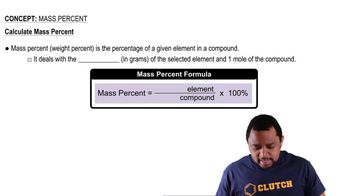
Mass Percent Concept

Solute and Solution

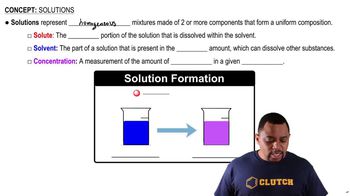
In a solution, the solute is the substance that is dissolved, while the solvent is the substance that does the dissolving. In this case, Na₂SO₄ is the solute, and the solution is the mixture of Na₂SO₄ and the solvent (usually water). Understanding the roles of solute and solvent is crucial for calculating concentrations and performing related chemical calculations.
추천 영상:

Units of Measurement

Units of measurement are essential in scientific calculations to ensure accuracy and consistency. In this context, grams (g) measure mass, and milliliters (mL) measure volume. Being familiar with these units and how to convert between them is vital for correctly calculating mass/volume percent and interpreting results in chemistry.
추천 영상:
가이드 코스
02:52
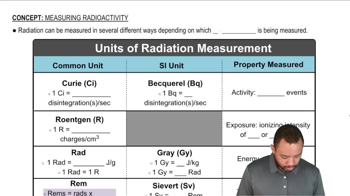
Measuring Radioactivity Concept 1