 뒤로
뒤로Genetics and Inheritance: Patterns, Chromosomal Abnormalities, and Mutations
스터디 가이드 - 스마트 노트
 자료에 맞춘 맞춤형 노트, 핵심 정의, 예시, 맥락을 확장해 제공합니다.
Genetics and Inheritance
Introduction to Genetics
Genetics is the study of inherited characteristics, or traits, and how they are passed from parents to offspring. Inheritance involves the transmission of genes, which are segments of DNA that code for specific traits. Genetic variation exists among individuals in natural populations, and the study of how traits are passed through generations is known as the pattern of inheritance.
Alleles and Variation
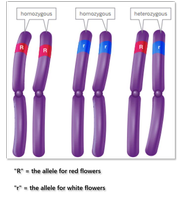
Genes can exist in different forms called alleles. Each individual typically inherits two alleles for each gene, one from each parent. These alleles may be identical (homozygous) or different (heterozygous).
Dominant allele: Expressed in the phenotype even if only one copy is present (e.g., red flower color in pea plants, represented by 'R').
Recessive allele: Only expressed when two copies are present (e.g., white flower color in pea plants, represented by 'r').
Genotype refers to the combination of alleles an organism possesses (e.g., RR, Rr, rr), while phenotype is the observable trait (e.g., red or white flowers).
Patterns of Inheritance in Pea Plants
The inheritance of flower color in pea plants is a classic example of Mendelian genetics. Red flower color is dominant over white. The possible genotypes and their corresponding phenotypes are:
RR: Homozygous dominant (red flowers)
Rr: Heterozygous (red flowers)
rr: Homozygous recessive (white flowers)

Pure-Breeding and Cross-Breeding
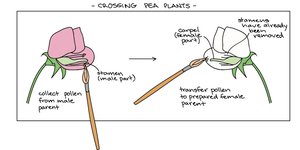
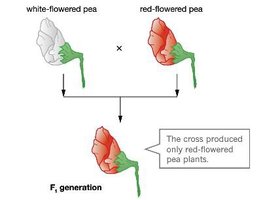
Pure-breeding refers to organisms that are homozygous for a trait and consistently pass that trait to offspring. Cross-breeding (test-cross) involves mating a homozygous dominant individual with a homozygous recessive individual. The first generation (F1) will all be heterozygous and display the dominant phenotype.
Punnett Squares and Probability
A Punnett square is a tool used to predict the probability of offspring genotypes and phenotypes based on parental genotypes. For example, crossing two heterozygous pea plants (Rr x Rr) yields the following probabilities:
1/4 RR (red)
1/2 Rr (red)
1/4 rr (white)
Sex Determination and Sex Linkage
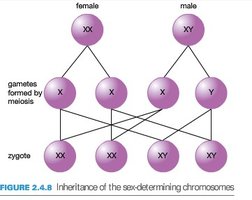
Sex is determined by the 23rd pair of chromosomes: XX for females and XY for males. The mother always contributes an X chromosome, while the father can contribute either X or Y, determining the sex of the offspring. Some genes are located on the sex chromosomes (sex-linked genes), with most being on the X chromosome. Traits such as color-blindness are X-linked and recessive.
Pedigrees
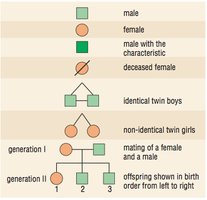
A pedigree is a diagram that traces the inheritance of a trait or disorder through generations of a family. Symbols are used to represent males, females, affected individuals, and carriers.
Chromosomal Abnormalities
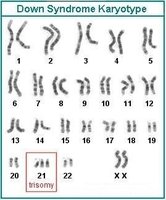
Errors during meiosis can result in chromosomal abnormalities. For example:
Down syndrome: Caused by an extra chromosome 21 (trisomy 21).
Klinefelter syndrome: Caused by an extra X chromosome in males (XXY).
Mutations
A mutation is a change in the DNA sequence. Mutations can occur spontaneously or be induced by environmental factors. Types of mutations include:
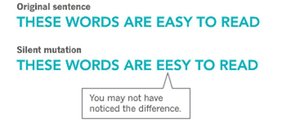
Silent mutation: No effect on protein function.
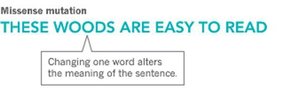
Missense mutation: Alters one amino acid in a protein.
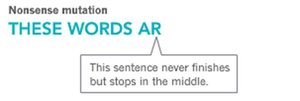
Nonsense mutation: Introduces a premature stop codon, resulting in a truncated, nonfunctional protein.
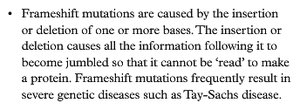
Frameshift mutation: Insertion or deletion of bases alters the reading frame, often resulting in severe effects.

Carcinogens and Mutation Agents
Agents that cause mutations are called mutagens. If a mutagen leads to cancer, it is called a carcinogen. Mutagens can be classified as:
Radiation | Chemical | Biological |
|---|---|---|
X-rays, radioisotopes, UV light | Cigarette smoke, asbestos, benzene, formaldehyde | Hepatitis B virus, human papilloma virus |
Summary: Understanding genetics and inheritance is fundamental to human biology. It explains how traits are passed, how genetic disorders arise, and how mutations can impact health and evolution.
