 뒤로
뒤로Intermediate Algebra: Functions, Graphs, and Lines Study Guide
스터디 가이드 - 스마트 노트
 자료에 맞춘 맞춤형 노트, 핵심 정의, 예시, 맥락을 확장해 제공합니다.
Q1. Find the domain and range of each relation, then state if the relation is a function or not.
Background
Topic: Relations, Functions, Domain, and Range
This question tests your understanding of how to determine the domain (all possible x-values) and range (all possible y-values) of a relation, and how to decide if a relation is a function (each x-value has only one y-value).
Key Terms and Formulas:
Relation: A set of ordered pairs (x, y).
Domain: The set of all x-values in the relation.
Range: The set of all y-values in the relation.
Function: A relation where each x-value is paired with exactly one y-value.
Step-by-Step Guidance
List all the x-values from the given relation to determine the domain.
List all the y-values from the given relation to determine the range.
Check if any x-value is paired with more than one y-value. If so, the relation is not a function.
For graphical or tabular representations, look for repeated x-values with different y-values.
For equations, consider the possible values x can take (domain) and the resulting y-values (range).
Try solving on your own before revealing the answer!
Final Answer:
Area of square: y = x^2 Domain: All real numbers (x ∈ ℝ). Range: y ≥ 0. This is a function because each x-value has only one y-value.
Equation of a line: y = x + 2 Domain: All real numbers (x ∈ ℝ). Range: All real numbers (y ∈ ℝ). This is a function because each x-value has only one y-value.
Ordered pairs: {(-2, 3), (0, 3), (2, 4)} Domain: {-2, 0, 2} Range: {3, 4} This is a function because each x-value is paired with only one y-value.
Table: (same as above) Domain: {-2, 0, 2} Range: {3, 4} This is a function.
Graph: (refer to the provided graph) Check if any vertical line crosses more than one point. If not, it's a function.
Each relation is a function if every x-value is paired with only one y-value. The domain and range are found by listing all x-values and y-values, respectively.
Q2. Given a relation \( y = \frac{1}{3}x + 1 \), let \( y = f(x) \). Write \( f(x) = \) ______. Evaluate \( f(0) \), \( f(-1) \), \( f(2a) \), and \( f(m-1) \).
Background
Topic: Function Notation and Evaluation
This question is about expressing a relation in function notation and evaluating the function for specific values of x.
Key Terms and Formulas:
Function Notation: \( f(x) \) represents the output when x is the input.
Evaluating a Function: Substitute the given value for x in the function and simplify.
Step-by-Step Guidance
Rewrite the given equation in function notation: \( f(x) = \frac{1}{3}x + 1 \).
To evaluate \( f(0) \), substitute 0 for x in the function and simplify.
To evaluate \( f(-1) \), substitute -1 for x in the function and simplify.
To evaluate \( f(2a) \), substitute 2a for x in the function and simplify.
To evaluate \( f(m-1) \), substitute (m-1) for x in the function and simplify.
Try solving on your own before revealing the answer!
Final Answer:
\( f(x) = \frac{1}{3}x + 1 \)
\( f(0) = 1 \) (so the point (0, 1) is on the graph)
\( f(-1) = \frac{1}{3}(-1) + 1 = \frac{-1}{3} + 1 = \frac{2}{3} \) (so the point (-1, 2/3) is on the graph)
\( f(2a) = \frac{1}{3}(2a) + 1 = \frac{2a}{3} + 1 \)
\( f(m-1) = \frac{1}{3}(m-1) + 1 = \frac{m-1}{3} + 1 \)
Each evaluation is done by substituting the input value for x and simplifying.
Q3. Use the vertical line test to identify functions from graphs.
Background
Topic: Vertical Line Test
This question is about determining if a graph represents a function by using the vertical line test.
Key Terms and Formulas:
Vertical Line Test: If any vertical line crosses the graph more than once, the graph does not represent a function.
Step-by-Step Guidance
Look at the graph and imagine drawing vertical lines (parallel to the y-axis) at various x-values.
Check if any vertical line crosses the graph at more than one point.
If every vertical line crosses the graph at most once, the graph is a function.
If any vertical line crosses the graph more than once, the graph is not a function.
Try solving on your own before revealing the answer!
Final Answer:
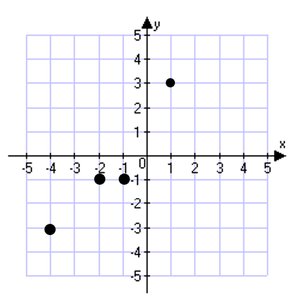
For the first graph (image_2), each vertical line crosses at most one point, so it is a function.
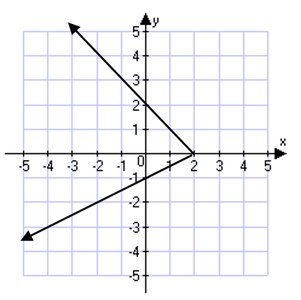
For the second graph (image_3), each vertical line crosses at most one point, so it is a function.
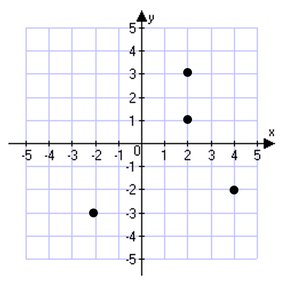
For the third graph (image_4), some vertical lines cross more than one point, so it is not a function.
The vertical line test helps you quickly determine if a graph represents a function.
