 뒤로
뒤로Section 4.1: Inequalities and Applications – Study Notes
스터디 가이드 - 스마트 노트
 자료에 맞춘 맞춤형 노트, 핵심 정의, 예시, 맥락을 확장해 제공합니다.
Section 4.1: Inequalities and Applications
Introduction to Inequalities
Inequalities are mathematical statements that compare two expressions using the symbols > (greater than), < (less than), ≥ (greater than or equal to), and ≤ (less than or equal to). Understanding how to solve, graph, and express the solution sets of inequalities is essential in algebra and its applications.
Solving Linear Inequalities
Solving Inequalities: The process is similar to solving equations, but with special attention when multiplying or dividing by negative numbers.
Key Properties:
Adding or subtracting the same number on both sides does not change the solution set.
Multiplying or dividing both sides by a positive number does not change the solution set.
Multiplying or dividing both sides by a negative number reverses the direction of the inequality.
Example: Solve for .
First, expand and simplify both sides.
Isolate to find the solution.
Graphing Solutions and Notation
Solutions to inequalities can be represented on a number line. The type of endpoint (open or closed) depends on whether the endpoint is included in the solution set.
Parentheses ( ) indicate endpoints that are not included.
Brackets [ ] indicate endpoints that are included.
Set-Builder and Interval Notation
Set-Builder Notation: Describes the set of all numbers that satisfy a given condition, e.g., .
Interval Notation: Uses intervals to describe all solutions, e.g., .
Examples of Notation
: Set-builder: ; Interval:
: Set-builder: ; Interval:
: Set-builder: ; Interval:
: Set-builder: ; Interval:
: Set-builder: ; Interval:
Solving and Expressing Inequalities
Example: Solve
Subtract 5 from both sides:
Interval notation:
Set-builder notation:
Example: Solve
Multiply both sides by 2:
Interval notation:
Set-builder notation:
Example: Solve
Divide both sides by -3 (reverse inequality):
Interval notation:
Set-builder notation:
Function Notation and Inequalities
Example: Let and . Find all for which .
Set up the inequality:
Solve for as with any linear inequality.
Express the solution in both interval and set-builder notation.
Translating Words to Inequalities
is at least → (greater than or equal to)
is at most → (less than or equal to)
is no more than →
is no less than →
greater than →
less than →
Examples:
I must score no less than 75 on the final:
I have no more than $25 in my account:
Applications and Problem Solving with Inequalities
Example: An online store offers a shipping deal: $100 per purchase. For what number of purchases is the deal better?
Set up the inequality:
Solve for to find the minimum number of purchases needed.
Example: Lazer Line charges $65 plus $45 per hour for copier repair. Jonas was billed less than $150. How many hours was Jonas' copier worked on?
Set up the inequality:
Solve for .
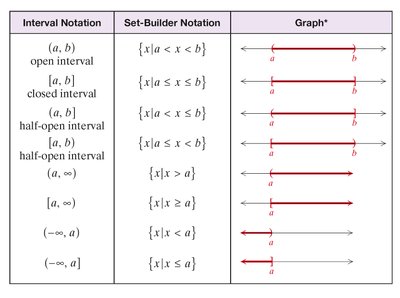
Summary Table: Interval and Set-Builder Notation
The following table summarizes the correspondence between interval notation, set-builder notation, and their graphical representation on the number line:
Key Points to Remember
Always reverse the inequality when multiplying or dividing both sides by a negative number.
Use parentheses for open intervals and brackets for closed intervals in interval notation.
Translate word problems into inequalities carefully, matching key phrases to the correct inequality symbol.
Practice Problems
Solve and graph:
Solve and graph:
Solve and graph:
Application: Jenn can rent a moving truck for either $99 plus per mile. For what mileages would the unlimited plan save money?
Application: Bea can be paid (Plan A) or (Plan B) for hours. For what values of $n$ is Plan B better?
