뒤로
뒤로Solving Perimeter Problems with Linear Equations
스터디 가이드 - 스마트 노트
 자료에 맞춘 맞춤형 노트, 핵심 정의, 예시, 맥락을 확장해 제공합니다.
Equations, Inequalities, and Problem Solving
Solving Perimeter Problems Using Linear Equations
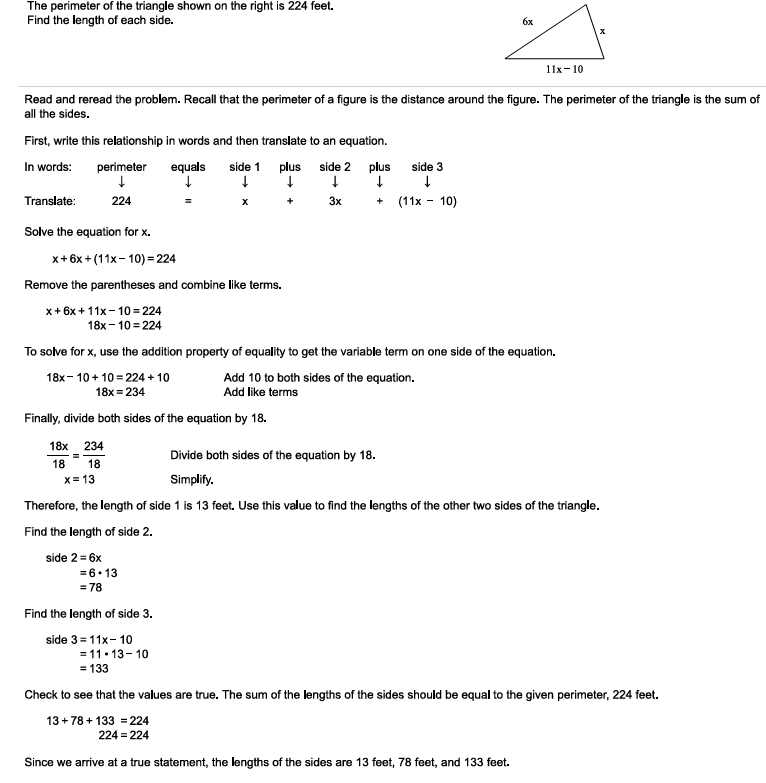
Perimeter problems often require translating a geometric scenario into an algebraic equation. In this example, the perimeter of a triangle is given, and the lengths of its sides are expressed in terms of a variable. The task is to find the value of the variable and then determine the length of each side.
Perimeter Definition: The perimeter of a figure is the total distance around it, found by summing the lengths of all sides.
Translating Words to Equations: Express the relationship in words, then translate to an equation. For a triangle:
In words: perimeter = side 1 + side 2 + side 3
In equation:
Combining Like Terms: Remove parentheses and combine terms:
Solving for the Variable: Use algebraic properties to isolate :
Add 10 to both sides:
Divide both sides by 18:
Finding Side Lengths: Substitute back into the expressions for each side:
Side 1:
Side 2:
Side 3:
Verification: Check that the sum matches the given perimeter:
Example: If a triangle has sides , , and and a perimeter of 224 feet, solve for and find the length of each side.
Step-by-step Solution:
Write the equation:
Combine like terms:
Add 10:
Divide by 18:
Side 1: $13$ feet
Side 2: $78$ feet
Side 3: $133$ feet
Application: This method can be used for any polygon where side lengths are given in terms of a variable and the perimeter is known.