 뒤로
뒤로Venn Diagrams and Set Operations: Foundations for Intermediate Algebra
스터디 가이드 - 스마트 노트
 자료에 맞춘 맞춤형 노트, 핵심 정의, 예시, 맥락을 확장해 제공합니다.
Venn Diagrams and Set Operations
Introduction to Venn Diagrams
Venn diagrams are visual tools used to illustrate the relationships between sets. They are named after John Venn, who introduced them to represent logical relationships in mathematics. Venn diagrams help in understanding set operations such as union, intersection, and complement.
Universal Set (U): The rectangle in a Venn diagram represents the universal set, which contains all possible elements under consideration.
Subsets: Circles within the rectangle represent subsets of the universal set.
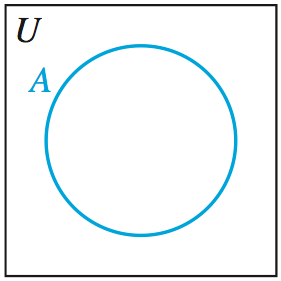
Basic Set Relationships
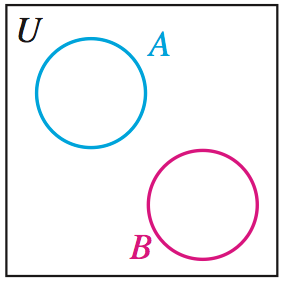
Disjoint Sets: Two sets are disjoint if they have no elements in common. Their intersection is the empty set.
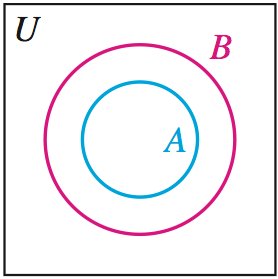
Proper Subset: Set A is a proper subset of set B (A ⊂ B) if every element of A is also in B, but B contains at least one element not in A.
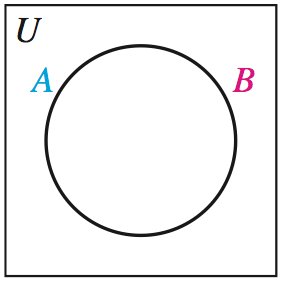
Equal Sets: Sets A and B are equal (A = B) if they contain exactly the same elements.
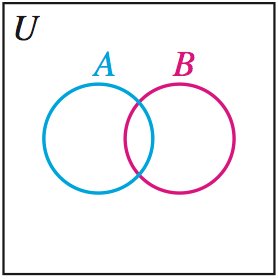
Overlapping Sets: Sets A and B overlap if they have some elements in common. This is the most general form of a Venn diagram.
Regions in Venn Diagrams
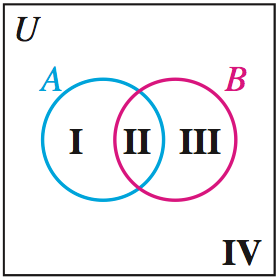
When two sets are represented in a Venn diagram, the diagram is divided into four regions:
Region I: Elements in A only
Region II: Elements in both A and B
Region III: Elements in B only
Region IV: Elements in U but not in A or B
Set Operations
Complement of a Set
The complement of set A, denoted A', is the set of all elements in the universal set U that are not in A.
Notation: A' = {x | x ∈ U and x ∉ A}
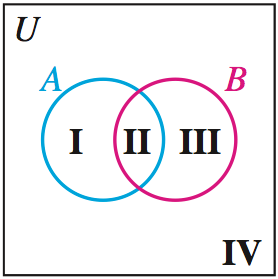
Example: If U = {a, b, c, d, e, f, g} and A = {a, c, e}, then A' = {b, d, f, g}.

Intersection of Sets
The intersection of sets A and B, denoted A ∩ B, is the set of all elements that are in both A and B.
Notation: A ∩ B = {x | x ∈ A and x ∈ B}

Example: If A = {1, 2, 3, 8} and B = {1, 3, 6, 7, 8}, then A ∩ B = {1, 3, 8}.
Union of Sets
The union of sets A and B, denoted A ∪ B, is the set containing all elements that are in A, in B, or in both.
Notation: A ∪ B = {x | x ∈ A or x ∈ B}
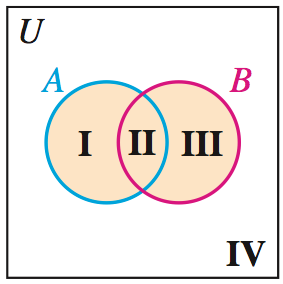
Example: If A = {1, 2, 4, 6} and B = {1, 3, 6, 7, 9}, then A ∪ B = {1, 2, 3, 4, 6, 7, 9}.
Difference of Sets
The difference of two sets A and B, denoted A – B, is the set of elements that are in A but not in B.
Notation: A – B = {x | x ∈ A and x ∉ B}

Example: If A = {b, d, e, f, g, h} and B = {a, b, d, h, i}, then A – B = {e, f, g}.
Cartesian Product of Sets
The Cartesian product of sets A and B, denoted A × B, is the set of all possible ordered pairs (a, b) where a ∈ A and b ∈ B.
Notation: A × B = { (a, b) | a ∈ A, b ∈ B }
Example: If A = {orange, banana, apple} and B = {1, 2}, then A × B = {(orange, 1), (orange, 2), (banana, 1), (banana, 2), (apple, 1), (apple, 2)}.
Key Formulas and Applications
Number of Elements in the Union of Two Sets
For any finite sets A and B, the number of elements in their union is given by:
Example: In a survey, 25 people speak Spanish, 14 speak French, and 4 speak both. The number who speak Spanish or French is:
Summary Table: Set Operations
Operation | Symbol | Definition | Example |
|---|---|---|---|
Union | A ∪ B | All elements in A or B or both | {1, 2} ∪ {2, 3} = {1, 2, 3} |
Intersection | A ∩ B | Elements in both A and B | {1, 2} ∩ {2, 3} = {2} |
Difference | A – B | Elements in A but not in B | {1, 2} – {2, 3} = {1} |
Complement | A' | Elements in U not in A | If U = {1, 2, 3}, A = {1}, A' = {2, 3} |
Cartesian Product | A × B | All ordered pairs (a, b) | {1, 2} × {a, b} = {(1, a), (1, b), (2, a), (2, b)} |
Logical Interpretation of Set Operations
"And" (Intersection): A ∩ B = {x | x ∈ A and x ∈ B}
"Or" (Union): A ∪ B = {x | x ∈ A or x ∈ B}
Conclusion
Understanding Venn diagrams and set operations is foundational for topics in algebra, probability, and logic. Mastery of these concepts enables students to analyze and solve problems involving groups, categories, and relationships between different sets.
