 뒤로
뒤로Introduction to Evolution, Natural Selection, and Population Genetics
스터디 가이드 - 스마트 노트
 자료에 맞춘 맞춤형 노트, 핵심 정의, 예시, 맥락을 확장해 제공합니다.
Biology: The Study of Life
Introduction to Biology and Evolution
Biology is the scientific study of life, encompassing the structure, function, growth, origin, evolution, and distribution of living organisms. Evolution is a central theme in biology, explaining the diversity and unity of life on Earth. The theory of evolution by natural selection provides a framework for understanding how organisms adapt and change over time.
Evolution: The process by which populations of organisms change over generations through variations in heritable traits.
Natural Selection: The mechanism by which individuals with advantageous traits reproduce more successfully, leading to changes in the traits of populations over time.
Phylogenetic Tree: A diagram that represents evolutionary relationships among organisms, showing common ancestry and divergence of species.
Evolution by Natural Selection
Theory of Natural Selection
Natural selection is the process by which certain heritable traits become more common in a population because they confer a reproductive advantage. For natural selection to occur, two main conditions must be met:
Heritable Variation: Individuals in a population must vary in traits that can be passed on to offspring.
Fitness Differences: In a given environment, some traits must lead to increased reproductive success (fitness).
Natural selection acts on individuals, but evolutionary change occurs in populations. Over time, advantageous traits become more common, leading to adaptation.
Key Definitions
Fitness: The ability of an individual to produce surviving offspring relative to others in the population.
Adaptation: A heritable trait that increases an individual's fitness in a particular environment.
Population: A group of individuals of the same species living in the same area at the same time.
Example: Giraffe Neck Length
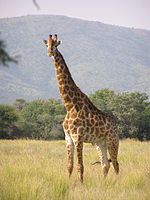
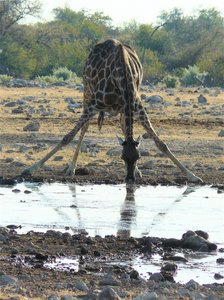
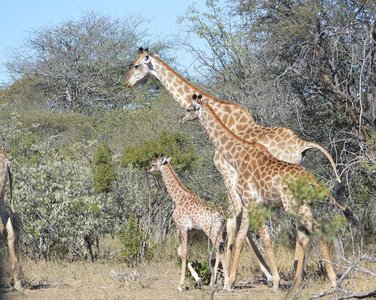
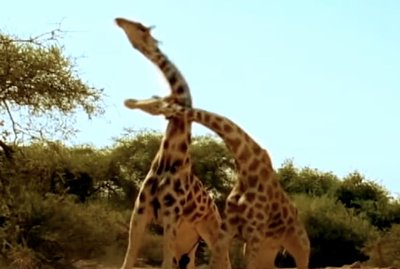
The evolution of long necks in giraffes is a classic example used to illustrate natural selection. Two main hypotheses have been proposed:
Feeding Competition Hypothesis: Long necks evolved to allow giraffes to reach higher leaves in trees.
Sexual Selection Hypothesis: Long necks evolved because males with longer necks win more fights and thus have greater reproductive success.
Phylogenetic Trees and Common Ancestry
Reading Phylogenetic Trees
Phylogenetic trees are used to depict evolutionary relationships among species. Branches that share a recent common ancestor represent closely related species, while branches that diverged earlier represent more distantly related species. These trees are often constructed using genetic data.
Homology: Similarity among organisms due to shared ancestry.
Vestigial Traits: Reduced or incompletely developed traits with no or reduced function, but similar to ancestral traits.
Evidence for Evolution
Fossil Record and Transitional Features
The fossil record provides evidence for evolution by documenting extinct species, transitional features (traits intermediate between older and younger species), and vestigial traits. Homologies in anatomy and genetics further support the concept of common ancestry.
Transitional Features: Traits that are intermediate between ancestral and derived forms.
Vestigial Traits: Traits that have lost their original function through evolution.
Misconceptions about Evolution
Common Misconceptions
Evolutionary change occurs in organisms (Correction: Evolution occurs in populations, not individuals).
Adaptations occur because organisms want or need them (Correction: Adaptations arise through random variation and selection, not by need).
Organisms are optimal because of natural selection (Correction: Evolution involves trade-offs and constraints; organisms are not perfectly adapted).
Population Genetics and the Hardy-Weinberg Principle
Hardy-Weinberg Equilibrium
The Hardy-Weinberg principle provides a mathematical model to study genetic variation in populations. It predicts genotype frequencies under certain conditions and is used to test whether evolution or nonrandom mating is occurring at a particular gene.
Assumptions of Hardy-Weinberg Equilibrium:
Large population size (no genetic drift)
Random mating
No gene flow (no migration)
No natural selection
No mutations
The Hardy-Weinberg equation is:
where p and q are the frequencies of two alleles in the population.
Application: Calculating Genotype Frequencies
Given allele frequencies, you can calculate expected genotype frequencies if the population is in Hardy-Weinberg equilibrium.
Deviations from expected frequencies indicate that evolution or nonrandom mating is occurring.
Nonrandom Mating and Inbreeding
Artificial Selection and Inbreeding
Artificial selection is a form of nonrandom mating where humans select for desirable traits. This can lead to inbreeding, which increases the frequency of homozygotes and can result in negative health effects due to the expression of deleterious alleles.
Inbreeding: Mating between closely related individuals, increasing homozygosity but not changing allele frequencies.
Outbreeding: Mating between unrelated individuals, which can alleviate the effects of inbreeding.
Modes of Natural Selection
Types of Selection
Directional Selection: Favors one extreme phenotype.
Stabilizing Selection: Favors intermediate phenotypes.
Disruptive Selection: Favors both extreme phenotypes.
Balancing Selection: Maintains genetic diversity in a population.
These modes of selection shape the genetic structure of populations and drive evolutionary change.
