Calculate the electronegativity difference and classify each of the following bonds as nonpolar covalent, polar covalent, or ionic: (6.7)
c. Na and Cl
검증된 단계별 안내
1
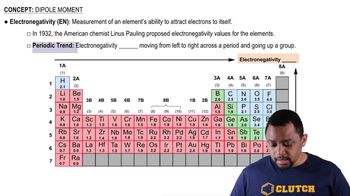
Identify the electronegativity values for sodium (Na) and chlorine (Cl) from the periodic table. Sodium typically has an electronegativity of about 0.93, and chlorine has an electronegativity of about 3.16.
Calculate the electronegativity difference by subtracting the electronegativity of sodium from that of chlorine: \( \Delta EN = EN_{Cl} - EN_{Na} \).
Determine the type of bond based on the electronegativity difference: if \( \Delta EN \) is less than 0.5, the bond is nonpolar covalent; if \( \Delta EN \) is between 0.5 and 1.7, the bond is polar covalent; if \( \Delta EN \) is greater than 1.7, the bond is ionic.
Compare the calculated electronegativity difference to these thresholds to classify the bond between Na and Cl.
Conclude the classification of the bond based on the comparison.
비슷한 문제에 대한 검증된 영상 답변:
이 영상 해법은 위 문제에 도움이 된다고 튜터들이 추천한 것입니다.
영상 길이:
3m
영상 재생:
0 댓글
주요 개념
질문에 올바르게 답하기 위해 반드시 이해해야 하는 핵심 개념들은 다음과 같습니다.
Electronegativity
Electronegativity is a measure of an atom's ability to attract and hold onto electrons in a chemical bond. It is a key factor in determining the nature of the bond formed between two atoms. The higher the electronegativity value, the stronger the atom's pull on electrons. This concept is essential for classifying bonds as nonpolar covalent, polar covalent, or ionic based on the difference in electronegativity between the bonded atoms.
Bonds can be classified into three main types based on the difference in electronegativity between the two atoms involved. Nonpolar covalent bonds occur when the electronegativity difference is negligible (typically less than 0.4), polar covalent bonds form with a moderate difference (0.4 to 1.7), and ionic bonds arise when the difference is significant (greater than 1.7). Understanding these classifications helps predict the properties and behaviors of compounds.
In the case of sodium (Na) and chlorine (Cl), sodium has a low electronegativity (0.93) while chlorine has a high electronegativity (3.16). The electronegativity difference between these two elements is 2.23, which classifies the bond as ionic. This occurs because sodium donates an electron to chlorine, resulting in the formation of Na+ and Cl- ions, which are held together by strong electrostatic forces.

 3:분
3:분 검증된 단계별 안내
 01:51
01:51