Based on electronegativity differences, would you expect bonds between the following pairs of atoms to be largely ionic or largely covalent? b. Ca and Cl
검증된 단계별 안내
1
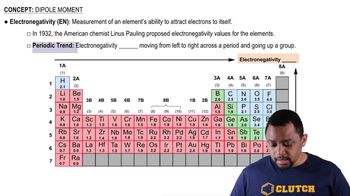
insert step 1> Determine the electronegativity values of calcium (Ca) and chlorine (Cl) from the periodic table.
insert step 2> Calculate the difference in electronegativity between Ca and Cl.
insert step 3> Use the electronegativity difference to predict the bond type: if the difference is greater than 1.7, the bond is likely ionic; if it is less, the bond is likely covalent.
insert step 4> Consider the position of Ca and Cl in the periodic table: Ca is a metal and Cl is a non-metal, which typically forms ionic bonds.
insert step 5> Conclude whether the bond between Ca and Cl is largely ionic or covalent based on the electronegativity difference and their positions in the periodic table.
비슷한 문제에 대한 검증된 영상 답변:
이 영상 해법은 위 문제에 도움이 된다고 튜터들이 추천한 것입니다.
영상 길이:
2m
영상 재생:
0 댓글
주요 개념
질문에 올바르게 답하기 위해 반드시 이해해야 하는 핵심 개념들은 다음과 같습니다.
Electronegativity
Electronegativity is a measure of an atom's ability to attract and hold onto electrons in a chemical bond. It is a key factor in determining the nature of the bond formed between two atoms. The greater the difference in electronegativity between two atoms, the more likely the bond will be ionic, as one atom will attract the shared electrons significantly more than the other.
Ionic bonds occur when electrons are transferred from one atom to another, resulting in the formation of charged ions that attract each other. In contrast, covalent bonds involve the sharing of electrons between atoms. The type of bond formed depends on the electronegativity difference: a large difference typically leads to ionic bonding, while a small difference results in covalent bonding.
The electronegativity scale, often represented by the Pauling scale, assigns values to elements based on their ability to attract electrons. For example, fluorine has the highest electronegativity, while metals like calcium have lower values. By comparing the electronegativity values of the atoms involved, one can predict whether the bond will be ionic or covalent based on the magnitude of their difference.

 2:02분
2:02분 검증된 단계별 안내
 01:51
01:51