Supply the missing information in the following table:
검증된 단계별 안내
1
Identify the atomic number from the isotopic symbol, which is the subscript number (79) next to the element symbol (Au).
Recognize that the atomic number (79) is equal to the number of protons in the atom.
Identify the mass number from the isotopic symbol, which is the superscript number (198) next to the element symbol (Au).
Calculate the number of neutrons by subtracting the atomic number (79) from the mass number (198).
Fill in the table with the atomic number (79), mass number (198), number of protons (79), and the calculated number of neutrons.
비슷한 문제에 대한 검증된 영상 답변:
이 영상 해법은 위 문제에 도움이 된다고 튜터들이 추천한 것입니다.
영상 길이:
1m
영상 재생:
0 댓글
주요 개념
질문에 올바르게 답하기 위해 반드시 이해해야 하는 핵심 개념들은 다음과 같습니다.
Isotopic Symbols
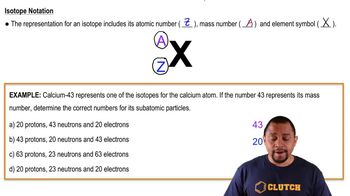
Isotopic symbols represent specific isotopes of elements, denoting the element's chemical symbol along with its mass number and atomic number. The mass number, located at the top left, indicates the total number of protons and neutrons in the nucleus, while the atomic number, found at the bottom left, specifies the number of protons, which defines the element.
The atomic number is a fundamental property of an element, representing the number of protons in its nucleus. This number determines the element's identity and its position in the periodic table. For example, gold (Au) has an atomic number of 79, meaning it has 79 protons and, in a neutral atom, also 79 electrons.
The mass number is the sum of protons and neutrons in an atom's nucleus. To find the number of neutrons, subtract the atomic number from the mass number. For instance, in the isotope 198Au, the mass number is 198, and with an atomic number of 79, the number of neutrons is 198 - 79 = 119.


 1:49분
1:49분 검증된 단계별 안내
 03:57
03:57