Write the atomic symbol for the isotope with each of the following characteristics:
c. 25 electrons and 28 neutrons
검증된 단계별 안내
1
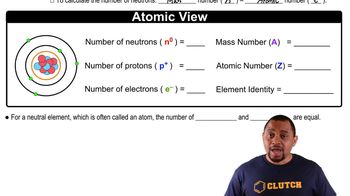
insert step 1: Understand that the atomic symbol of an element is determined by its number of protons, which is equal to the number of electrons in a neutral atom.
insert step 2: Since the isotope has 25 electrons, it must also have 25 protons.
insert step 3: Identify the element with 25 protons using the periodic table. This element is manganese (Mn).
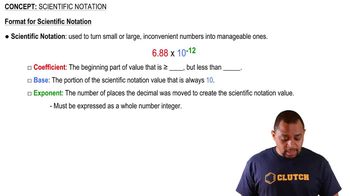
insert step 4: The atomic number (Z) of manganese is 25, and the mass number (A) is the sum of protons and neutrons.
insert step 5: Calculate the mass number: A = 25 (protons) + 28 (neutrons) = 53. The atomic symbol is written as: ^{53}_{25}Mn.
비슷한 문제에 대한 검증된 영상 답변:
이 영상 해법은 위 문제에 도움이 된다고 튜터들이 추천한 것입니다.
영상 길이:
1m
영상 재생:
0 댓글
주요 개념
질문에 올바르게 답하기 위해 반드시 이해해야 하는 핵심 개념들은 다음과 같습니다.
Atomic Structure
Atoms consist of protons, neutrons, and electrons. The atomic number, which is the number of protons, determines the element's identity. In a neutral atom, the number of electrons equals the number of protons, balancing the charge. Understanding atomic structure is essential for identifying isotopes and their symbols.
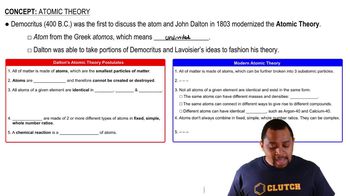
Isotopes are variants of a chemical element that have the same number of protons but different numbers of neutrons. This difference in neutrons affects the atomic mass but not the chemical properties. For example, carbon-12 and carbon-14 are isotopes of carbon, with 6 and 8 neutrons, respectively. Recognizing isotopes is crucial for writing their atomic symbols.
The atomic symbol notation represents an element and its isotopes using the format A/Z Element, where A is the mass number (protons + neutrons) and Z is the atomic number (number of protons). For the given question, the atomic symbol can be derived by calculating the mass number from the provided electrons and neutrons, allowing for accurate representation of the isotope.

 1:15분
1:15분 검증된 단계별 안내
 05:22
05:22