Use the following table for problems 9.25 to 9.28:
A solution containing 80. g of NaNO₃ in 75 g of H₂O at 50 °C is cooled to 20 °C.
b. How many grams of solid NaNO₃ crystallized after cooling?
검증된 단계별 안내
1
Identify the solubility of NaNO₃ at both 50 °C and 20 °C using the provided table.
Determine how much NaNO₃ can remain dissolved in 75 g of H₂O at 20 °C.
Calculate the difference between the initial amount of NaNO₃ (80 g) and the amount that can remain dissolved at 20 °C.
The difference calculated in the previous step represents the amount of NaNO₃ that crystallized out of the solution.
Express the final answer in grams of NaNO₃ that crystallized.
비슷한 문제에 대한 검증된 영상 답변:
이 영상 해법은 위 문제에 도움이 된다고 튜터들이 추천한 것입니다.
영상 길이:
6m
영상 재생:
0 댓글
주요 개념
질문에 올바르게 답하기 위해 반드시 이해해야 하는 핵심 개념들은 다음과 같습니다.
Solubility and Temperature
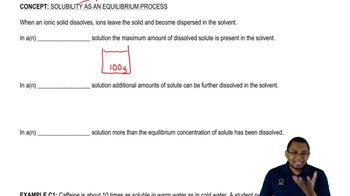
Solubility refers to the maximum amount of solute that can dissolve in a solvent at a given temperature. For many substances, solubility decreases as temperature decreases, meaning that a solution can hold less solute when cooled. Understanding this relationship is crucial for predicting how much solute will crystallize out of a solution when it is cooled.
The saturation point is the concentration of solute in a solution at which no more solute can dissolve at a specific temperature. When a solution is cooled, it may exceed this saturation point, leading to the formation of solid crystals. Knowing the saturation point of NaNO₃ at both 50 °C and 20 °C is essential for determining how much NaNO₃ will crystallize upon cooling.
Crystallization is the process where solute particles come together to form a solid phase from a solution. This occurs when the solution becomes supersaturated, often due to a decrease in temperature. Understanding the conditions that lead to crystallization helps in calculating the amount of solute that will precipitate out of the solution as it cools.


 04:38
04:38
 6:39분
6:39분