In a laboratory experiment, a 10.0-mL sample of NaCl solution is poured into an evaporating dish with a mass of 24.10 g. The combined mass of the evaporating dish and NaCl solution is 36.15 g. After heating, the evaporating dish and dry NaCl have a combined mass of 25.50 g. (9.4)
a. What is the mass percent (m/m) of the NaCl solution?
검증된 단계별 안내
1
Calculate the mass of the NaCl solution by subtracting the mass of the empty evaporating dish from the combined mass of the dish and solution: \( m_{\text{solution}} = 36.15\, \text{g} - 24.10\, \text{g} \).
Determine the mass of the dry NaCl by subtracting the mass of the empty evaporating dish from the combined mass of the dish and dry NaCl: \( m_{\text{NaCl}} = 25.50\, \text{g} - 24.10\, \text{g} \).
Calculate the mass of the water in the solution by subtracting the mass of the dry NaCl from the mass of the NaCl solution: \( m_{\text{water}} = m_{\text{solution}} - m_{\text{NaCl}} \).
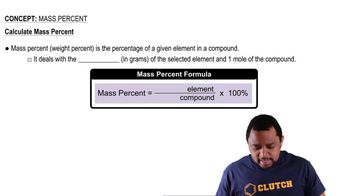
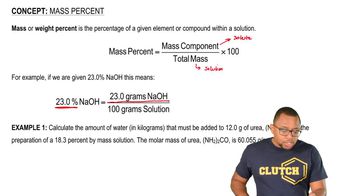
Use the formula for mass percent (m/m) to find the mass percent of NaCl in the solution: \( \text{Mass percent} = \left( \frac{m_{\text{NaCl}}}{m_{\text{solution}}} \right) \times 100\% \).
Substitute the values obtained in the previous steps into the mass percent formula to find the mass percent of NaCl in the solution.
비슷한 문제에 대한 검증된 영상 답변:
이 영상 해법은 위 문제에 도움이 된다고 튜터들이 추천한 것입니다.
영상 길이:
3m
영상 재생:
0 댓글
주요 개념
질문에 올바르게 답하기 위해 반드시 이해해야 하는 핵심 개념들은 다음과 같습니다.
Mass Percent (m/m)
Mass percent (m/m) is a way to express the concentration of a solution, calculated as the mass of the solute divided by the total mass of the solution, multiplied by 100. In this context, it helps determine how much of the NaCl solution is made up of NaCl itself, which is essential for understanding the solution's composition.
To find the mass percent, one must first identify the mass of the solute (NaCl) and the mass of the solution (NaCl solution). The mass of the solution can be derived from the combined mass of the evaporating dish and the NaCl solution, while the mass of the solute can be calculated by subtracting the mass of the empty dish from the mass after evaporation.
Evaporation is the process of removing the solvent (water) from a solution, leaving behind the solute (NaCl in this case). Understanding this process is crucial, as it allows for the determination of the mass of the solute after the solvent has been evaporated, which is necessary for calculating the mass percent of the NaCl solution.