Indicate which diagram (1, 2, or 3) represents the volume of the gas sample in a flexible container when each of the following changes (a to d) takes place: (8.2, 8.3)
d. Doubling the atmospheric pressure and doubling the Kelvintemperature.
검증된 단계별 안내
1
Identify the initial conditions of the gas sample: initial pressure (P1), initial temperature (T1), and initial volume (V1).
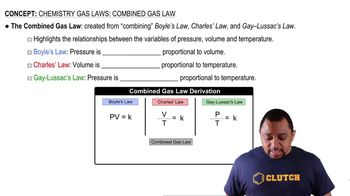
Apply the combined gas law: \( \frac{P1 \times V1}{T1} = \frac{P2 \times V2}{T2} \), where P2 is the doubled pressure and T2 is the doubled temperature.
Substitute the known values into the equation: \( \frac{P1 \times V1}{T1} = \frac{2P1 \times V2}{2T1} \).
Conclude that V2 = V1, meaning the volume remains unchanged, so the diagram representing the unchanged volume is the correct one.
비슷한 문제에 대한 검증된 영상 답변:
이 영상 해법은 위 문제에 도움이 된다고 튜터들이 추천한 것입니다.
영상 길이:
1m
영상 재생:
0 댓글
주요 개념
질문에 올바르게 답하기 위해 반드시 이해해야 하는 핵심 개념들은 다음과 같습니다.
Gas Laws
Gas laws describe the behavior of gases in relation to pressure, volume, and temperature. Key laws include Boyle's Law, which states that pressure and volume are inversely related at constant temperature, and Charles's Law, which states that volume is directly proportional to temperature at constant pressure. Understanding these relationships is crucial for predicting how a gas will respond to changes in its environment.
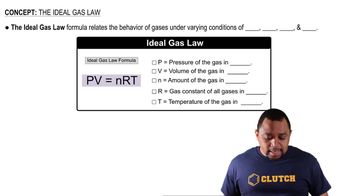
The ideal gas law combines several gas laws into a single equation (PV=nRT) that relates pressure (P), volume (V), number of moles (n), the ideal gas constant (R), and temperature (T). While real gases deviate from this behavior under high pressure or low temperature, the ideal gas law provides a useful approximation for many conditions, allowing for predictions about gas behavior when variables change.
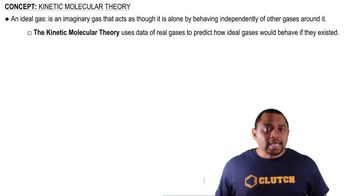
Kinetic Molecular Theory explains the behavior of gases at a molecular level, positing that gas particles are in constant, random motion and that their collisions with container walls create pressure. This theory helps to understand how changes in temperature (which affects particle speed) and pressure (which affects particle collisions) influence the volume of a gas in a flexible container, such as a balloon.

 1:54분
1:54분
 검증된 단계별 안내
 01:43
01:43