What happens when a weak base such as NH₃ is dissolved in water?
검증된 단계별 안내
1
Identify the weak base in the problem, which is ammonia (NH₃).
Understand that when a weak base like NH₃ is dissolved in water, it partially ionizes. This means it does not completely dissociate into ions.
Write the chemical equation for the reaction of NH₃ with water: \[ \text{NH}_3 + \text{H}_2\text{O} \rightleftharpoons \text{NH}_4^+ + \text{OH}^- \]
Recognize that the equilibrium established in this reaction involves the formation of ammonium ions (NH₄⁺) and hydroxide ions (OH⁻), which makes the solution slightly basic.
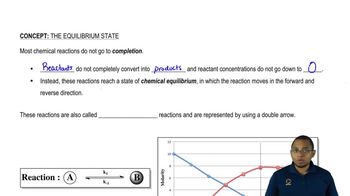
Consider the concept of equilibrium and the fact that the position of equilibrium for a weak base like NH₃ lies far to the left, indicating that only a small fraction of NH₃ molecules are ionized at any given time.
비슷한 문제에 대한 검증된 영상 답변:
이 영상 해법은 위 문제에 도움이 된다고 튜터들이 추천한 것입니다.
영상 길이:
2m
영상 재생:
0 댓글
주요 개념
질문에 올바르게 답하기 위해 반드시 이해해야 하는 핵심 개념들은 다음과 같습니다.
Weak Bases
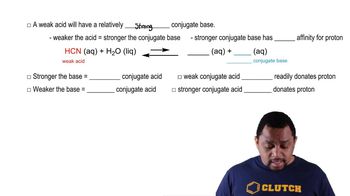
Weak bases are substances that partially ionize in solution, meaning they do not completely dissociate into ions. Ammonia (NH₃) is a common example, which reacts with water to form ammonium ions (NH₄⁺) and hydroxide ions (OH⁻). This partial ionization results in a lower pH compared to strong bases, which fully dissociate.
When a weak base like NH₃ is dissolved in water, it establishes an equilibrium between the undissociated base and the ions produced. This dynamic balance is described by the equilibrium constant (K_b), which quantifies the extent of ionization. Understanding this concept is crucial for predicting the behavior of weak bases in solution.
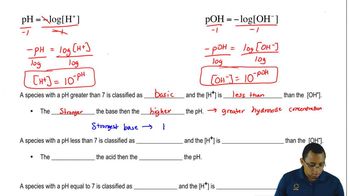
The pH scale measures the acidity or basicity of a solution, with values below 7 indicating acidity and above 7 indicating basicity. When NH₃ dissolves in water, it increases the concentration of hydroxide ions, leading to a higher pH. This basic nature is a key characteristic of weak bases and is essential for understanding their effects in aqueous solutions.

 2:47분
2:47분 검증된 단계별 안내
 01:46
01:46