What happens when a strong acid such as HBr is dissolved in water?
검증된 단계별 안내
1
Identify the strong acid: In this case, the strong acid is hydrobromic acid (HBr).
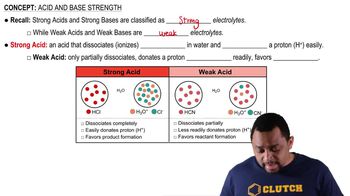
Understand the dissociation process: Strong acids completely dissociate in water. This means that HBr will break apart into its ions.
Write the dissociation equation: HBr (aq) → H⁺ (aq) + Br⁻ (aq). This shows that HBr dissociates into hydrogen ions (H⁺) and bromide ions (Br⁻) in water.
Recognize the effect on pH: The release of H⁺ ions increases the concentration of hydrogen ions in the solution, making the solution acidic.
Consider the implications: The complete dissociation of HBr in water results in a high concentration of H⁺ ions, which is characteristic of strong acids, leading to a low pH value.
비슷한 문제에 대한 검증된 영상 답변:
이 영상 해법은 위 문제에 도움이 된다고 튜터들이 추천한 것입니다.
영상 길이:
2m
영상 재생:
0 댓글
주요 개념
질문에 올바르게 답하기 위해 반드시 이해해야 하는 핵심 개념들은 다음과 같습니다.
Strong Acids
Strong acids are substances that completely dissociate into their ions in water. For example, when hydrogen bromide (HBr) is added to water, it separates into H⁺ and Br⁻ ions. This complete ionization is what characterizes strong acids, leading to a significant increase in the concentration of hydrogen ions in the solution.
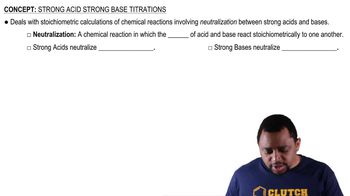
Strong Acid Strong Base Titrations (Simplified) Concept 1
Dissociation in Water
Dissociation refers to the process by which a compound breaks apart into its constituent ions when dissolved in a solvent, such as water. In the case of HBr, the polar nature of water molecules facilitates the separation of HBr into H⁺ and Br⁻ ions, allowing them to interact freely with the solvent and each other, which is crucial for understanding acid-base reactions.
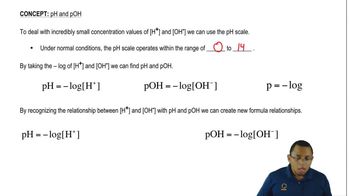
The pH scale measures the acidity or basicity of a solution, with lower values indicating higher acidity. When a strong acid like HBr is dissolved in water, the concentration of H⁺ ions increases, resulting in a lower pH value. This change in pH is essential for understanding the strength of acids and their effects on chemical reactions and biological systems.

 2:21분
2:21분 검증된 단계별 안내
 01:02
01:02