Identify each of the following changes of state as melting, freezing, sublimation, or deposition:
a. Dry ice in an ice-cream cart disappears.
검증된 단계별 안내
1
Identify the initial state of the substance: Dry ice is solid carbon dioxide (CO2).
Determine the final state of the substance: The dry ice disappears, indicating it transitions directly to a gas.
Recognize the process: When a solid changes directly to a gas without passing through the liquid state, it is called sublimation.
Relate the process to the given scenario: The disappearance of dry ice in the ice-cream cart is due to sublimation.
Conclude the change of state: The change of state for dry ice disappearing is sublimation.
비슷한 문제에 대한 검증된 영상 답변:
이 영상 해법은 위 문제에 도움이 된다고 튜터들이 추천한 것입니다.
영상 길이:
1m
영상 재생:
0 댓글
주요 개념
질문에 올바르게 답하기 위해 반드시 이해해야 하는 핵심 개념들은 다음과 같습니다.
Sublimation
Sublimation is the process in which a solid transitions directly into a gas without passing through the liquid state. This occurs when the molecules in the solid gain enough energy to overcome intermolecular forces, allowing them to escape into the air as gas. A common example is dry ice (solid carbon dioxide), which sublimates at room temperature, creating a fog-like effect.
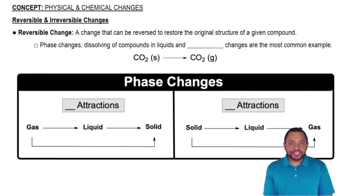
Phase changes refer to the transitions between different states of matter: solid, liquid, and gas. Each phase change involves energy transfer, which can be in the form of heat. Understanding these changes is crucial for identifying processes like melting (solid to liquid), freezing (liquid to solid), sublimation (solid to gas), and deposition (gas to solid).
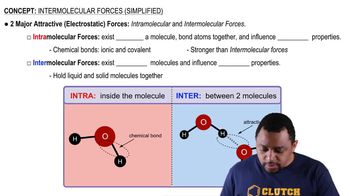
Intermolecular forces are the attractive forces between molecules that influence their physical properties and phase changes. In solids, these forces are strong, keeping molecules closely packed, while in gases, they are weak, allowing molecules to move freely. The strength of these forces determines the energy required for a substance to change states, such as during sublimation.

 1:22분
1:22분 검증된 단계별 안내
 1:48
1:48