For dinner, Charles had one cup of clam chowder, which contains 16g of carbohydrate, 12g of fat, and 9 g of protein. How much energy, in kilocalories and kilojoules, is in the clam chowder? (Round off the answer for each food type to the tensplace.)
검증된 단계별 안내
1
Identify the energy contribution per gram for each macronutrient: carbohydrates provide 4 kcal/g, proteins provide 4 kcal/g, and fats provide 9 kcal/g.
Calculate the energy from carbohydrates by multiplying the grams of carbohydrates by the energy per gram: 16 g of carbohydrates * 4 kcal/g.
Calculate the energy from fats by multiplying the grams of fat by the energy per gram: 12 g of fat * 9 kcal/g.
Calculate the energy from proteins by multiplying the grams of protein by the energy per gram: 9 g of protein * 4 kcal/g.
Add the energy contributions from carbohydrates, fats, and proteins to find the total energy in kilocalories, then convert the total energy from kilocalories to kilojoules using the conversion factor 1 kcal = 4.184 kJ.
비슷한 문제에 대한 검증된 영상 답변:
이 영상 해법은 위 문제에 도움이 된다고 튜터들이 추천한 것입니다.
영상 길이:
7m
영상 재생:
0 댓글
주요 개념
질문에 올바르게 답하기 위해 반드시 이해해야 하는 핵심 개념들은 다음과 같습니다.
Macronutrients and Their Energy Values
Macronutrients—carbohydrates, fats, and proteins—are the primary sources of energy in our diet. Each macronutrient provides a specific amount of energy: carbohydrates yield approximately 4 kilocalories per gram, fats provide about 9 kilocalories per gram, and proteins also contribute around 4 kilocalories per gram. Understanding these values is essential for calculating the total energy content of food.
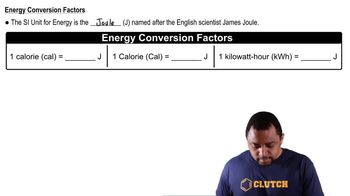
Energy can be measured in different units, primarily kilocalories (kcal) and kilojoules (kJ). To convert kilocalories to kilojoules, one can use the conversion factor where 1 kcal is approximately equal to 4.184 kJ. This knowledge is crucial for expressing energy content in the desired unit, especially in scientific contexts where different units may be preferred.
Rounding is a mathematical process used to reduce the number of digits in a number while maintaining its approximate value. In this context, rounding to the tens place means adjusting the calculated energy values to the nearest ten. This is important for simplifying results and making them easier to interpret, especially in dietary contexts.

 7:08분
7:08분 검증된 단계별 안내
 00:37
00:37