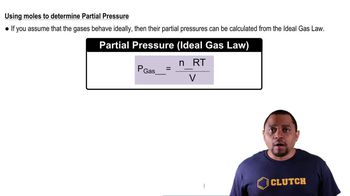
Partial pressure is the pressure exerted by a single gas in a mixture of gases.
According to Dalton's Law of Partial Pressures, the total pressure of a gas mixture is the sum of the partial pressures of each individual gas.
Mathematically, it can be expressed as: \( P_{\text{total}} = P_1 + P_2 + P_3 + \ldots + P_n \), where \( P_1, P_2, \ldots, P_n \) are the partial pressures of the gases in the mixture.
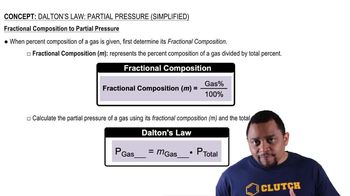
The partial pressure of a gas can be calculated using the formula: \( P_i = X_i \times P_{\text{total}} \), where \( X_i \) is the mole fraction of the gas.
Understanding partial pressure is crucial for studying gas behavior, chemical reactions involving gases, and applications like scuba diving and respiratory physiology.
Verified video answer for a similar problem:
This video solution was recommended by our tutors as helpful for the problem above
영상 길이:
1m
영상 재생:
0 댓글
TextbookSolutions.keyConceptsTitle
TextbookSolutions.keyConceptsSubtitle
Partial Pressure
Partial pressure refers to the pressure exerted by a single component of a gas mixture. According to Dalton's Law of Partial Pressures, the total pressure of a gas mixture is equal to the sum of the partial pressures of each individual gas present. This concept is crucial for understanding how gases behave in mixtures and is commonly applied in various fields, including chemistry, physics, and engineering.
Dalton's Law states that in a mixture of non-reacting gases, the total pressure is the sum of the partial pressures of each gas. This law allows us to calculate the contribution of each gas to the overall pressure, which is essential for predicting gas behavior in different conditions. It is particularly useful in applications such as calculating gas concentrations in chemical reactions and understanding respiratory physiology.
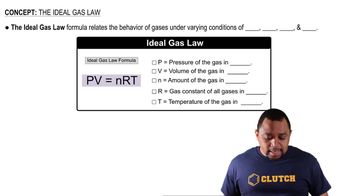
The Ideal Gas Law is a fundamental equation in chemistry that relates the pressure, volume, temperature, and number of moles of an ideal gas. It is expressed as PV = nRT, where P is pressure, V is volume, n is the number of moles, R is the ideal gas constant, and T is temperature in Kelvin. Understanding this law is important for applying the concept of partial pressure, as it helps in calculating the behavior of gases under various conditions.