Determine the percent composition of air in the lungs from the following composition in partial pressures: PN2 = 573 mmHg, PO2 = 100 mmHg, PCO2 = 40 mmHg, and PH2O = 47 mmHg; all at 37 °C and 1 atm pressure.
검증된 단계별 안내
1
Calculate the total pressure by summing up the partial pressures: \( P_{\text{total}} = P_{N_2} + P_{O_2} + P_{CO_2} + P_{H_2O} \).
Determine the percent composition of nitrogen by using the formula: \( \text{Percent } N_2 = \left( \frac{P_{N_2}}{P_{\text{total}}} \right) \times 100 \% \).
Determine the percent composition of oxygen by using the formula: \( \text{Percent } O_2 = \left( \frac{P_{O_2}}{P_{\text{total}}} \right) \times 100 \% \).
Determine the percent composition of carbon dioxide by using the formula: \( \text{Percent } CO_2 = \left( \frac{P_{CO_2}}{P_{\text{total}}} \right) \times 100 \% \).
Determine the percent composition of water vapor by using the formula: \( \text{Percent } H_2O = \left( \frac{P_{H_2O}}{P_{\text{total}}} \right) \times 100 \% \).
비슷한 문제에 대한 검증된 영상 답변:
이 영상 해법은 위 문제에 도움이 된다고 튜터들이 추천한 것입니다.
영상 길이:
4m
영상 재생:
0 댓글
주요 개념
질문에 올바르게 답하기 위해 반드시 이해해야 하는 핵심 개념들은 다음과 같습니다.
Partial Pressure
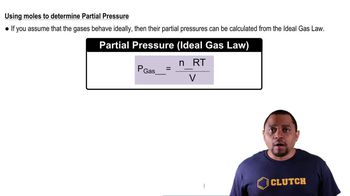
Partial pressure refers to the pressure exerted by a single gas in a mixture of gases. It is a crucial concept in understanding gas behavior, as each gas in a mixture contributes to the total pressure according to its mole fraction. In this context, the partial pressures of nitrogen, oxygen, carbon dioxide, and water vapor in the lungs are used to determine their respective contributions to the overall composition of air.
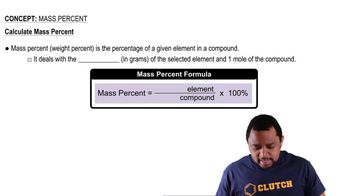
Percent composition is a way to express the concentration of each component in a mixture as a percentage of the total. It is calculated by dividing the partial pressure of each gas by the total pressure of the gas mixture and multiplying by 100. This concept is essential for determining how much of each gas is present in the air within the lungs, which is vital for understanding respiratory physiology.
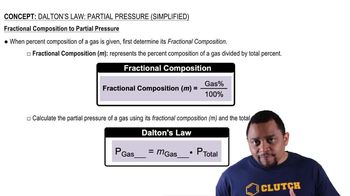
Dalton's Law states that the total pressure of a gas mixture is equal to the sum of the partial pressures of its individual gases. This principle allows us to calculate the total pressure in the lungs by adding the partial pressures of nitrogen, oxygen, carbon dioxide, and water vapor. Understanding this law is fundamental for analyzing gas mixtures and their behaviors in various conditions, such as in the human respiratory system.