Write the equilibrium constant expressions for the following reactions.
C(s) + H2O(g) ⇌ CO(g) + H2(g)
검증된 단계별 안내
1
Identify the reaction: C(s) + H2O(g) ⇌ CO(g) + H2(g).
Recognize that the equilibrium constant expression, K, is based on the concentrations of the gaseous reactants and products.
Note that solids, like C(s), do not appear in the equilibrium constant expression.
Write the equilibrium constant expression as K = \(\frac{[CO][H_2]}{[H_2O]}\).
Understand that [CO], [H_2], and [H_2O] represent the equilibrium concentrations of CO, H2, and H2O, respectively.
비슷한 문제에 대한 검증된 영상 답변:
이 영상 해법은 위 문제에 도움이 된다고 튜터들이 추천한 것입니다.
영상 길이:
1m
영상 재생:
0 댓글
주요 개념
질문에 올바르게 답하기 위해 반드시 이해해야 하는 핵심 개념들은 다음과 같습니다.
Equilibrium Constant (K)
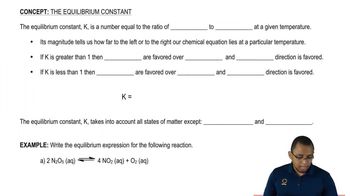
The equilibrium constant (K) is a numerical value that expresses the ratio of the concentrations of products to the concentrations of reactants at equilibrium for a given reaction at a specific temperature. It is calculated using the formula K = [products]^[coefficients] / [reactants]^[coefficients], where the brackets denote concentration. A large K value indicates that products are favored at equilibrium, while a small K value suggests that reactants are favored.
The reaction quotient (Q) is a measure of the relative amounts of products and reactants present in a reaction at any point in time, not just at equilibrium. It is calculated using the same expression as the equilibrium constant but with the current concentrations. Comparing Q to K helps predict the direction in which a reaction will proceed to reach equilibrium: if Q < K, the reaction will shift to the right (toward products), and if Q > K, it will shift to the left (toward reactants).
In equilibrium constant expressions, only the concentrations of gases and aqueous solutions are included, while solids and liquids are omitted because their activities are defined as 1. In the given reaction, carbon (C) is a solid, and water (H2O) is a gas, which means only the gaseous products (CO and H2) will be included in the equilibrium expression. Understanding the phases of substances is crucial for correctly writing these expressions.