Do the following reactions favor reactants or products at equilibrium? Give relative concentrations at equilibrium.
Sucrose(aq) + H2O(l) ⇌ Glucose(aq) + Fructose(aq) K = 1.4 x 10^5
검증된 단계별 안내
1
Identify the equilibrium constant (K) for the reaction, which is given as K = 1.4 \(\times\) 10^5.
Understand that the equilibrium constant (K) indicates the ratio of the concentrations of products to reactants at equilibrium.
Since K is much greater than 1, this suggests that the products are favored at equilibrium.
At equilibrium, the concentration of products (Glucose and Fructose) will be much higher than the concentration of reactants (Sucrose and H2O).
Conclude that the reaction favors the formation of products at equilibrium, resulting in higher concentrations of Glucose and Fructose compared to Sucrose.
비슷한 문제에 대한 검증된 영상 답변:
이 영상 해법은 위 문제에 도움이 된다고 튜터들이 추천한 것입니다.
영상 길이:
6m
영상 재생:
0 댓글
주요 개념
질문에 올바르게 답하기 위해 반드시 이해해야 하는 핵심 개념들은 다음과 같습니다.
Chemical Equilibrium
Chemical equilibrium occurs when the rates of the forward and reverse reactions are equal, resulting in constant concentrations of reactants and products. At this point, the system is in a dynamic state where the concentrations of all species remain unchanged over time, even though reactions continue to occur. Understanding this concept is crucial for analyzing the favorability of reactants or products in a given reaction.
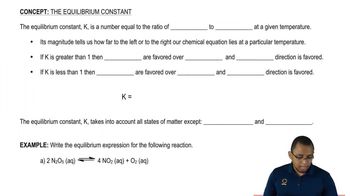
The equilibrium constant (K) quantifies the ratio of the concentrations of products to reactants at equilibrium, raised to the power of their stoichiometric coefficients. A large K value, such as 1.4 x 10^5 in this case, indicates that at equilibrium, the concentration of products is significantly higher than that of reactants, suggesting that the reaction favors the formation of products.
Relative concentrations refer to the proportions of reactants and products present at equilibrium. In the context of the given reaction, understanding how to calculate these concentrations based on the equilibrium constant allows for predictions about the extent of the reaction. This involves using the value of K to determine how much more abundant the products are compared to the reactants at equilibrium.

 6:07분
6:07분 검증된 단계별 안내
 03:42
03:42