For each of the following pairs, which is the larger unit?
b. milliliter or microliter
검증된 단계별 안내
1
Understand the metric prefixes: 'milli-' means 10^{-3} and 'micro-' means 10^{-6}.
Recognize that a liter (L) is the base unit for volume in the metric system.
Convert each unit to the base unit (liters) for comparison: 1 milliliter (mL) = 10^{-3} L and 1 microliter (μL) = 10^{-6} L.
Compare the exponents: 10^{-3} is larger than 10^{-6}.
Conclude that a milliliter is a larger unit than a microliter.
비슷한 문제에 대한 검증된 영상 답변:
이 영상 해법은 위 문제에 도움이 된다고 튜터들이 추천한 것입니다.
영상 길이:
1m
영상 재생:
0 댓글
주요 개념
질문에 올바르게 답하기 위해 반드시 이해해야 하는 핵심 개념들은 다음과 같습니다.
Units of Volume
Volume is a measure of the three-dimensional space an object occupies, commonly expressed in liters (L) and its subdivisions. The metric system uses prefixes to denote fractions or multiples of a unit, such as milliliters (mL) and microliters (µL). Understanding these units is essential for comparing volumes, as they represent different scales of measurement.
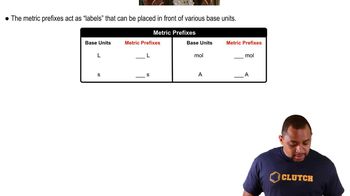
Metric prefixes are used to indicate the size of a unit in relation to the base unit. For example, 'milli-' denotes one-thousandth (10^-3) of a liter, while 'micro-' denotes one-millionth (10^-6) of a liter. This hierarchical structure allows for easy conversion and comparison between different units of measurement.
To determine which unit is larger, one must understand how to convert between different metric units. For instance, 1 milliliter equals 1,000 microliters. This conversion is crucial for accurately comparing volumes and understanding the scale of measurements in scientific contexts.

 1:51분
1:51분 검증된 단계별 안내

 01:15
01:15