Use metric conversion factors to solve each of the following problems:
c. A hummingbird has a mass of 0.0055 kg. What is the mass, in grams, of the hummingbird?
검증된 단계별 안내
1
Identify the given mass of the hummingbird in kilograms: 0.0055 kg.
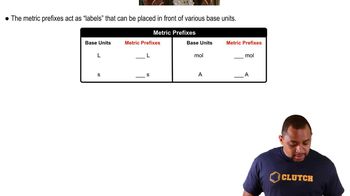
Recall the conversion factor between kilograms and grams: 1 kg = 1000 g.
Set up the conversion by multiplying the given mass by the conversion factor to convert kilograms to grams.
Write the equation: \( \text{mass in grams} = 0.0055 \text{ kg} \times \frac{1000 \text{ g}}{1 \text{ kg}} \).
Perform the multiplication to find the mass in grams.
비슷한 문제에 대한 검증된 영상 답변:
이 영상 해법은 위 문제에 도움이 된다고 튜터들이 추천한 것입니다.
영상 길이:
46s
영상 재생:
0 댓글
주요 개념
질문에 올바르게 답하기 위해 반드시 이해해야 하는 핵심 개념들은 다음과 같습니다.
Metric System
The metric system is a decimal-based system of measurement used globally, which includes units such as meters for length, liters for volume, and grams for mass. It is based on powers of ten, making conversions straightforward. Understanding the metric system is essential for performing calculations and conversions accurately in scientific contexts.
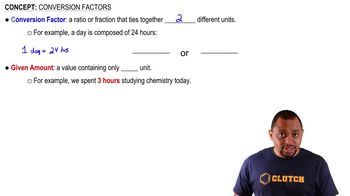
Unit conversion involves changing a quantity expressed in one unit to another unit without changing its value. This process often requires the use of conversion factors, which are ratios that express how many of one unit are equivalent to another. For example, to convert kilograms to grams, one would use the conversion factor of 1000 grams per kilogram.
Mass is a measure of the amount of matter in an object, typically measured in kilograms or grams, while weight is the force exerted by gravity on that mass. In the context of this question, understanding that mass remains constant regardless of location is crucial for converting between units. The mass of the hummingbird is given in kilograms, and the goal is to express it in grams.

 0:46분
0:46분 검증된 단계별 안내
 01:16
01:16