The reaction H2(g) + I2(g) ⇌ 2 HI(g) has ∆H = -2.2 kcal/mol (-9.2 kJ/mol). Will the equilibrium concentration of HI increase or decrease when
H2 is removed?
검증된 단계별 안내
1
Identify the type of reaction: The given reaction is an exothermic reaction, as indicated by the negative \( \Delta H \) value.
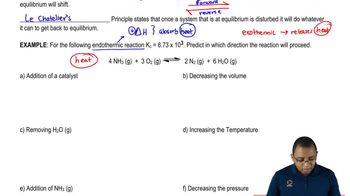
Understand Le Chatelier's Principle: This principle states that if a dynamic equilibrium is disturbed by changing the conditions, the position of equilibrium shifts to counteract the change.
Analyze the effect of removing \( H_2 \): Removing \( H_2 \) will decrease its concentration, causing the equilibrium to shift towards the reactants to produce more \( H_2 \).
Determine the impact on \( HI \) concentration: As the equilibrium shifts towards the reactants, the concentration of \( HI \) will decrease because the reaction will favor the reverse process to produce more \( H_2 \) and \( I_2 \).
Conclude the effect: Therefore, the equilibrium concentration of \( HI \) will decrease when \( H_2 \) is removed.
비슷한 문제에 대한 검증된 영상 답변:
이 영상 해법은 위 문제에 도움이 된다고 튜터들이 추천한 것입니다.
영상 길이:
1m
영상 재생:
0 댓글
주요 개념
질문에 올바르게 답하기 위해 반드시 이해해야 하는 핵심 개념들은 다음과 같습니다.
Le Chatelier's Principle
Le Chatelier's Principle states that if a dynamic equilibrium is disturbed by changing the conditions, the system will adjust to counteract the change and restore a new equilibrium. In this case, removing H2 will shift the equilibrium position to favor the production of H2 to compensate for its loss.
The following is an endothermic reaction where Kc = 6.73 x 10³.For each of the choices below predict in which direction the reaction will proceed
Equilibrium Constant (K)
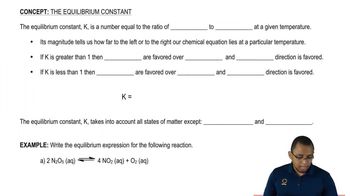
The equilibrium constant (K) is a numerical value that expresses the ratio of the concentrations of products to reactants at equilibrium for a given reaction at a specific temperature. Changes in concentration of reactants or products can affect the position of equilibrium but not the value of K itself.
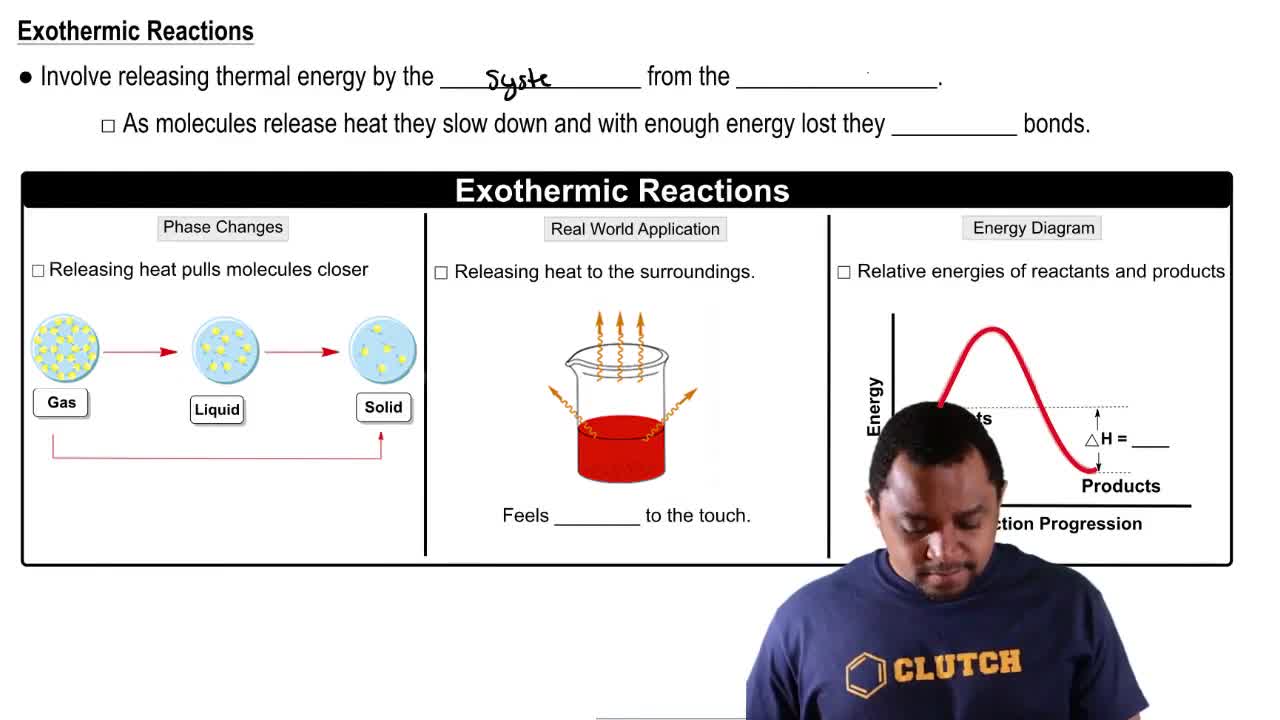
Reactions can be classified as endothermic or exothermic based on the heat absorbed or released. The given reaction is exothermic (∆H = -2.2 kcal/mol), meaning it releases heat. Understanding the nature of the reaction helps predict how changes in concentration will affect the equilibrium position.