When the following equilibria are disturbed by increasing the pressure, does the concentration of reaction products increase, decrease, or remain the same?
2 CO2(g) ⇌ 2 CO(g) + O2(g)
검증된 단계별 안내
1
Identify the number of moles of gas on each side of the equilibrium equation. On the left side, there are 2 moles of CO2(g). On the right side, there are 2 moles of CO(g) and 1 mole of O2(g), totaling 3 moles of gas.
Apply Le Chatelier's Principle, which states that if a system at equilibrium is subjected to a change in pressure, the system will adjust to counteract that change. Increasing pressure favors the side with fewer moles of gas.
Since the left side of the equation has fewer moles of gas (2 moles) compared to the right side (3 moles), increasing the pressure will shift the equilibrium towards the left side.
Determine the effect on the concentration of reaction products. As the equilibrium shifts to the left, the concentration of products (CO and O2) will decrease.
Conclude that increasing the pressure will result in a decrease in the concentration of the reaction products CO(g) and O2(g).
비슷한 문제에 대한 검증된 영상 답변:
이 영상 해법은 위 문제에 도움이 된다고 튜터들이 추천한 것입니다.
영상 길이:
1m
영상 재생:
0 댓글
주요 개념
질문에 올바르게 답하기 위해 반드시 이해해야 하는 핵심 개념들은 다음과 같습니다.
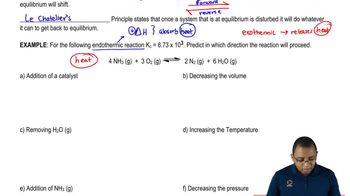
Le Chatelier's Principle
Le Chatelier's Principle states that if a dynamic equilibrium is disturbed by changing the conditions, the system will adjust to counteract the change and restore a new equilibrium. In the context of pressure changes, the system will shift in the direction that reduces the pressure, which typically means favoring the side with fewer gas molecules.
The following is an endothermic reaction where Kc = 6.73 x 10³.For each of the choices below predict in which direction the reaction will proceed
Mole Ratio in Gaseous Reactions
In gaseous reactions, the number of moles of gas on each side of the equilibrium equation is crucial for understanding how changes in pressure affect the system. In the given reaction, there are 2 moles of CO2 on the left and 3 moles (2 CO + 1 O2) on the right, indicating that increasing pressure will favor the formation of CO2, as it has fewer moles of gas.
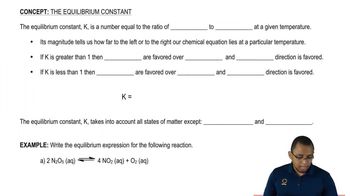
The equilibrium constant (K) quantifies the ratio of concentrations of products to reactants at equilibrium for a given reaction at a specific temperature. While pressure changes can shift the position of equilibrium, the value of K remains constant unless the temperature changes. Understanding K helps predict how concentrations will change in response to disturbances.