For each of the following bonds, indicate the positive end with 𝛿⁺ and the negative end with 𝛿⁻ . Draw an arrow to show the dipole for each.
a. N and F
검증된 단계별 안내
1
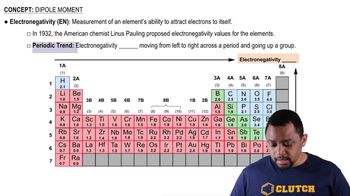
Identify the electronegativity values of nitrogen (N) and fluorine (F) from the periodic table.
Compare the electronegativity values: the atom with the higher electronegativity will attract the shared electrons more strongly.
Determine the direction of the dipole: the arrow points towards the more electronegative atom, which is fluorine (F) in this case.
Label the nitrogen (N) atom with 𝛿⁺ (partial positive charge) because it is less electronegative.
Label the fluorine (F) atom with 𝛿⁻ (partial negative charge) because it is more electronegative.
비슷한 문제에 대한 검증된 영상 답변:
이 영상 해법은 위 문제에 도움이 된다고 튜터들이 추천한 것입니다.
영상 길이:
2m
영상 재생:
0 댓글
주요 개념
질문에 올바르게 답하기 위해 반드시 이해해야 하는 핵심 개념들은 다음과 같습니다.
Electronegativity
Electronegativity is a measure of an atom's ability to attract and hold onto electrons in a chemical bond. In the context of the bond between nitrogen (N) and fluorine (F), fluorine is more electronegative than nitrogen, meaning it pulls the shared electrons closer to itself, creating a dipole moment.
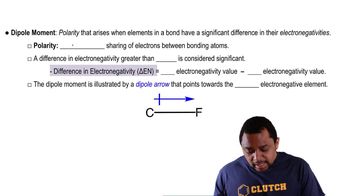
A dipole moment occurs in a polar bond where there is an uneven distribution of electron density. It is represented by an arrow pointing from the positive end (𝛿⁺) to the negative end (𝛿⁻) of the bond. In the N-F bond, the dipole moment indicates that fluorine has a partial negative charge due to its higher electronegativity.
Bonds can be classified as polar or nonpolar based on the difference in electronegativity between the two atoms involved. A polar bond, like that between N and F, has a significant difference in electronegativity, resulting in a dipole moment. In contrast, nonpolar bonds occur when atoms share electrons equally, leading to no dipole moment.

 2:47분
2:47분 검증된 단계별 안내
 01:51
01:51