Balance each of the following neutralization equations:
a. HNO₃(aq) + Ba(OH)₂(s) → H₂O(l) + Ba(NO₃)₂(aq)
검증된 단계별 안내
1
Identify the reactants and products in the equation: HNO₃(aq) + Ba(OH)₂(s) → H₂O(l) + Ba(NO₃)₂(aq).
Write down the number of each type of atom present in the reactants and products. For example, count the number of hydrogen, nitrogen, oxygen, and barium atoms on both sides of the equation.
Start by balancing the atoms that appear in the least number of compounds. In this case, balance the barium (Ba) atoms first.
Next, balance the nitrate ions (NO₃⁻) by ensuring the number of nitrate ions on the reactant side equals the number on the product side.
Finally, balance the hydrogen (H) and oxygen (O) atoms by adjusting the coefficients of H₂O to ensure the same number of each atom on both sides of the equation.
비슷한 문제에 대한 검증된 영상 답변:
이 영상 해법은 위 문제에 도움이 된다고 튜터들이 추천한 것입니다.
영상 길이:
4m
영상 재생:
0 댓글
주요 개념
질문에 올바르게 답하기 위해 반드시 이해해야 하는 핵심 개념들은 다음과 같습니다.
Neutralization Reaction
A neutralization reaction occurs when an acid reacts with a base to produce water and a salt. In this process, the hydrogen ions (H⁺) from the acid combine with the hydroxide ions (OH⁻) from the base to form water (H₂O). The remaining ions form the salt, which in this case is barium nitrate (Ba(NO₃)₂). Understanding this concept is crucial for balancing the equation correctly.
Lewis Dot Structures: Neutral Compounds (Simplified) Concept 1
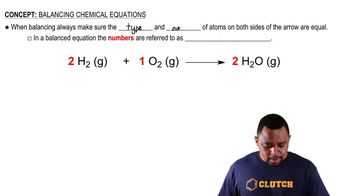
Balancing Chemical Equations
Balancing chemical equations involves ensuring that the number of atoms of each element is the same on both sides of the equation. This is achieved by adjusting the coefficients in front of the chemical formulas. The law of conservation of mass dictates that matter cannot be created or destroyed in a chemical reaction, making balancing essential for accurate representation of the reaction.
Balancing Chemical Equations (Simplified) Concept 1
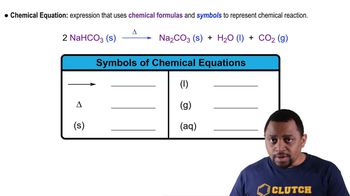
State Symbols in Chemical Reactions
State symbols indicate the physical state of the reactants and products in a chemical reaction. Common symbols include (s) for solid, (l) for liquid, (g) for gas, and (aq) for aqueous solutions. Recognizing these symbols helps in understanding the conditions under which the reaction occurs and is important for correctly interpreting and balancing the equation.