Skip to main content
Introduction to Chemistry
나의 코스
배우기
시험 준비
AI 튜터
학습 가이드
플래시카드
탐험해 보세요
앱을 사용해 보세요
나의 코스
배우기
시험 준비
AI 튜터
학습 가이드
플래시카드
탐험해 보세요
앱을 사용해 보세요
뒤로
The Equilibrium Constant definitions
카드를 뒤집기 위해 탭할 수 있습니다.
Equilibrium Constant
카드를 뒤집기 위해 탭할 수 있습니다.
👆
Equilibrium Constant
A numerical value expressing the ratio of product to reactant concentrations at a specific temperature for a chemical reaction.
진행 상황 추적
컨트롤 버튼이 '내비게이션' 모드로 변경되었습니다.
1/13
관련 플래시카드
관련 실천
추천 영상
The Equilibrium Constant quiz
The Equilibrium Constant
15 용어
The Equilibrium Constant
15. Chemical Equilibrium
5 문제점
주제
Le Chatelier's Principle
15. Chemical Equilibrium
5 문제점
주제
15. Chemical Equilibrium
6 주제
16 문제점
장
VideoThumbView.guidedCourse
02:50
The Equilibrium Constant Concept 1
4695
views
27
rank
2
comments
VideoThumbView.guidedCourse
03:43
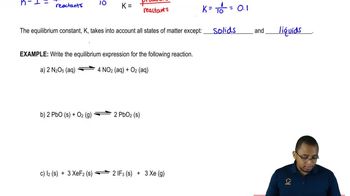
The Equilibrium Constant Example 1
4285
views
25
rank
이 집합의 용어 (13)
하이드의 정의
Equilibrium Constant
A numerical value expressing the ratio of product to reactant concentrations at a specific temperature for a chemical reaction.
K
A symbol representing the equilibrium constant, indicating the extent to which a reaction favors products or reactants.
Ratio
A comparison of the concentrations of products to reactants, used to determine the value of the equilibrium constant.
Temperature
A factor that directly influences the magnitude of the equilibrium constant, with increases raising and decreases lowering its value.
Products
Substances formed as a result of a chemical reaction, whose concentration is used in the numerator when calculating the equilibrium constant.
Reactants
Starting substances in a chemical reaction, whose concentration is used in the denominator when calculating the equilibrium constant.
Forward Direction
The progression of a reaction toward forming more products, favored when the equilibrium constant is greater than one.
Reverse Direction
The progression of a reaction toward forming more reactants, favored when the equilibrium constant is less than one.
Magnitude
The size or value of the equilibrium constant, indicating whether products or reactants are favored at equilibrium.
State of Matter
A physical form—solid, liquid, or gas—of substances, with only gases and aqueous species considered in equilibrium constant calculations.
Solids
A state of matter excluded from equilibrium constant calculations due to unchanging concentration during reactions.
Liquids
A state of matter not included in equilibrium constant calculations, as their concentration remains constant in reactions.
Balanced State
A condition where the amounts of products and reactants are equal, corresponding to an equilibrium constant value of one.
 뒤로뒤로
뒤로뒤로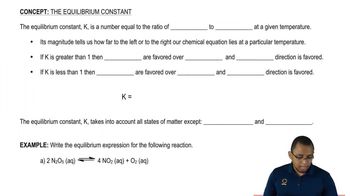
 02:50
02:50