Skip to main content
Introduction to Chemistry
나의 코스
배우기
시험 준비
AI 튜터
학습 가이드
플래시카드
탐험해 보세요
앱을 사용해 보세요
나의 코스
배우기
시험 준비
AI 튜터
학습 가이드
플래시카드
탐험해 보세요
앱을 사용해 보세요
뒤로
The Equilibrium Constant quiz
카드를 뒤집기 위해 탭할 수 있습니다.
What does the equilibrium constant 'k' represent in a chemical reaction?
카드를 뒤집기 위해 탭할 수 있습니다.
👆
What does the equilibrium constant 'k' represent in a chemical reaction?
It represents the ratio of products to reactants at a specific temperature, indicating the extent of the reaction's progress.
진행 상황 추적
컨트롤 버튼이 '내비게이션' 모드로 변경되었습니다.
1/15
관련 플래시카드
관련 실천
추천 영상
The Equilibrium Constant definitions
The Equilibrium Constant
13 용어
The Equilibrium Constant
15. Chemical Equilibrium
5 문제점
주제
Le Chatelier's Principle
15. Chemical Equilibrium
5 문제점
주제
15. Chemical Equilibrium
6 주제
16 문제점
장
VideoThumbView.guidedCourse
02:50
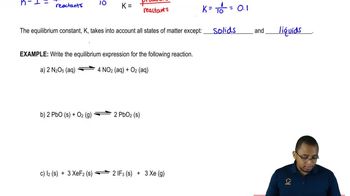
The Equilibrium Constant Concept 1
4695
views
27
rank
2
comments
VideoThumbView.guidedCourse
03:43
The Equilibrium Constant Example 1
4285
views
25
rank
이 집합의 용어 (15)
하이드의 정의
What does the equilibrium constant 'k' represent in a chemical reaction?
It represents the ratio of products to reactants at a specific temperature, indicating the extent of the reaction's progress.
How does temperature affect the equilibrium constant 'k'?
Increasing temperature raises the value of 'k', while decreasing temperature lowers it.
What does a 'k' value greater than 1 indicate about a reaction?
It indicates that products are favored, meaning the reaction proceeds in the forward direction to produce more products.
What does a 'k' value less than 1 suggest about the direction of a reaction?
It suggests that reactants are favored, so the reaction proceeds in the reverse direction.
What does it mean when the equilibrium constant 'k' equals 1?
It means the amounts of products and reactants are equal, signifying a balanced state in the reaction.
Which states of matter are ignored in the calculation of the equilibrium constant 'k'?
The concentrations of solids and liquids are not considered in the calculation of 'k'.
Why is the equilibrium constant 'k' described as a ratio?
Because it is calculated as the concentration of products divided by the concentration of reactants.
If the product concentration is 10 and reactant concentration is 1, what is the value of 'k'?
The value of 'k' would be 10, which is greater than 1, indicating products are favored.
If the product concentration is 1 and reactant concentration is 10, what is the value of 'k'?
The value of 'k' would be 0.1, which is less than 1, indicating reactants are favored.
What does the magnitude of 'k' tell us about a chemical reaction?
It tells us how far the reaction has shifted toward products or reactants at a given temperature.
What direction is favored when 'k' is greater than 1?
The forward direction is favored, leading to the formation of more products.
What direction is favored when 'k' is less than 1?
The reverse direction is favored, leading to the formation of more reactants.
Why are solids and liquids excluded from the equilibrium constant calculation?
Their concentrations do not change during the reaction, so they are not included in the calculation.
At what value of 'k' are products and reactants present in equal amounts?
When 'k' equals 1, products and reactants are present in equal amounts.
Is the equilibrium constant 'k' the same at all temperatures?
No, 'k' changes with temperature; it is specific to each temperature.
 뒤로
뒤로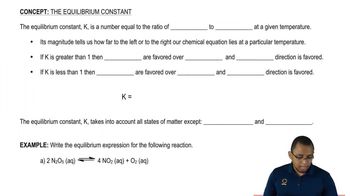
 02:50
02:50