뒤로
뒤로Chapter 1: Matter and Energy – Structured Study Notes
스터디 가이드 - 스마트 노트
 자료에 맞춘 맞춤형 노트, 핵심 정의, 예시, 맥락을 확장해 제공합니다.
Matter and Energy
Introduction to Matter and Energy
Matter and energy are fundamental concepts in chemistry. Matter is anything that has mass and occupies space, while energy is the capacity to do work or produce change. Understanding their properties and classifications is essential for studying chemical processes.
Classifying Matter
States of Matter
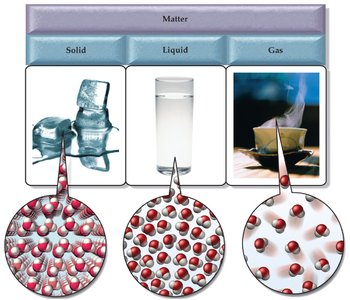
Matter exists in three common states: solid, liquid, and gas. Each state has distinct physical properties based on the arrangement and movement of atoms or molecules.
Solid: Definite shape and volume; particles vibrate about fixed positions and are closely packed.
Liquid: Indefinite shape but definite volume; particles are close together but move freely relative to one another.
Gas: Indefinite shape and volume; particles are far apart and move freely.
Properties of Solids, Liquids, and Gases
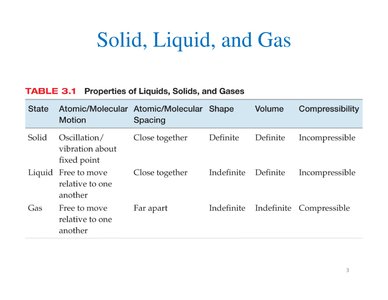
The table below summarizes the main properties of each state of matter:
State | Atomic/Molecular Motion | Atomic/Molecular Spacing | Shape | Volume | Compressibility |
|---|---|---|---|---|---|
Solid | Oscillation/vibration about fixed point | Close together | Definite | Definite | Incompressible |
Liquid | Free to move relative to one another | Close together | Indefinite | Definite | Incompressible |
Gas | Free to move relative to one another | Far apart | Indefinite | Indefinite | Compressible |
Classification of Matter
Pure Substances and Mixtures
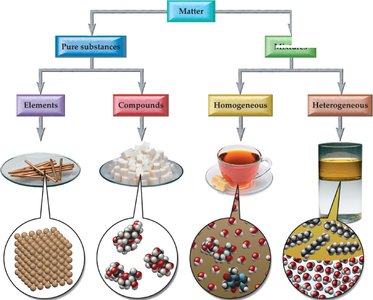
Matter can be classified as either pure substances or mixtures. Pure substances have a uniform and definite composition, while mixtures consist of two or more substances physically combined.
Pure Substances: Include elements and compounds.
Mixtures: Can be homogeneous (uniform throughout) or heterogeneous (not uniform).
Elements and Compounds
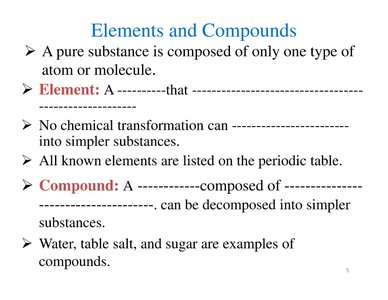
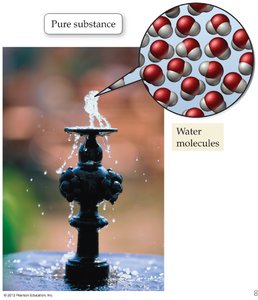
A pure substance is composed of only one type of atom or molecule.
Element: A substance that cannot be chemically transformed into simpler substances. All known elements are listed on the periodic table.
Compound: A substance composed of two or more elements in fixed, definite proportions. Compounds can be decomposed into simpler substances by chemical means.
Examples of compounds include water, table salt, and sugar.
Example: Helium as an Element
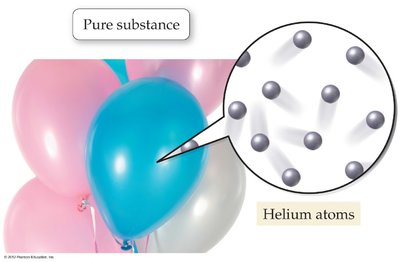
Helium is a pure substance composed only of one type of atom: helium atoms.
Example: Water as a Compound
Water is a pure substance composed only of water molecules, which consist of two elements (hydrogen and oxygen) in fixed, definite proportions.
Mixtures
A mixture is composed of two or more substances physically combined. There are two types of mixtures:
Homogeneous mixtures: Have uniform properties throughout. Examples: salt water, air.
Heterogeneous mixtures: Do not have uniform properties throughout. Example: sand and water.
Example: Air and Seawater
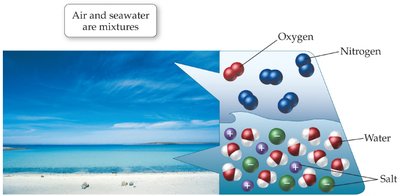
Air contains primarily nitrogen and oxygen, while seawater contains primarily salt and water. Both are mixtures.
Sample Exercise: Classification
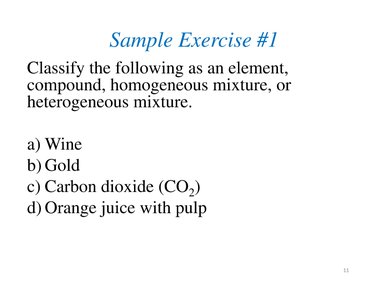
Classify the following as an element, compound, homogeneous mixture, or heterogeneous mixture:
Wine – Homogeneous mixture
Gold – Element
Carbon dioxide (CO2) – Compound
Orange juice with pulp – Heterogeneous mixture
Physical and Chemical Properties
Definitions and Examples
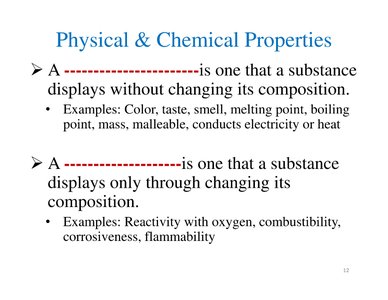
Properties of substances can be classified as physical or chemical:
Physical property: Displayed without changing the composition of the substance. Examples: color, taste, smell, melting point, boiling point, mass, malleability, conductivity.
Chemical property: Displayed only through changing the composition of the substance. Examples: reactivity with oxygen, combustibility, corrosiveness, flammability.
Sample Exercise: Identifying Properties
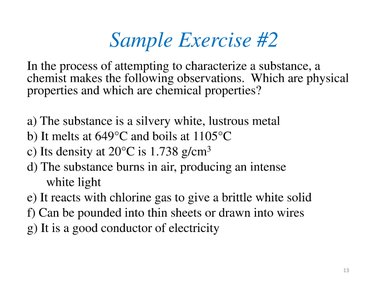
Identify which of the following are physical or chemical properties:
Silvery white, lustrous metal – Physical
Melts at 649°C, boils at 1105°C – Physical
Density at 20°C is 1.738 g/cm3 – Physical
Burns in air, producing intense white light – Chemical
Reacts with chlorine gas to give a brittle white solid – Chemical
Can be pounded into thin sheets or drawn into wires – Physical
Good conductor of electricity – Physical
Physical and Chemical Changes
Definitions
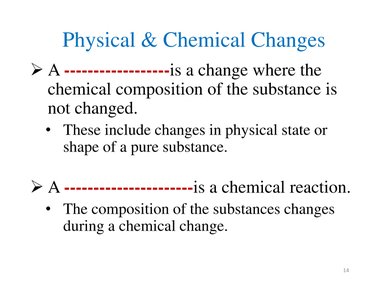
Changes in matter can be classified as physical or chemical:
Physical change: A change where the chemical composition of the substance is not changed. Includes changes in physical state or shape.
Chemical change: A chemical reaction where the composition of the substances changes.
Phase Changes
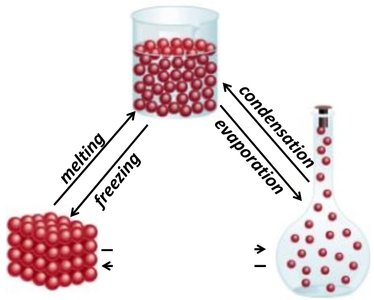
Phase changes such as melting, freezing, condensation, and evaporation are examples of physical changes.
Evidence for Chemical Changes
Indicators of a chemical change include:
Gas release (bubbles)
Light or release of heat energy
Formation of a precipitate
A permanent color change
Sample Exercise: Identifying Changes
Determine whether the following are physical or chemical changes:
Rusting iron – Chemical
Sugar dissolving in water – Physical
Burning a log – Chemical
Melting ice – Physical
Grinding cinnamon – Physical
Energy
Conservation of Energy
Energy, like matter, is conserved. The law of conservation of energy states that energy is neither created nor destroyed. The total amount of energy in the universe is constant, though it can be transferred or transformed.
Energy can be changed from one form to another.
Energy can be transferred between objects.
Energy cannot be created from nothing or vanish into nothing.
Forms of Energy
The total energy of a sample of matter is the sum of its kinetic energy (energy of motion) and potential energy (energy of position or composition).
Kinetic energy:
Potential energy:
Types of Energy
Electrical energy: Energy associated with the flow of electrical charge.
Thermal energy: Energy associated with the random motions of atoms and molecules in matter.
Chemical energy: A form of potential energy associated with the positions of the particles that compose a chemical system.