 뒤로
뒤로Chapter 3: Matter and Energy – Study Notes for Introductory Chemistry
스터디 가이드 - 스마트 노트
 자료에 맞춘 맞춤형 노트, 핵심 정의, 예시, 맥락을 확장해 제공합니다.
Matter and Energy
Defining Matter
Matter is anything that occupies space and has mass. All physical objects, from textbooks to air, are composed of matter. Matter can be visible, like steel or water, or invisible, like air or microscopic dust.
Atoms: The fundamental building blocks of matter, submicroscopic in size.
Molecules: Two or more atoms bonded together in specific geometric arrangements.
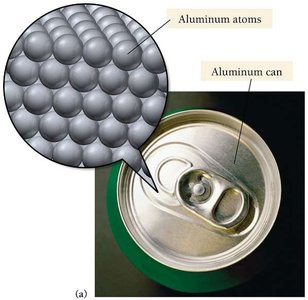
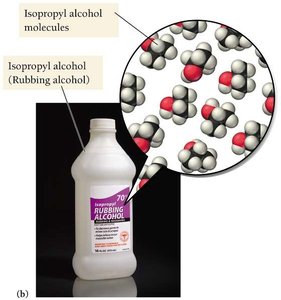
Additional info: Advances in microscopy allow us to visualize atoms and molecules directly.
Classification of Matter by State
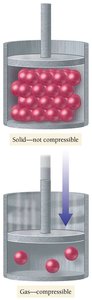
Matter can be classified by its physical state: solid, liquid, or gas. The state depends on how atoms or molecules are arranged and how they move.
Solid: Atoms/molecules are closely packed, vibrate but do not move past each other. Solids have a fixed volume and shape.
Liquid: Atoms/molecules are close but can move relative to each other. Liquids have a fixed volume but take the shape of their container.
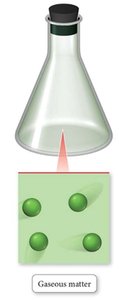
Gas: Atoms/molecules are far apart and move freely. Gases take both the shape and volume of their container and are compressible.
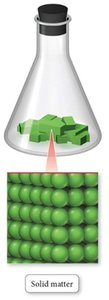
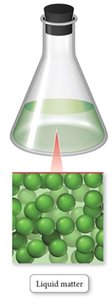
Types of Solids
Solids can be further classified as crystalline or amorphous:
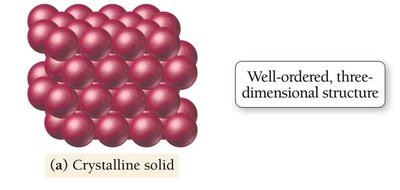
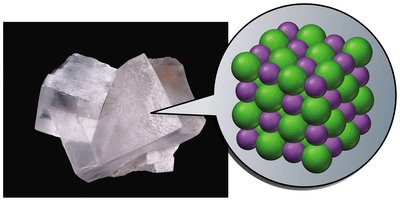
Crystalline solids: Atoms/molecules are arranged in long-range, repeating order (e.g., table salt, diamond).
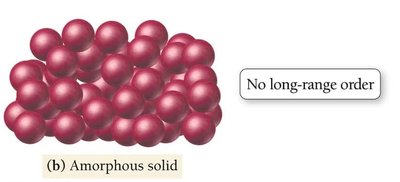
Amorphous solids: Atoms/molecules lack long-range order (e.g., glass, plastic).
Properties of Solids, Liquids, and Gases
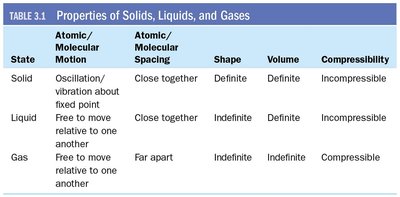
The following table summarizes the main properties of the three states of matter:
State | Atomic/Molecular Motion | Atomic/Molecular Spacing | Shape | Volume | Compressibility |
|---|---|---|---|---|---|
Solid | Oscillation/vibration about fixed point | Close together | Definite | Definite | Incompressible |
Liquid | Free to move relative to one another | Close together | Indefinite | Definite | Incompressible |
Gas | Free to move relative to one another | Far apart | Indefinite | Indefinite | Compressible |
Classification of Matter by Composition
Pures Substances and Mixtures
Matter can also be classified by its composition:
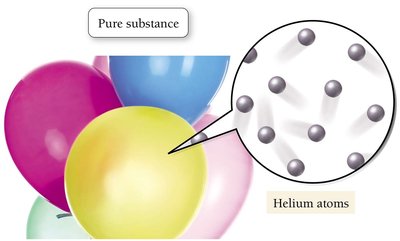
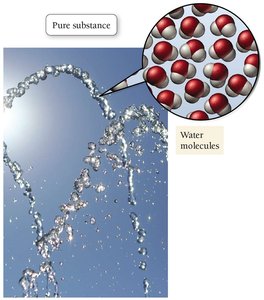
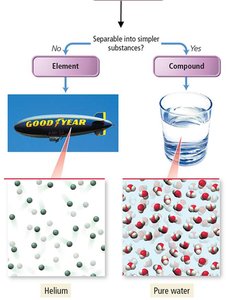
Pure substance: Composed of only one type of atom or molecule (e.g., helium, water).
Mixture: Composed of two or more different types of atoms or molecules combined in variable proportions (e.g., air, seawater).
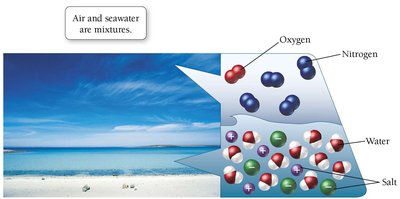
Elements, Compounds, and Mixtures
Element: A pure substance that cannot be broken down into simpler substances (e.g., copper, helium).
Compound: A pure substance composed of two or more elements in fixed, definite proportions (e.g., water, table salt).
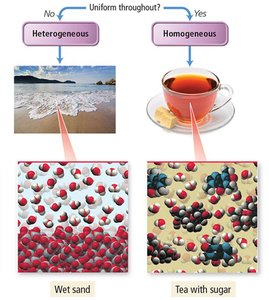
Mixture: Contains two or more substances not chemically bonded. Can be homogeneous (uniform composition, e.g., sweetened tea) or heterogeneous (non-uniform, e.g., wet sand).

Physical and Chemical Properties and Changes
Physical Properties and Changes
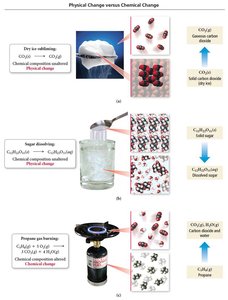
Physical properties are characteristics that can be observed without changing the substance's composition (e.g., odor, taste, color, melting point, boiling point, density).
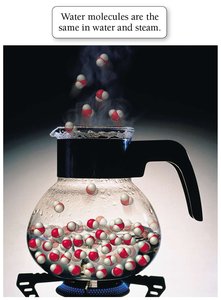
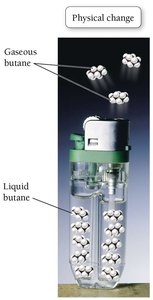
Physical change: Alters only the state or appearance, not composition (e.g., boiling, melting, dissolving).
Chemical Properties and Changes
Chemical properties describe a substance's ability to change into a different substance (e.g., flammability, acidity, toxicity).
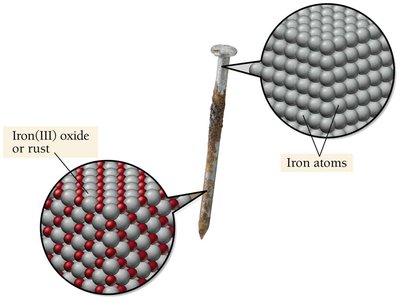
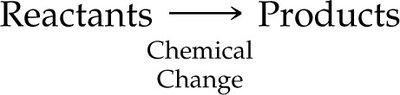
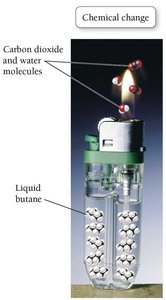
Chemical change: Alters the composition of matter; atoms rearrange to form new substances (e.g., rusting of iron, burning of butane).
Separation of Mixtures
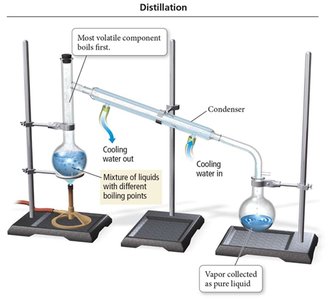
Mixtures can be separated by exploiting differences in physical or chemical properties:
Decanting: Pouring off a liquid from a solid-liquid mixture.
Distillation: Separating substances based on differences in boiling points.
Filtration: Separating an insoluble solid from a liquid.
Conservation Laws in Chemistry
Law of Conservation of Mass
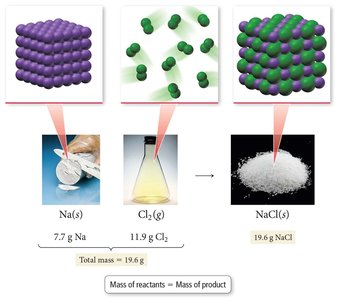
In a chemical reaction, matter is neither created nor destroyed. The total mass of reactants equals the total mass of products.
Example: Burning butane: 58 g butane + 208 g oxygen → 176 g carbon dioxide + 90 g water (total mass = 266 g).

Law of Conservation of Energy
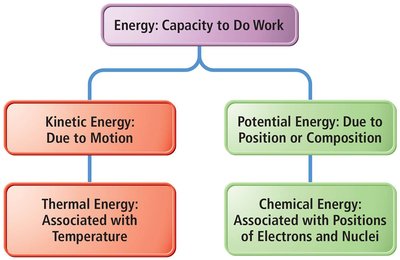
Energy is the capacity to do work. Like matter, energy is conserved: it cannot be created or destroyed, only transformed or transferred.
Kinetic energy: Energy of motion.
Potential energy: Energy stored due to position or composition.
Thermal energy: Associated with the random motion of atoms and molecules.
Chemical energy: A form of potential energy stored in chemical bonds.
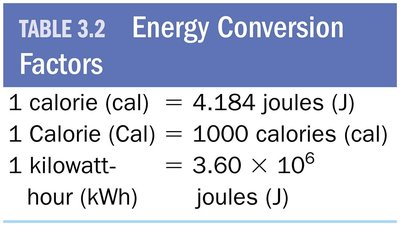
Units and Conversion of Energy
Joule (J): SI unit of energy; 1 J = 1 kg·m2/s2
Calorie (cal): Energy to raise 1 g of water by 1°C; 1 cal = 4.184 J
Calorie (Cal): Nutritional unit; 1 Cal = 1000 cal
Kilowatt-hour (kWh): 1 kWh = 3.60 × 10⁶ J
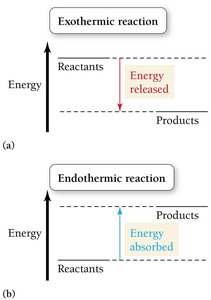
Exothermic and Endothermic Reactions
Exothermic reaction: Releases energy to the surroundings (e.g., combustion).
Endothermic reaction: Absorbs energy from the surroundings (e.g., photosynthesis).
Thermal Energy, Temperature, and Heat
Thermal Energy and Temperature
Thermal energy is the energy associated with the random motion of atoms and molecules. Temperature measures the average thermal energy of a substance.
Heat flows from high-temperature matter to low-temperature matter until thermal equilibrium is reached.
Temperature Scales
Celsius (°C): Water freezes at 0°C, boils at 100°C.
Kelvin (K): Absolute zero is 0 K; water freezes at 273 K, boils at 373 K.
Fahrenheit (°F): Water freezes at 32°F, boils at 212°F.
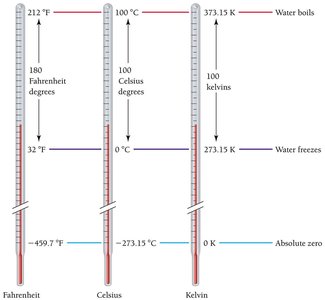
The degree symbol is used with Celsius and Fahrenheit, but not with Kelvin.

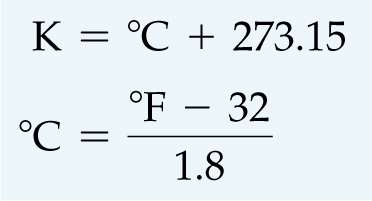
Temperature Conversion Formulas
Kelvin to Celsius:
Celsius to Fahrenheit:
Heat Capacity and Specific Heat
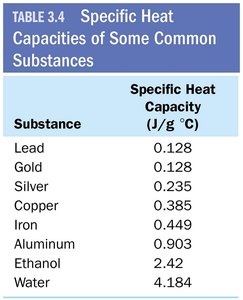
Heat capacity is the amount of heat required to change the temperature of a substance by 1°C. Specific heat capacity is the heat required to change 1 gram of a substance by 1°C, with units J/g·°C.
Calculating Heat Transfer
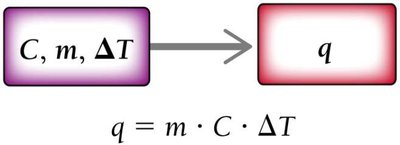
The amount of heat () absorbed or released by a substance is calculated as:
= heat (J)
= mass (g)
= specific heat capacity (J/g·°C)
= temperature change (°C)


Summary Table: Specific Heat Capacities
Substance | Specific Heat Capacity (J/g·°C) |
|---|---|
Lead | 0.128 |
Gold | 0.128 |
Silver | 0.235 |
Copper | 0.385 |
Iron | 0.449 |
Aluminum | 0.903 |
Ethanol | 2.42 |
Water | 4.184 |
Key Learning Objectives
Classify matter as element, compound, or mixture.
Distinguish between physical and chemical properties and changes.
Apply the law of conservation of mass and energy.
Identify and convert among energy units.
Convert between Fahrenheit, Celsius, and Kelvin temperature scales.
Perform calculations involving heat transfer and temperature changes.
