 뒤로
뒤로Chemical Kinetics: Reaction Rates and Mechanisms
스터디 가이드 - 스마트 노트
 자료에 맞춘 맞춤형 노트, 핵심 정의, 예시, 맥락을 확장해 제공합니다.
Chemical Kinetics
Introduction to Chemical Kinetics
Chemical kinetics is the branch of chemistry that studies the speed, or rate, at which chemical reactions occur and the factors that affect these rates. Understanding reaction rates is essential for controlling chemical processes in industrial, environmental, and biological contexts.
Reaction Rates
Average Reaction Rate
The reaction rate is a measure of how quickly reactants are converted into products in a chemical reaction. It is typically expressed as the change in concentration of a reactant or product per unit time.
Average rate is calculated over a finite time interval.
For a reactant A, the average rate is given by:
The negative sign indicates the concentration of reactant decreases over time.
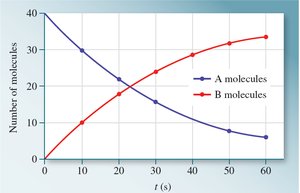
Example: The graph above shows the decrease in A molecules and the increase in B molecules as the reaction proceeds.
Stoichiometry and Reaction Rate
Reaction rates can be related to the stoichiometry of the reaction. For a general reaction:
The rate can be expressed as:

This ensures that the rate is consistent regardless of which species is monitored.
Experimental Determination of Reaction Rate
Reaction rates are often determined by measuring the concentration of a reactant or product at various times. The data can be tabulated as shown below:
Time (s) | [Br2] (M) | Rate (M/s) |
|---|---|---|
0.0 | 0.0120 | 4.20 × 10⁻³ |
50.0 | 0.0101 | 3.52 × 10⁻³ |
100.0 | 0.00846 | 2.96 × 10⁻³ |
150.0 | 0.00710 | 2.49 × 10⁻³ |
200.0 | 0.00596 | 2.09 × 10⁻³ |
250.0 | 0.00500 | 1.75 × 10⁻³ |
300.0 | 0.00420 | 1.48 × 10⁻³ |
350.0 | 0.00353 | 1.23 × 10⁻³ |
400.0 | 0.00296 | 1.04 × 10⁻³ |
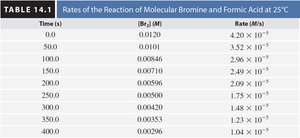
Example: The table above shows how the concentration of Br2 and the reaction rate change over time.
Instantaneous Rate
The instantaneous rate is the rate at a specific moment in time, found by taking the slope of the tangent to the concentration vs. time curve at that point.
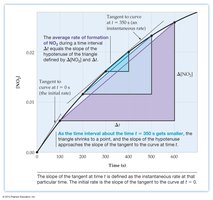
Initial rate is the instantaneous rate at t = 0.
Rate Laws and Reaction Order
The Rate Law
The rate law expresses the relationship between the reaction rate and the concentrations of reactants. For a general reaction:
k is the rate constant.
x and y are the reaction orders with respect to A and B, determined experimentally.
The sum x + y is the overall reaction order.
Example: If rate = k[Br2]1[HCOOH]0 = k[Br2], the reaction is first order in Br2, zeroth order in HCOOH, and first order overall.
Experimental Determination of the Rate Law
To determine the rate law, initial rates are measured for different starting concentrations of reactants. The effect of changing each reactant's concentration on the rate is analyzed to deduce the order with respect to each reactant.

Key Points:
Reaction order is determined from experimental data, not from the stoichiometry of the balanced equation.
Reaction order is defined in terms of reactant concentrations.
Integrated Rate Laws
Zeroth-Order Reactions
For a zeroth-order reaction, the rate is independent of the concentration of the reactant:
The integrated rate law is:
A plot of [A] vs. t yields a straight line with slope -k.
First-Order Reactions
For a first-order reaction, the rate depends linearly on the concentration of one reactant:
The integrated rate law is:
A plot of ln[A] vs. t yields a straight line with slope -k.
![Graphs for first-order reactions: [A] vs t and ln[A] vs t](https://static.studychannel.pearsonprd.tech/study_guide_files/intro-to-chemistry/sub_images/ce112172_image_18.png)
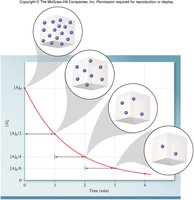
Half-life (t1/2): The time required for the concentration of a reactant to decrease to half its initial value. For a first-order reaction:
Second-Order Reactions
For a second-order reaction (rate depends on the square of one reactant):
The integrated rate law is:
A plot of 1/[A] vs. t yields a straight line with slope k.
![Graphs for second-order reactions: [A] vs t and 1/[A] vs t](https://static.studychannel.pearsonprd.tech/study_guide_files/intro-to-chemistry/sub_images/ce112172_image_21.png)
Reaction Rates and Temperature
Collision Theory
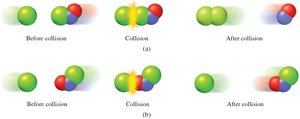
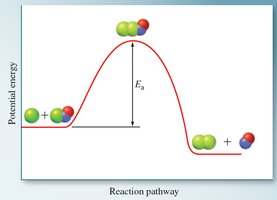
According to collision theory, chemical reactions occur when molecules collide with sufficient energy and proper orientation. The rate of reaction increases with the frequency of effective collisions.
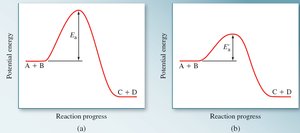
Activation energy (Ea) is the minimum energy required for a reaction to occur.
The steric factor (p) accounts for the fraction of collisions with the correct orientation.
The Arrhenius Equation
The Arrhenius equation relates the rate constant k to temperature and activation energy:
Or, in logarithmic form:
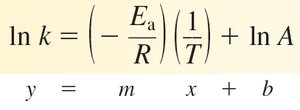
Where:
A is the frequency factor
Ea is the activation energy
R is the gas constant (8.314 J/K·mol)
T is the temperature in Kelvin
Reaction Mechanisms
Elementary Reactions and Molecularity
A reaction mechanism is a sequence of elementary steps that describes the pathway from reactants to products. Each elementary step involves a specific number of molecules, called the molecularity:
Unimolecular: One molecule decomposes or rearranges.
Bimolecular: Two molecules collide.
Termolecular: Three molecules collide (rare).
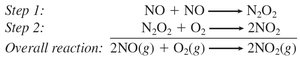
Reaction intermediates are species produced in one step and consumed in another; they do not appear in the overall balanced equation.
Rate-Determining Step
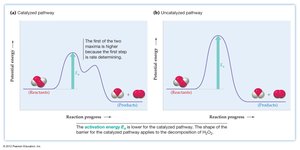
In a multistep mechanism, the rate-determining step is the slowest step, which controls the overall reaction rate and determines the observed rate law.
Catalysis
Introduction to Catalysis
A catalyst is a substance that increases the rate of a chemical reaction without being consumed. Catalysts work by lowering the activation energy required for the reaction.
Homogeneous and Heterogeneous Catalysis
Homogeneous catalysis: Catalyst and reactants are in the same phase (usually liquid).
Heterogeneous catalysis: Catalyst and reactants are in different phases (e.g., solid catalyst with gaseous or liquid reactants).

Enzymes: Biological Catalysts
Enzymes are highly specific biological catalysts that increase the rate of biochemical reactions, often by factors of 106 to 1018. Enzyme catalysis is usually homogeneous, as both enzyme and substrate are in aqueous solution.
