 뒤로
뒤로Comprehensive Study Notes: Key Equations and Concepts for Introductory Chemistry
스터디 가이드 - 스마트 노트
 자료에 맞춘 맞춤형 노트, 핵심 정의, 예시, 맥락을 확장해 제공합니다.
Constants and Fundamental Quantities
Gas Constant and Avogadro's Number
The gas constant and Avogadro's number are essential constants in chemistry, used in calculations involving gases and the mole concept.
Gas Constant (R): atm·L/(mol·K)
Avogadro’s Number (): particles/mol
Concentration and Solutions
Molarity and Solution Preparation
Molarity (M) is a measure of concentration, defined as the number of moles of solute per liter of solution. Solutions are homogeneous mixtures of solute and solvent.
Formula:
Solution: Solute + Solvent
Dilution Equation
To prepare a solution of lower concentration from a more concentrated one, use the dilution equation:
Where and are the molarity and volume of the concentrated solution, and and are those of the diluted solution.
Percent Concentrations
Percent concentration expresses the amount of solute in a given amount of solution, using mass or volume.
Mass/Volume Percent (% m/v):
Mass/Mass Percent (% m/m or % w/w):
Volume/Volume Percent (% v/v):
Parts Per Million (ppm) and Parts Per Billion (ppb)
These units are used for very dilute solutions.
ppm:
ppb:
Temperature Conversions
Temperature Scales
Temperature can be measured in Celsius (°C), Fahrenheit (°F), or Kelvin (K). The following equations allow conversion between these scales:
Acids and Bases
pH, pOH, and Ion Concentrations
The pH scale measures the acidity or basicity of a solution. The relationship between hydronium and hydroxide ion concentrations is governed by the ion product constant for water ().
Acid-Base Neutralization
Neutralization reactions involve acids and bases reacting to form water and a salt. The equation for titration calculations is:
Where and are the molarity and volume of the acid, and and are those of the base.
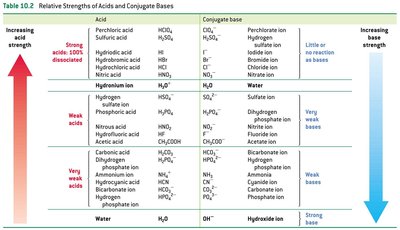
Relative Strengths of Acids and Bases
The strength of acids and bases can be compared using their dissociation in water and the strength of their conjugate pairs.
Pressure and Gases
Gas Laws and Pressure Units
Gases are described by several laws, with pressure commonly measured in atmospheres (atm), millimeters of mercury (mmHg), or torr.
1 atm = 760 mmHg = 760 torr
Ideal Gas Law:
Where P = pressure, V = volume, n = moles, R = gas constant, T = temperature (K)
Thermodynamics
Gibbs Free Energy
Thermodynamics studies energy changes in chemical reactions. The Gibbs free energy equation predicts spontaneity:
Where is the standard free energy change, is the standard enthalpy change, is temperature in Kelvin, and is the standard entropy change.
Density
Definition and Calculation
Density (D) is the mass of a substance per unit volume.
Organic Chemistry
Functional Groups and Nomenclature
Organic compounds are classified by functional groups, which determine their chemical properties and reactivity. The suffix or group in the name indicates the class of compound.
Suffix/Group | Formula/Group | Class of Compound (Functional Group) |
|---|---|---|
-e | CnH2n+2 | Alkane (Hydrocarbon) |
-e | CnH2n | Alkene / Cyclo- (Hydrocarbon) |
-e | CnH2n-2 | Alkyne (Hydrocarbon) |
-ol | -OH | Alcohol |
-al | -CHO | Aldehyde |
-one | -C=O | Ketone |
-oic acid | -COOH | Carboxylic Acid |
-amine | -NH2 | Amine |
-amide | -CONH2 | Amide |
ether | C-O-C | Ether |
-oate | -COOC- | Ester |
Atoms, Elements, and the Periodic Table
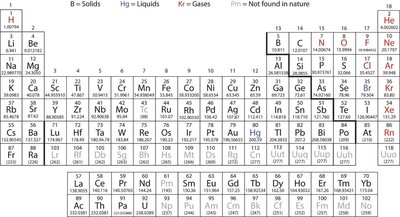
Periodic Table Overview
The periodic table organizes elements by increasing atomic number and similar chemical properties. It is a foundational tool for understanding atomic structure, periodic trends, and chemical reactivity.
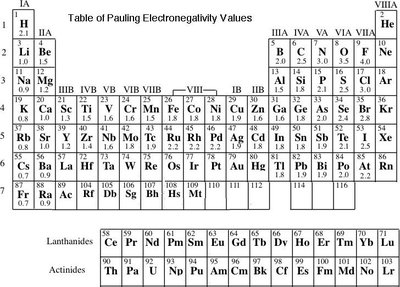
Electronegativity and Bond Types
Electronegativity is the ability of an atom to attract electrons in a chemical bond. The difference in electronegativity () between two atoms determines the bond type:
Electronegativity Difference () | Bond Type | Electron Bonding |
|---|---|---|
0 – 0.4 | Nonpolar Covalent | Electrons Shared Equally |
0.5 – 1.8 | Polar Covalent | Electrons Shared Unequally |
1.9 – 3.3 | Ionic Bonding | Electrons Transferred |
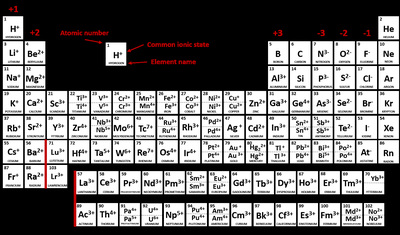
Common Ionic States
Elements can form ions by gaining or losing electrons. The periodic table can be used to predict common ionic charges for main group elements.
Additional info:
Some equations and tables were expanded for clarity and completeness.
Images included only when directly relevant to the explanation and to reinforce understanding of periodic trends, electronegativity, and acid-base strength.
