 뒤로
뒤로Introduction to Chemistry: Foundations, Matter, and Measurement
스터디 가이드 - 스마트 노트
 자료에 맞춘 맞춤형 노트, 핵심 정의, 예시, 맥락을 확장해 제공합니다.
Chapter 1: Chemistry – The Chemical World
1.1 Science and Technology: The Roots of Knowledge
Chemistry is a branch of science that seeks to understand the behavior of matter by studying the behavior of atoms and molecules. Science is a systematic search for understanding, and chemistry specifically describes how matter interacts with other matter. Scientific discoveries often lead to technological advancements, such as the development of medicines, nonstick cookware, and alternative fuels.
Science: The pursuit of knowledge through observation, experimentation, and reasoning.
Chemistry: The science that studies the composition, structure, properties, and changes of matter.
Technology: The application of scientific knowledge for practical purposes.
Alchemy: An early form of chemistry focused on transforming substances, such as turning metals into gold.
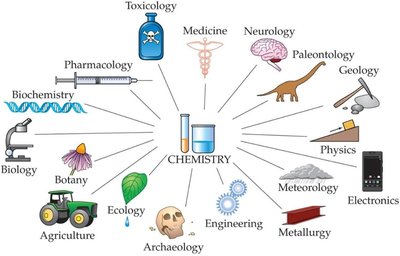
Example: The discovery of fire led to advancements in cooking, pottery, and metallurgy. Fermentation led to the production of beer and wine.
1.2 Science: Reproducible, Testable, Tentative, Predictive, and Explanatory
Science begins with observations, which lead to questions and hypotheses. A hypothesis is a tentative explanation that must be testable and falsifiable. Experiments are designed to test hypotheses, and results can confirm or refute them. Repeated observations may lead to scientific laws, which summarize patterns in nature, while theories provide deeper explanations for why those patterns exist.
Observation: Gathering information using the senses or instruments.
Hypothesis: A testable and falsifiable explanation for an observation.
Scientific Law: A statement that summarizes consistent experimental observations (e.g., Law of Conservation of Mass: "In a chemical reaction, matter is neither created nor destroyed.").
Scientific Theory: A well-substantiated explanation of some aspect of the natural world that incorporates laws, hypotheses, and facts (e.g., Kinetic Molecular Theory).
Scientific Model: A representation (physical, mathematical, or conceptual) of a system or process to aid understanding.
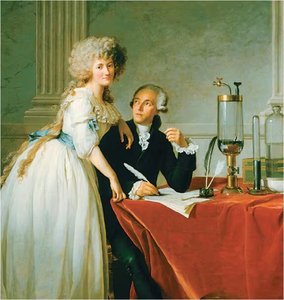
Example: When iron rusts in a closed container, the mass does not change (law). The explanation for why this happens involves atomic theory (theory).
1.3 Science and Technology: Risks and Benefits
Scientific advancements can have both positive and negative impacts. Risk-benefit analysis is used to weigh the desirability of an action or technology by comparing its benefits (positive effects) to its risks (potential for harm).
Desirability Quotient (DQ):
Benefit: Promotes well-being or has a positive effect.
Risk: Potential for loss, injury, or negative effect.
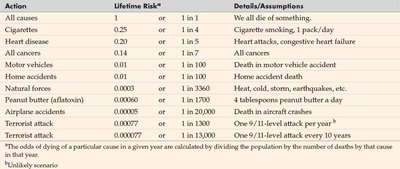
Example: The use of certain medications may be justified for short-term pain relief in some patients but not in others due to differing risk profiles.
1.4 Solving Society’s Problems: Scientific Research
Scientific research can be classified as applied or basic. Applied research aims to solve specific, practical problems, while basic research seeks to expand knowledge without immediate practical application.
Applied Research: Focused on solving real-world problems (e.g., pollution analysis, drug synthesis).
Basic Research: Pursues knowledge for its own sake (e.g., studying the structure of purines, which later led to medical advances).
Chapter 1.5: Chemistry – A Study of Matter and Its Changes
1.5 Matter: Definition and Properties
Matter is anything that occupies space and has mass. It exists in three primary states: solid, liquid, and gas. The composition of matter refers to the types and arrangements of atoms and molecules that make it up.
Mass: A measure of the amount of matter (inertia).
Weight: The force exerted by gravity on an object.
State: The physical form of matter (solid, liquid, gas).
Composition: The types and amounts of simpler substances that make up a sample of matter.
Physical and Chemical Properties
Properties of matter can be classified as physical or chemical. Physical properties can be observed without changing the substance's composition, while chemical properties can only be observed during a chemical change.
Physical Properties: Odor, taste, color, appearance, melting point, boiling point, density, malleability.
Chemical Properties: Flammability, acidity, toxicity, reactivity, corrosiveness.
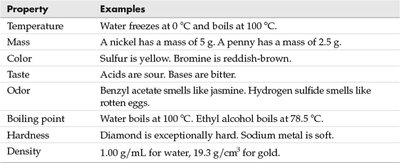
Property | Examples |
|---|---|
Temperature | Water freezes at 0°C and boils at 100°C. |
Mass | A nickel has a mass of 5 g. A penny has a mass of 2.5 g. |
Color | Sulfur is yellow. Bromine is reddish-brown. |
Taste | Acids are sour. Bases are bitter. |
Odor | Benzyl acetate smells like jasmine. Hydrogen sulfide smells like rotten eggs. |
Boiling point | Water boils at 100°C. Ethyl alcohol boils at 78.5°C. |
Hardness | Diamond is exceptionally hard. Sodium metal is soft. |
Density | 1.00 g/mL for water, 19.3 g/cm³ for gold. |
Physical and Chemical Changes
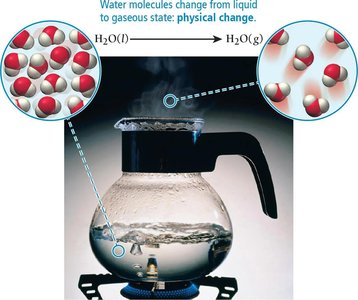
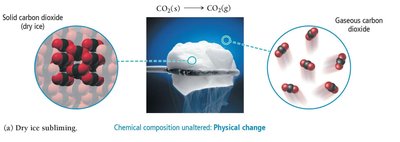
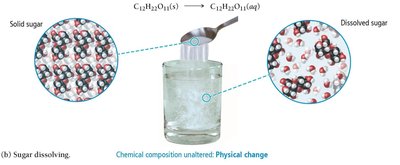
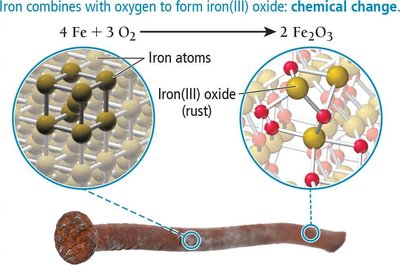
A physical change alters only the state or appearance of matter, not its composition. A chemical change alters the composition, resulting in new substances.
Physical Change: Boiling water, dissolving sugar, melting ice.
Chemical Change: Burning propane, rusting iron, digesting food.
Chapter 1.6: Classification of Matter
Atoms, Molecules, and States of Matter
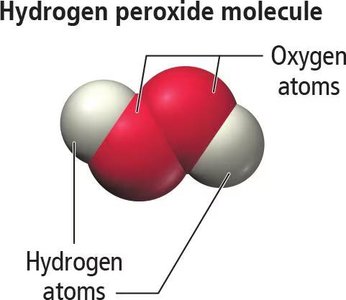
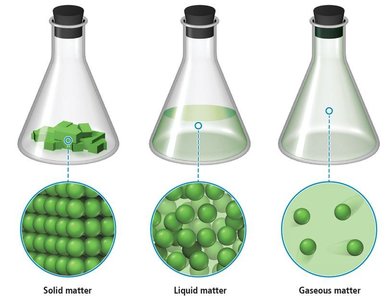
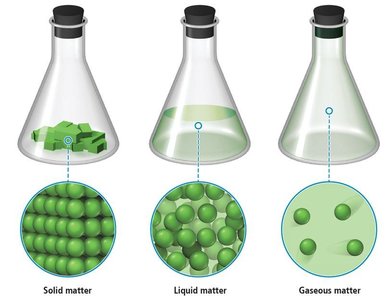
Atoms are the fundamental building blocks of matter, and molecules are groups of atoms bonded together in specific arrangements. Matter can be classified by its state (solid, liquid, gas) and by its composition (element, compound, mixture).
Solid: Definite shape and volume; atoms are closely packed in fixed positions.
Liquid: Definite volume but no definite shape; atoms are close but can move past each other.
Gas: No definite shape or volume; atoms are far apart and move freely.
Pure Substances and Mixtures
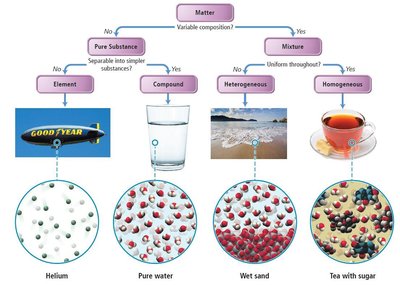
Matter can be classified as a pure substance or a mixture. Pure substances have a fixed composition and include elements and compounds. Mixtures contain two or more substances in variable proportions and can be homogeneous or heterogeneous.
Element: A substance that cannot be broken down into simpler substances (e.g., H, O, Fe).
Compound: A substance composed of two or more elements chemically combined (e.g., H2O, CO2).
Mixture: A combination of two or more substances that retain their individual properties.
Homogeneous Mixture: Uniform composition throughout (e.g., saltwater, air).
Heterogeneous Mixture: Composition varies from one region to another (e.g., vegetable soup, wet sand).
Chemical Symbols and Formulas
Chemical symbols are one- or two-letter abbreviations for elements, derived from their English, Latin, or Greek names. Chemical formulas use these symbols and subscripts to represent compounds.
Example: H2O (water), CO (carbon monoxide), Co (cobalt).
Mixtures do not have fixed formulas.
Chapter 1.7: The Measurement of Matter
Measurement Systems and SI Units
Scientists use the International System of Units (SI), which is based on the metric system. Common SI units include the meter (m) for length, kilogram (kg) for mass, and second (s) for time. Prefix multipliers (e.g., kilo-, milli-) are used to express different scales.
1 meter (m) = 39.37 inches
1 kilogram (kg) = 1000 grams (g) = 2.205 pounds (lbs)
1 second (s) = base unit of time
1 liter (L) = 1 cubic decimeter (dm3)
1 milliliter (mL) = 1 cubic centimeter (cm3)
Scientific Notation: Used to express very large or small numbers compactly (e.g., m).
Significant Figures
Significant figures reflect the precision of a measured quantity. The last digit is considered uncertain. More digits indicate greater certainty. For introductory chemistry, always use three significant figures unless otherwise specified.
Volume and Density
Volume is the amount of space an object occupies, measured in units such as m3, cm3, or L. Density is the ratio of mass to volume and is an intensive property (independent of amount).
Volume of a cube:
Density formula:
Chapter 1.9: Energy – Heat and Temperature
Energy, Heat, and Temperature
Energy is the capacity to do work or produce change. Heat is energy transferred from a warmer object to a cooler one. Temperature measures the average kinetic energy of particles in a substance.
SI unit for energy: joule (J)
Calorie (cal): 1 cal = 4.184 J
1 kilocalorie (kcal): 1000 cal (used in food energy)
Temperature Scales and Conversions
Temperature can be measured in Celsius (°C), Fahrenheit (°F), or Kelvin (K). Kelvin is the SI unit and is based on absolute zero, the lowest possible temperature.
Celsius to Fahrenheit:
Celsius to Kelvin:
Chapter 1.10: Critical Thinking in Science
Principles of Scientific Reasoning
Critical thinking in science involves evaluating claims based on evidence and logical reasoning. Key principles include falsifiability, logical consistency, replicability, and sufficiency of evidence.
Falsifiability: Claims must be testable and capable of being proven false.
Logical: Arguments must be sound and based on valid reasoning.
Replicability: Results must be reproducible by others.
Sufficiency: Evidence must be adequate to support claims, with extraordinary claims requiring extraordinary evidence.
