 뒤로
뒤로Introduction to Chemistry Review: Concepts, Calculations, and Scientific Reasoning
스터디 가이드 - 스마트 노트
 자료에 맞춘 맞춤형 노트, 핵심 정의, 예시, 맥락을 확장해 제공합니다.
Q16. Classify each statement as an observation, a law, or a theory.
Background
Topic: Scientific Method and Reasoning
This question tests your understanding of the differences between observations, scientific laws, and scientific theories in chemistry and science.
Key Terms:
Observation: A direct measurement or description of a phenomenon.
Law: A statement that describes a consistent relationship observed in nature, often expressed mathematically.
Theory: An explanation of why or how something happens, based on evidence and reasoning.
Step-by-Step Guidance
Read each statement carefully and identify whether it describes a direct measurement, a general principle, or an explanation.
For statements describing a specific event or measurement (e.g., a star moving away, a stone falling), consider if they are observations.
For statements that describe a universal relationship (e.g., "A body in motion stays in motion unless acted upon by a force"), check if they are laws.
For statements that attempt to explain why something happens (e.g., "The universe began as a cosmic explosion called the Big Bang"), consider if they are theories.
Try to match each statement to the correct category using the definitions above, but stop before assigning the final classification to each.
Try solving on your own before revealing the answer!
Final Answer:
a. Observation
b. Law
c. Theory
d. Observation
Observations are direct measurements or descriptions, laws describe consistent relationships, and theories explain phenomena based on evidence.
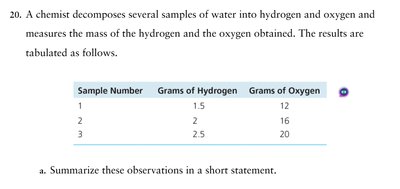
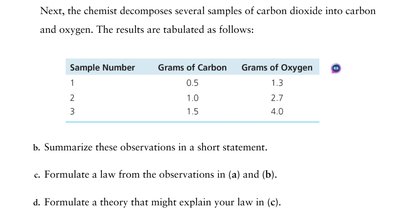
Q20. Summarize the observations from the decomposition of water and carbon dioxide, and formulate a law and a theory.
Background
Topic: Law of Definite Proportions and Scientific Reasoning
This question tests your ability to interpret experimental data, summarize observations, and formulate scientific laws and theories based on evidence.
Key Terms and Formulas:
Law of Definite Proportions: A chemical compound always contains the same proportion of elements by mass.
Ratio: The mass ratio of elements in a compound.
Step-by-Step Guidance
Examine the tables and note the mass of each element in each sample.
Calculate the ratio of hydrogen to oxygen in water and carbon to oxygen in carbon dioxide for each sample.
Summarize the pattern you observe in a short statement for each compound.
Use the summarized observations to formulate a law that describes the relationship between the elements in each compound.
Think about a theory that could explain why these ratios are consistent, but stop before writing the final law or theory.
Try solving on your own before revealing the answer!
Final Answer:
a. Water always decomposes into hydrogen and oxygen in a fixed mass ratio.
b. Carbon dioxide always decomposes into carbon and oxygen in a fixed mass ratio.
c. Law: The mass ratio of elements in a compound is always constant (Law of Definite Proportions).
d. Theory: Atoms combine in specific ratios to form compounds, explaining the constant mass ratios.
The data supports the law of definite proportions, and atomic theory explains why these ratios are observed.
Q32. Express each number in scientific notation.
Background
Topic: Scientific Notation
This question tests your ability to convert large numbers into scientific notation, which is commonly used in chemistry to express very large or small values.
Key Terms and Formulas:
Scientific Notation: A way of expressing numbers as a product of a coefficient and a power of ten:
Step-by-Step Guidance
Identify the number you need to convert.
Move the decimal point so that only one nonzero digit remains to the left of the decimal.
Count how many places you moved the decimal; this determines the exponent.
Write the number in the form , but stop before calculating the final scientific notation for each.
Try solving on your own before revealing the answer!
Final Answer:
a.
b.
c.
d.
Each number is written as a coefficient times a power of ten, making it easier to handle large values.
Q34. Express each number in scientific notation.
Background
Topic: Scientific Notation for Small Numbers
This question tests your ability to convert very small numbers into scientific notation, which is essential for measurements in chemistry.
Key Terms and Formulas:
Scientific Notation: where is negative for small numbers.
Step-by-Step Guidance
Identify the number to convert.
Move the decimal point so that only one nonzero digit remains to the left of the decimal.
Count the number of places moved; this will be a negative exponent.
Write the number in scientific notation, but stop before writing the final form for each.
Try solving on your own before revealing the answer!
Final Answer:
a.
b.
c.
d.
Small numbers are written with negative exponents in scientific notation.
Q36. Express each number in decimal notation (i.e., without scientific notation).
Background
Topic: Decimal Notation
This question tests your ability to convert numbers from scientific notation to standard decimal form.
Key Terms and Formulas:
Decimal Notation: Writing numbers without exponents, using standard digits.
Step-by-Step Guidance
Identify the coefficient and exponent in each scientific notation.
Move the decimal point to the right for positive exponents, or to the left for negative exponents.
Write the number in standard decimal form, but stop before writing the final decimal value for each.
Try solving on your own before revealing the answer!
Final Answer:
a. m
b. years
c. years
d. $50$ years
Decimal notation is useful for everyday numbers and avoids exponents.
Q44. For each measured quantity, underline the zeros that are significant and draw an X through the zeros that are not.
Background
Topic: Significant Figures
This question tests your understanding of which zeros in a measured quantity are significant and which are not, a key concept in chemistry measurements.
Key Terms:
Significant Figures: Digits in a measurement that are known with certainty plus one estimated digit.
Leading Zeros: Zeros before the first nonzero digit; not significant.
Trailing Zeros: Zeros at the end of a number; significant if after a decimal point.
Captive Zeros: Zeros between nonzero digits; always significant.
Step-by-Step Guidance
Identify the type of zeros in each number (leading, trailing, captive).
Underline zeros that are significant based on their position.
Draw an X through zeros that are not significant (e.g., leading zeros).
Apply these rules to each number, but stop before marking the zeros in the final answer.
Try solving on your own before revealing the answer!
Final Answer:
a. s (leading zeros not significant, trailing zero after decimal is significant)
b. kg (all zeros between nonzero digits are significant)
c. in. (leading zeros not significant, trailing zero after decimal is significant)
d. m (leading zeros not significant, all others are significant)
Significant figures are important for precision in scientific measurements.
Q50. Round each number to three significant figures.
Background
Topic: Rounding and Significant Figures
This question tests your ability to round numbers to a specified number of significant figures, which is important for reporting scientific data.
Key Terms:
Rounding: Adjusting a number to a specified number of significant digits.
Significant Figures: The digits that carry meaning in a measurement.
Step-by-Step Guidance
Identify the first three significant digits in each number.
Look at the digit immediately after the third significant figure to determine if you round up or down.
Apply rounding rules, but stop before writing the rounded value for each number.
Try solving on your own before revealing the answer!
Final Answer:
a.
b.
c.
d.
Rounding to three significant figures ensures consistency and clarity in scientific reporting.
Q58. Perform each calculation to the correct number of significant figures.
Background
Topic: Significant Figures in Calculations
This question tests your ability to apply rules for significant figures when performing mathematical operations in chemistry.
Key Terms and Formulas:
Multiplication/Division: The result should have the same number of significant figures as the measurement with the fewest significant figures.
Addition/Subtraction: The result should have the same number of decimal places as the measurement with the fewest decimal places.
Step-by-Step Guidance
Identify the number of significant figures in each value used in the calculation.
Perform the calculation as written.
Apply the significant figure rules to the result, but stop before writing the final rounded value.
Try solving on your own before revealing the answer!
Final Answer:
a. (rounded to 2 significant figures)
b. (rounded to 2 significant figures)
c. (rounded to 2 significant figures)
d. (rounded to 3 significant figures)
Always round your final answer to the correct number of significant figures based on the calculation type.
Q62. Perform each calculation to the correct number of significant figures.
Background
Topic: Significant Figures in Addition and Subtraction
This question tests your ability to apply significant figure rules to addition and subtraction calculations.
Key Terms and Formulas:
Addition/Subtraction Rule: The result should have the same number of decimal places as the measurement with the fewest decimal places.
Step-by-Step Guidance
Identify the number of decimal places in each value used in the calculation.
Perform the calculation as written.
Round the result to match the measurement with the fewest decimal places, but stop before writing the final rounded value.
Try solving on your own before revealing the answer!
Final Answer:
a. (rounded to 1 decimal place)
b. (rounded to 3 decimal places)
c. (rounded to the nearest whole number)
d. (rounded to 1 decimal place)
For addition and subtraction, match the decimal places of the least precise measurement.
Q74. Perform each conversion.
Background
Topic: Unit Conversions
This question tests your ability to convert between different units of measurement, a fundamental skill in chemistry.
Key Terms and Formulas:
Conversion Factor: A ratio used to convert from one unit to another.
Common conversion factors:
1 inch = 2.54 cm
1 yard = 0.9144 meters
1 foot = 30.48 cm
1 inch = 25.4 mm
Step-by-Step Guidance
Identify the starting unit and the target unit for each conversion.
Write the appropriate conversion factor as a fraction.
Set up the calculation so that the starting unit cancels, leaving the target unit.
Multiply and solve, but stop before calculating the final converted value.
Try solving on your own before revealing the answer!
Final Answer:
a.
b.
c.
d.
Unit conversions are essential for comparing and calculating measurements in chemistry.
Q84. A cyclist rides at an average speed of 24 mi/h. If the cyclist wants to bike 195 km, how long (in hours) must they ride?
Background
Topic: Speed, Distance, and Time Calculations
This question tests your ability to use the relationship between speed, distance, and time, and to convert units as needed.
Key Terms and Formulas:
Speed Formula:
Time Formula:
Conversion factor:
Step-by-Step Guidance
Identify the distance to be traveled (195 km) and the speed (24 mi/h).
Convert the speed from mi/h to km/h using the conversion factor.
Use the time formula to set up the calculation: .
Plug in the values, but stop before calculating the final time in hours.
Try solving on your own before revealing the answer!
Final Answer:
The cyclist must ride for about 5.05 hours to cover 195 km at 24 mi/h.
