 뒤로
뒤로Introductory Chemistry I (CHM 101) - Syllabus and Course Structure Study Guide
스터디 가이드 - 스마트 노트
 자료에 맞춘 맞춤형 노트, 핵심 정의, 예시, 맥락을 확장해 제공합니다.
Course Overview
This study guide summarizes the structure, objectives, and assessment methods for the Introductory Chemistry I (CHM 101) course at Northern Virginia Community College, Manassas Campus. The course is designed for non-science majors and covers foundational concepts in general, inorganic, organic, and biological chemistry, with an emphasis on both theoretical and experimental aspects.
Course Description and Purpose
Course Title: Hybrid CHM-101 (4 credits)
Format: Hybrid (in-person lectures and online assignments)
Purpose: To provide a general background in chemistry, preparing students for further study or to fulfill general education requirements.
Target Audience: Non-science majors and students needing a chemistry foundation.
Course Objectives
Upon successful completion of this course, students should be able to:
Define and apply basic chemistry terminology.
Balance simple chemical equations.
Apply principles of the scientific method and measurement.
Use chemical symbols, formulas, and nomenclature correctly.
Perform simple stoichiometric calculations.
Explain atomic structure and predict periodic trends.
Solve basic gas law problems.
Determine bonding types, molecular shapes, and polarity.
Calculate solution concentration and pH.
Relate concentration and temperature to reaction rates.
Discuss the effects of air and water pollution on the environment.
Course Structure and Schedule
The course is organized by chapters, each focusing on a core topic in introductory chemistry. The schedule includes in-person meetings, online readings, video quizzes, homework, and exams. Students are expected to engage in both individual and group assignments.
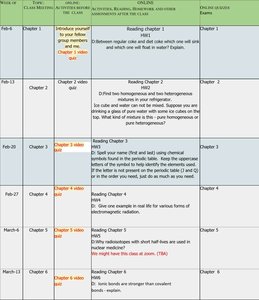
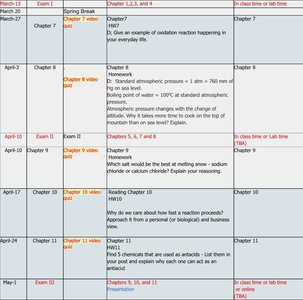
Sample Weekly Structure
In-Class Activities: Lectures, discussions, and group work.
Online Assignments: Chapter readings, video quizzes, homework, and discussion board participation.
Assessment: Online quizzes, exams, research project, and laboratory work.
Assessment and Grading
Student performance is evaluated through a combination of attendance, homework, quizzes, exams, laboratory reports, and a research project. The grading breakdown is as follows:
Assessment | Percentage |
|---|---|
Attendance | 1% |
Homework & Discussion Board | 6% |
Pre-lecture Assignments (Video Quizzes) | 3% |
Online Quizzes | 15% |
Exams | 25% |
Comprehensive Final Exam | 20% |
Research Project | 5% |
Lab | 25% |
Grading Scale:
Grade | Percentage Range |
|---|---|
A | 90.0–100.0 |
B | 80.0–89.9 |
C | 70.0–79.9 |
D | 60.0–69.9 |
F | 59.9 and below |
Course Topics by Chapter
Chapter 1: The Chemical World
Chapter 2: Measurement and Problem Solving
Chapter 3: Matter and Energy
Chapter 4: Atoms and Elements
Chapter 5: Molecules and Compounds
Chapter 6: Chemical Composition
Chapter 7: Chemical Reactions
Chapter 8: Quantities in Chemical Reactions
Chapter 9: Electrons in Atoms and the Periodic Table
Chapter 10: Chemical Bonding
Chapter 11: Gases
Additional topics include solutions, acids and bases, chemical equilibrium, oxidation and reduction, and radioactivity, as indicated by the comprehensive final exam covering all chapters.
Course Policies and Expectations
Attendance: Mandatory for in-person sessions; excessive absences may result in course failure.
Participation: Active participation in discussions and group work is required.
Assignments: Must be submitted on time; late work incurs penalties.
Technology: Students must have access to a computer with internet, webcam, and basic office software.
Exams: No make-up exams; final exam is comprehensive and mandatory.
Study and Success Tips
Read textbook chapters and review PowerPoints before class meetings.
Complete all practice problems and assignments on Canvas.
Participate actively in group discussions and online forums.
Prepare for quizzes and exams by reviewing key concepts and practicing calculations.
Contact the instructor for clarification or help as needed.
Key Definitions and Concepts
Stoichiometry: The calculation of reactants and products in chemical reactions.
Atomic Structure: The arrangement of protons, neutrons, and electrons in an atom.
Chemical Bonding: The interactions that hold atoms together in compounds (ionic, covalent, metallic bonds).
Gas Laws: Mathematical relationships describing the behavior of gases (e.g., Boyle's Law, Charles's Law).
Solution Concentration: The amount of solute dissolved in a given quantity of solvent, often expressed as molarity ().
pH: A measure of the acidity or basicity of a solution ().
Example: Balancing a Chemical Equation
To balance the reaction of hydrogen and oxygen forming water:
This equation shows that two molecules of hydrogen gas react with one molecule of oxygen gas to produce two molecules of water.
Example: Calculating Molarity
If 0.5 moles of NaCl are dissolved in 1.0 L of water, the molarity is:
Additional Info
Students are encouraged to use the Canvas platform regularly for updates and assignment submissions.
Laboratory sessions are an integral part of the course and contribute significantly to the final grade.
