 뒤로
뒤로Liquids and Solids: Properties, Boiling Point, and Vapor Pressure
스터디 가이드 - 스마트 노트
 자료에 맞춘 맞춤형 노트, 핵심 정의, 예시, 맥락을 확장해 제공합니다.
Liquids and Solids
Properties of Liquids
Liquids possess unique physical properties that distinguish them from solids and gases. Understanding these properties is essential for predicting the behavior of liquids in various chemical and physical processes.
No definite shape, definite volume: Liquids take the shape of their container but maintain a constant volume.
Non-compressible: Liquids cannot be compressed easily due to closely packed particles.
Particles loosely arranged: The particles in a liquid are less tightly packed than in solids, allowing movement.
Fluidity: Liquid particles can flow freely, making liquids fluids.
Diffusion: Liquids can undergo diffusion, though more slowly than gases.
Intermolecular forces: Liquids have intermolecular forces of attraction, which influence their properties.
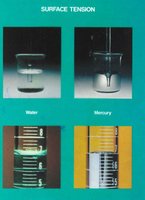
Surface tension: Liquids usually exhibit surface tension, a result of stronger forces of attraction between molecules at the surface.
Physical Properties of Water
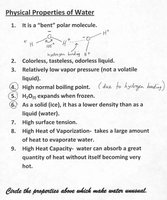
Water is an exceptional liquid with several unusual physical properties due to its molecular structure and hydrogen bonding.
Bent polar molecule: Water has a bent shape, making it a polar molecule.
Colorless, tasteless, odorless liquid: Pure water lacks color, taste, and odor.
Relatively low vapor pressure: Water is not a volatile liquid.
High normal boiling point: Water boils at a relatively high temperature due to hydrogen bonding.
Expansion upon freezing: Water expands when frozen, making ice less dense than liquid water.
Lower density as a solid: Ice floats on water because it is less dense.
High surface tension: Water molecules at the surface experience strong cohesive forces.
High heat of vaporization: Water requires a large amount of heat to evaporate.
High heat capacity: Water can absorb a significant amount of heat without a large temperature increase.
Viscosity
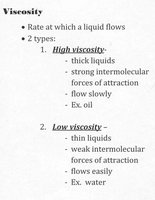
Viscosity is the measure of a liquid's resistance to flow. It depends on the strength of intermolecular forces and the structure of the liquid's molecules.
High viscosity: Thick liquids with strong intermolecular forces (e.g., oil) flow slowly.
Low viscosity: Thin liquids with weak intermolecular forces (e.g., water) flow easily.
Volatility
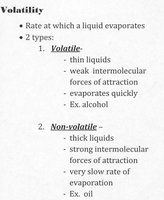
Volatility describes how readily a liquid evaporates. It is closely related to the strength of intermolecular forces within the liquid.
Volatile liquids: Thin liquids with weak intermolecular forces (e.g., alcohol) evaporate quickly.
Non-volatile liquids: Thick liquids with strong intermolecular forces (e.g., oil) evaporate slowly.
Vapor and Vapor Pressure
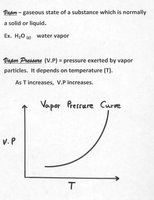
Vapor refers to the gaseous state of a substance that is normally a liquid or solid at room temperature. Vapor pressure is the pressure exerted by vapor particles above a liquid in a closed system and depends on temperature.
Vapor pressure increases with temperature: As temperature rises, more molecules escape into the vapor phase, increasing vapor pressure.
Boiling Point
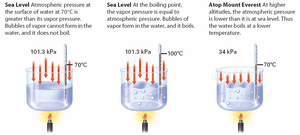
The boiling point is the temperature at which the vapor pressure of a liquid equals the external pressure. At this point, bubbles of vapor form throughout the liquid, and it begins to boil.
Normal boiling point: The boiling point at a standard pressure of 101.3 kPa (1 atm).
Boiling point varies with pressure: At lower external pressures, the boiling point decreases; at higher pressures, it increases.
Temperature vs. Vapor Pressure Curves
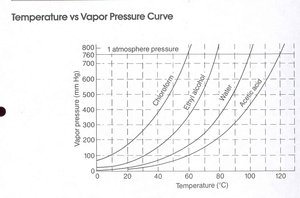
Temperature vs. vapor pressure curves illustrate how the vapor pressure of different liquids changes with temperature. These curves are useful for comparing the volatility and boiling points of various substances.
Substances with higher boiling points: Have stronger intermolecular forces and lower vapor pressures at a given temperature.
Examples: Ethyl alcohol, acetic acid, and chloroform each have distinct curves, indicating their unique boiling points and vapor pressures.
Key Relationships and Examples
Boiling point and intermolecular forces: The higher the normal boiling point, the stronger the intermolecular forces in the liquid.
Example calculations:
Ethyl alcohol boils at 70°C at 500 mmHg.
Acetic acid boils at 80°C at 200 mmHg.
Chloroform's normal boiling point is 60°C.
Summary Table: Properties of Liquids and Water
Property | Liquids (General) | Water (Specific) |
|---|---|---|
Shape & Volume | No definite shape, definite volume | No definite shape, definite volume |
Compressibility | Non-compressible | Non-compressible |
Intermolecular Forces | Present, varies by liquid | Strong (hydrogen bonding) |
Surface Tension | Usually present | High |
Boiling Point | Varies | High (100°C at 1 atm) |
Density (solid vs. liquid) | Usually solid > liquid | Ice (solid) < liquid water |
