 뒤로
뒤로Measurement and Problem Solving: Study Notes for Introductory Chemistry
스터디 가이드 - 스마트 노트
 자료에 맞춘 맞춤형 노트, 핵심 정의, 예시, 맥락을 확장해 제공합니다.
Measurement and Problem Solving
Scientific Notation
Scientific notation is a method used to express very large or very small numbers in a concise format. It consists of two parts: a decimal part (between 1 and 10) and an exponential part (10 raised to an exponent).
Decimal Part: A number between 1 and 10.
Exponential Part: 10n, where n is an integer.
Positive Exponent: Indicates multiplication by 10 n times.
Negative Exponent: Indicates division by 10 n times.
Conversion Steps:
Move the decimal point to obtain a number between 1 and 10.
Multiply by 10 raised to the power reflecting the number of decimal places moved.
If moved left, exponent is positive; if moved right, exponent is negative.
Example: 0.00045 = 4.5 × 10⁻⁴
Significant Figures
Significant figures reflect the precision of a measurement. The rules for identifying significant figures are essential for reporting and calculating scientific data accurately.
All nonzero digits are significant.
Interior zeros (between nonzero digits) are significant.
Trailing zeros after a decimal point are significant.
Trailing zeros before a decimal point are significant.
Leading zeros (before the first nonzero digit) are not significant.
Trailing zeros before an implied decimal point are ambiguous and should be avoided.
Unlimited significant figures: Counting numbers and defined quantities (e.g., 100 apples).
Significant Figures in Calculations
When performing calculations, the number of significant figures in the result depends on the operation:
Multiplication/Division: The result has the same number of significant figures as the factor with the fewest significant figures.
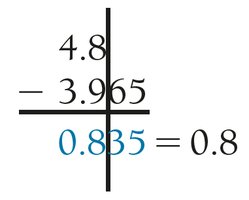
Addition/Subtraction: The result has the same number of decimal places as the quantity with the fewest decimal places.
Rounding: Round only the final answer, not intermediate steps. If the last digit dropped is 4 or less, round down; if 5 or more, round up.
Example: 2.33 rounds to 2.3 (two significant figures); 2.37 rounds to 2.4.
Example of Addition/Subtraction Rule:
4.8 - 3.965 = 0.835, rounded to one decimal place (0.8) because 4.8 has one decimal place.
Combined Calculations
For calculations involving both multiplication/division and addition/subtraction:
Perform steps in parentheses first.
Determine significant figures for intermediate answers without rounding.
Complete remaining steps and round only the final answer.
Basic Units of Measurement
The International System of Units (SI) is the standard for scientific measurements. The main SI base units are:
Length: Meter (m) – defined as the distance light travels in vacuum in 1/299,792,458 seconds.
Mass: Kilogram (kg) – defined using Planck’s constant.
Time: Second (s) – defined by the frequency of radiation from cesium-133 atoms.
Weight vs. Mass
Mass is the measure of the amount of matter in an object, while weight is the measure of the gravitational pull on that matter. Mass is constant; weight depends on gravity.
SI Prefix Multipliers
SI prefixes are used to express units in convenient sizes. For example, a picometer (pm) is suitable for measuring chemical bonds (~120 pm).
Volume as a Derived Unit
Volume is a derived unit, calculated by cubing a unit of length. Common units include cubic meters (m3), cubic centimeters (cm3), and cubic millimeters (mm3).
Problem-Solving and Unit Conversions
Many chemistry problems involve converting units or applying specific equations. Dimensional analysis is a systematic method for solving these problems.
Dimensional Analysis: Treat units as algebraic quantities, multiplying, dividing, and canceling them logically.
Conversion Factors: Constructed from equivalent quantities (e.g., 1 in = 2.54 cm).
Solution Map: Diagram the steps required to convert from one unit to another.
General Problem-Solving Strategy
Sort: Organize the information given.
Strategize: Create a solution map.
Solve: Perform calculations, paying attention to significant figures.
Check: Ensure the answer makes physical sense and units are correct.
Solving Multistep Unit Conversion Problems
Each step should use a conversion factor with the previous unit in the denominator and the next unit in the numerator. Round the final answer to the correct number of significant figures.
Unit Conversion in Both Numerator and Denominator
Some problems require converting units in both the numerator and denominator (e.g., mi/gal to km/L).
Converting Units Raised to a Power
When converting units raised to a power, the conversion factor must also be raised to that power (e.g., cm3 to mL).
Physical Property: Density
Density is the ratio of mass to volume and is a key property for distinguishing substances. It is calculated as:
Formula:
Example: A liquid with a mass of 27.2 g and a volume of 22.5 mL has a density of
Density as a Conversion Factor
Density can be used to convert between mass and volume. For example, to find the volume needed to deliver a certain mass, use the density as a conversion factor.
Solution Map: Mass (g) → Volume (cm3) → Volume (mL)
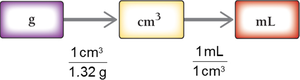
Example: To obtain 68.4 g of a liquid with density 1.32 g/cm3, measure 51.8 mL.
Densities of Common Substances
Reference tables provide densities for common substances, which are useful for solving problems involving mass and volume conversions.
Additional info: SI Prefix Multipliers and density tables are referenced but not fully reproduced due to incomplete data in the source.
