 뒤로
뒤로Measurement, Significant Figures, Metric Conversions, and Density in Chemistry
스터디 가이드 - 스마트 노트
 자료에 맞춘 맞춤형 노트, 핵심 정의, 예시, 맥락을 확장해 제공합니다.
Measurement and Problem Solving
Scientific Notation
Scientific notation is a method used in chemistry to express very large or very small numbers in a concise and manageable form. This is essential for dealing with the vast range of quantities encountered in chemical measurements.
Definition: Scientific notation expresses numbers as a product of a coefficient (between 1 and 10) and a power of ten.
Example:
Application: Used for atomic and molecular scales, such as the mass of an electron or Avogadro's number.
Key Steps:
Move the decimal point to create a coefficient between 1 and 10.
Count the number of places moved; this becomes the exponent of 10.
If the decimal is moved to the left, the exponent is positive; if to the right, it is negative.
Example:
Standard Notation
Standard notation is the regular way of writing numbers without exponents. Converting between scientific and standard notation is a fundamental skill in chemistry calculations.
Example:
Uncertainty in Measurement
Significant Figures
Significant figures (sig figs) reflect the precision of a measured or calculated quantity. Every measurement contains some uncertainty, and significant figures communicate this uncertainty.
Definition: The digits in a measurement that are known with certainty plus one estimated digit.
Example: Measuring a length as 2.35 cm means 2 and 3 are certain, 5 is estimated.
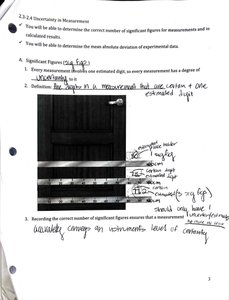
Rules for Determining Significant Figures
Nonzero digits are always significant.
Zeros between nonzero digits are significant.
Leading zeros are not significant.
Trailing zeros are significant only if there is a decimal point.
Examples:
0.0045 (2 sig figs)
100.0 (4 sig figs)
1200 (2 sig figs unless specified otherwise)
Rounding Calculated Answers
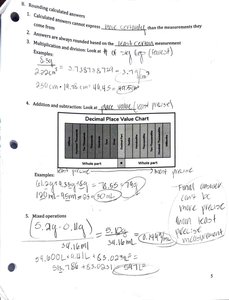
Calculated answers cannot be more certain than the measurements used.
For multiplication and division, the answer should have the same number of significant figures as the measurement with the fewest sig figs.
For addition and subtraction, the answer should have the same number of decimal places as the measurement with the fewest decimal places.
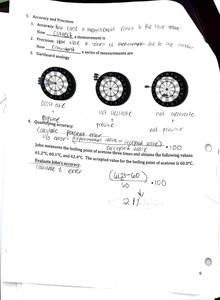
Accuracy and Precision
Accuracy and precision are two important concepts in measurement:
Accuracy: How close a measurement is to the true or accepted value.
Precision: How close a series of measurements are to each other.
Example: Hitting the bullseye on a dartboard is accurate; grouping darts closely together is precise.
Quantifying Precision: Mean Absolute Deviation (MAD)
The mean absolute deviation is used to quantify the precision of a set of measurements.
Formula:
Where is each measurement, is the mean, and is the number of measurements.
Determination | Measured Mass (g) |
|---|---|
1 | 9.983 |
2 | 9.985 |
3 | 9.980 |
4 | 9.980 |
Example Calculation: Calculate the mean, then the average of the absolute deviations from the mean.
Metric and Non-Metric Conversions
Conversion Factors
Conversion factors are ratios used to express measurements in different units. Dimensional analysis is a systematic approach to solving conversion problems using these factors.
Example:
Dimensional Analysis: Multiply by conversion factors so units cancel appropriately.
Unit | Equivalent |
|---|---|
1 in | 2.54 cm |
1 lb | 454 g |
1 qt | 0.946 L |
1 mi | 1.609 km |
Metric Units and Prefixes
The metric system uses base units and prefixes to indicate multiples or fractions of these units.
Prefix | Meaning | Example |
|---|---|---|
giga (G) | ||
mega (M) | ||
kilo (k) | ||
centi (c) | ||
milli (m) | ||
micro (\mu) | ||
nano (n) |
SI Base Units
Quantity | Metric/SI Base Unit | English Equivalent |
|---|---|---|
Length | meter (m) | 1.09 yd |
Volume | liter (L) | 1.06 qt |
Mass | gram (g) | 0.0022 lb |
Temperature | Kelvin (K), Celsius (°C) | -- |
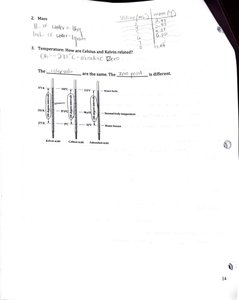
Temperature: Celsius and Kelvin
The Celsius and Kelvin scales are commonly used in chemistry. The size of one degree is the same, but the zero point is different.
Conversion:
Water freezes at: or
Water boils at: or
Density
Definition and Calculation
Density is a physical property defined as the mass of a substance per unit volume. It is used to identify substances and predict whether they will float or sink in a fluid.
Formula:
Units: Commonly expressed in or
Example Calculation: If a substance has a mass of 7.9 g and a volume of 0.69 cm3, its density is:
This value is characteristic of lead.
Applications of Density
Used to identify unknown substances.
Determines whether an object will float or sink in water (objects with density less than water float).
Summary Table: Key Concepts
Concept | Definition | Example |
|---|---|---|
Scientific Notation | Expressing numbers as a coefficient and power of ten | |
Significant Figures | Digits that reflect measurement precision | 0.00450 (3 sig figs) |
Accuracy | Closeness to true value | Measured value = accepted value |
Precision | Closeness of repeated measurements | Values are consistent |
Density | Mass per unit volume |
Additional info: These notes cover foundational measurement and calculation skills essential for all subsequent chemistry topics, including chemical reactions, stoichiometry, and solution preparation.
