 뒤로
뒤로Nuclear Chemistry: Radioactivity, Nuclear Reactions, and Radioactive Decay
스터디 가이드 - 스마트 노트
 자료에 맞춘 맞춤형 노트, 핵심 정의, 예시, 맥락을 확장해 제공합니다.
Nuclear Chemistry
Nuclear Reactions and Their Characteristics
Nuclear chemistry focuses on changes in the nucleus of atoms, which can result in the transformation of one element into another. These changes are fundamentally different from chemical reactions, which involve only the rearrangement of electrons and do not alter the identity of the elements involved.
Nuclear Reaction: A process that changes the composition of an atom's nucleus, often producing a different element.
Chemical Reaction: Involves only the rearrangement of electrons; the nuclei of atoms remain unchanged.
Isotopes: Different isotopes of an element behave similarly in chemical reactions but can behave very differently in nuclear reactions.
Energy Change: The energy change in a nuclear reaction is much greater than in a chemical reaction.
Radioactivity
Types of Radioactive Decay
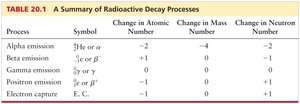
Radioactive decay is the spontaneous transformation of an unstable atomic nucleus into a more stable one, accompanied by the emission of particles or electromagnetic radiation. The main types of radioactive decay are summarized below:
Process | Symbol | Change in Atomic Number | Change in Mass Number | Change in Neutron Number |
|---|---|---|---|---|
Alpha emission | or | -2 | -4 | -2 |
Beta emission | or | +1 | 0 | -1 |
Gamma emission | or | 0 | 0 | 0 |
Positron emission | or | -1 | 0 | +1 |
Electron capture | E.C. | -1 | 0 | +1 |
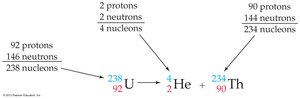
Example: Alpha decay of uranium-238:
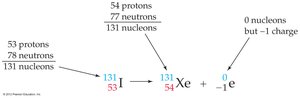
Example: Beta decay of iodine-131:
Balancing Nuclear Reactions
When writing nuclear equations, both the total number of nucleons (protons + neutrons) and the total charge (atomic number) must be conserved. This means that the sum of the mass numbers and the sum of the atomic numbers on both sides of the equation must be equal.
Mass Number (A): Total number of protons and neutrons in the nucleus.
Atomic Number (Z): Number of protons in the nucleus.
Balancing Rule: and
Radioactive Decay Rates
First Order Kinetics of Radioactive Decay
Radioactive decay follows first-order kinetics, meaning the rate of decay is proportional to the number of radioactive nuclei present. The decay rate can be described by the following equations:
First Order Rate Law: , where is the decay constant and is the number of radioactive nuclei.
Integrated Rate Law: , where is the initial number of nuclei and is time.
Half-life (): The time required for half of the radioactive nuclei to decay.
Example: The decay constant for sodium-24 is . The half-life is calculated as:
Example: To find the percentage of sodium-24 remaining after a certain time, use:
Applications: Radiocarbon Dating
Radioactive decay rates are used to date ancient materials, such as archaeological artifacts and fossils. Radiocarbon dating relies on the decay of carbon-14, which is incorporated into living organisms. After death, the carbon-14 decays at a known rate, allowing scientists to estimate the age of the sample.
Principle: Living organisms maintain a constant ratio of carbon-14 to carbon-12. After death, no new carbon-14 is absorbed, and the existing carbon-14 decays.
Application: Used to date materials that were once part of living organisms, such as wood, bone, or parchment.

Example: The Dead Sea Scrolls and other ancient manuscripts have been dated using radiocarbon dating techniques.
