 뒤로
뒤로Liberal Arts Math Study Guide: Sets, Scientific Notation, Unit Analysis, and the Real Number System
스터디 가이드 - 스마트 노트
 자료에 맞춘 맞춤형 노트, 핵심 정의, 예시, 맥락을 확장해 제공합니다.
Sets and Set Relationships
Definition of a Set
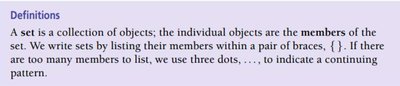
A set is a collection of objects; the individual objects are called members of the set. Sets are written by listing their members within a pair of braces, { }. If there are too many members to list, three dots, ... , are used to indicate a continuing pattern.
Set Relationships and Venn Diagrams
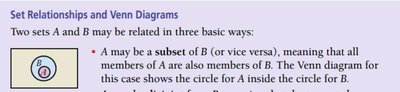
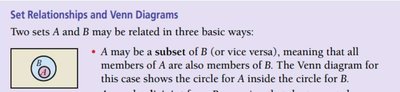
Two sets, A and B, may be related in three basic ways:
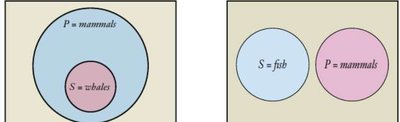
Subset: A may be a subset of B (or vice versa), meaning all members of A are also members of B. The Venn diagram for this case shows the circle for A inside the circle for B.
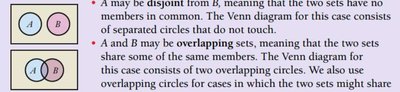
Disjoint: A may be disjoint from B, meaning the two sets have no members in common. The Venn diagram consists of separated circles that do not touch.
Overlapping: A and B may be overlapping sets, meaning the sets share some of the same members. The Venn diagram consists of two overlapping circles.
Venn Diagrams in Practice
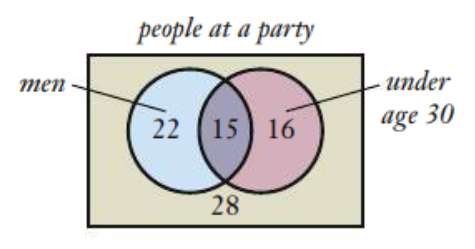
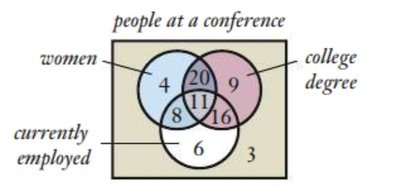
Venn diagrams are used to visually represent relationships between sets and to solve problems involving sets, such as counting members in overlapping groups.
The Real Number System
Classification of Numbers
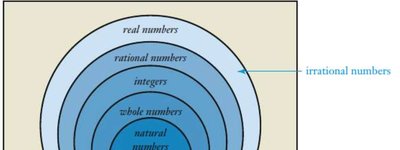
The real number system is organized into several subsets:
Natural numbers: Counting numbers (1, 2, 3, ...)
Whole numbers: Natural numbers plus zero (0, 1, 2, ...)
Integers: Whole numbers and their negatives (..., -2, -1, 0, 1, 2, ...)
Rational numbers: Numbers that can be written as a fraction of two integers
Irrational numbers: Numbers that cannot be written as a fraction (e.g., π, √2)
Real numbers: All rational and irrational numbers

Scientific Notation and Order of Magnitude
Definition of Scientific Notation
Scientific notation is a format in which a number is expressed as a number between 1 and 10 multiplied by a power of 10.

Order of Magnitude
An order of magnitude estimate specifies only a broad range of values, usually within one or two powers of ten, such as "in the ten thousands" or "in the millions." This is useful for making rough estimates and comparisons.

Examples and Applications
To convert 0.0000000346 to scientific notation: Move the decimal point so the number is between 1 and 10, then count the number of places moved.
To calculate without a calculator:
Divide the coefficients:
Subtract the exponents:
Final answer:
Energy Comparisons in Scientific Notation
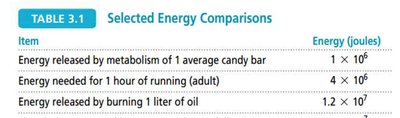
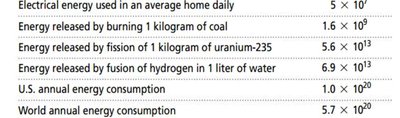
Scientific notation is commonly used to express large quantities, such as energy values. The following table compares selected energy values:
Item | Energy (joules) |
|---|---|
Energy released by metabolism of 1 average candy bar | |
Energy needed for 1 hour of running (adult) | |
Energy released by burning 1 liter of oil | |
Electrical energy used in an average home daily | |
Energy released by burning 1 kilogram of coal | |
Energy released by fission of 1 kilogram of uranium-235 | |
Energy released by fusion of hydrogen in 1 liter of water | |
U.S. annual energy consumption | |
World annual energy consumption |
Unit Analysis and Measurement Systems
Definition of Unit Analysis
The units of a quantity describe what that quantity measures or counts. Unit analysis is the process of working with units to help solve problems.
Summary of Unit Analysis
You generally cannot add or subtract numbers with different units, but you can combine different units through multiplication, division, or raising to powers.
Always perform all operations on both the numbers and their associated units.
When you complete your calculations, make sure your answer has the units you expected. If it doesn't, you've done something wrong.

Key Words and Operations in Unit Analysis
Key Word or Symbol | Operation | Example |
|---|---|---|
per | Division | Read miles ÷ hours as "miles per hour" |
of or hyphen | Multiplication | Read kilowatts × hours as "kilowatt-hours" |
square | Raising to second power | Read ft × ft, or ft2, as "square feet" |
cube or cubic | Raising to third power | Read ft × ft × ft, or ft3, as "cubic feet" |
Measurement Systems and Conversions
Common measurement systems include the U.S. customary system and the metric system. Conversion between units is essential for solving real-world problems.
1 foot = 12 inches
1 yard = 3 feet
1 inch = 2.54 centimeters
1 kilogram = 2.2046 pounds
1 liter = 0.2642 gallons
Area and Volume Conversions
When converting area or volume, remember to square or cube the conversion factor, respectively. For example, 1 square yard contains 9 square feet.
Metric Prefixes
Metric prefixes are used to indicate multiples or fractions of units. For example, 'kilo-' means 1,000 times, and 'centi-' means one hundredth.
Prefix | Abbreviation | Value |
|---|---|---|
deci- | d | (one-tenth) |
deca- | da | (ten) |

Logic and Categorical Propositions
The Four Standard Categorical Propositions
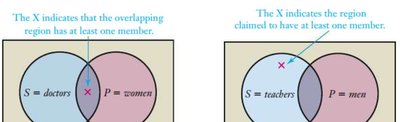
Categorical propositions are statements about the relationship between two sets. The four standard forms are:
Form | Example | Subject Set (S) | Predicate Set (P) |
|---|---|---|---|
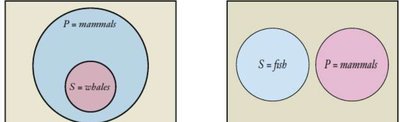
All S are P | All whales are mammals | whales | mammals |
No S are P | No fish are mammals | fish | mammals |
Some S are P | Some doctors are women | doctors | women |
Some S are not P | Some teachers are not men | teachers | men |
Venn Diagrams for Categorical Propositions
Venn diagrams visually represent categorical propositions. For example, 'All S are P' is shown with S inside P, while 'No S are P' is shown with separate circles.


Unit Analysis in Practice
Examples of Unit Analysis
To convert 1 cubic foot to cubic inches:
To convert 25 kilograms to pounds:
To convert 10 square meters to square feet:
Summary
This study guide covers foundational concepts in sets, scientific notation, unit analysis, and the real number system, all of which are essential for Liberal Arts Math. Understanding these topics will help you solve problems involving classification, measurement, and logical reasoning.
