Skip to main content
Macroeconomics
나의 코스
배우기
시험 준비
AI 튜터
학습 가이드
플래시카드
탐험해 보세요
앱을 사용해 보세요
나의 코스
배우기
시험 준비
AI 튜터
학습 가이드
플래시카드
탐험해 보세요
앱을 사용해 보세요
뒤로
Dynamic AD-AS Model: Introduction quiz
카드를 뒤집기 위해 탭할 수 있습니다.
What are the two main unrealistic assumptions of the standard AD-AS model?
카드를 뒤집기 위해 탭할 수 있습니다.
👆
What are the two main unrealistic assumptions of the standard AD-AS model?
The standard AD-AS model assumes there is no long-run inflation and no long-run economic growth.
진행 상황 추적
컨트롤 버튼이 '내비게이션' 모드로 변경되었습니다.
1/15
관련 플래시카드
관련 실천
추천 영상
Dynamic AD-AS Model: Introduction definitions
Dynamic AD-AS Model: Introduction
15 용어
Dynamic AD-AS Model: Introduction
23. Dynamic AD/AS Model
10 문제점
주제
Dynamic AD-AS Model: Inflation and Recession
23. Dynamic AD/AS Model
10 문제점
주제
25. Dynamic AD/AS Model
4 주제
15 문제점
장
VideoThumbView.guidedCourse
04:59
Dynamic AD-AS Model: Introduction
238
views
7
rank
이 집합의 용어 (15)
하이드의 정의
What are the two main unrealistic assumptions of the standard AD-AS model?
The standard AD-AS model assumes there is no long-run inflation and no long-run economic growth.
Why does the standard AD-AS model struggle with long-term economic predictions?
Because it assumes economies return to the same equilibrium and ignores ongoing growth and inflation.
How does the standard AD-AS model incorrectly predict recessions?
It predicts that recessions are often accompanied by falling prices, which rarely happens in reality.
What is the main improvement of the dynamic AD-AS model over the standard model?
The dynamic model allows all curves to shift over time, reflecting real-world changes in the economy.
Why is the dynamic AD-AS model called 'dynamic'?
Because it allows the aggregate demand, short-run aggregate supply, and long-run aggregate supply curves to change over time.
What does the long-run aggregate supply (LRAS) curve represent?
It represents the potential GDP of the economy if it is operating at full employment.
Why does the LRAS curve shift to the right over time in the dynamic model?
Because population growth and technological improvements increase the economy's productive capacity.
What causes the short-run aggregate supply (SRAS) curve to shift to the right in the dynamic model?
The same factors as LRAS: population growth and technological advancements.
Why does the aggregate demand (AD) curve shift to the right each year in the dynamic model?
Because increases in population, income, and government spending boost overall demand.
How does economic growth affect aggregate demand in the dynamic AD-AS model?
Economic growth leads to higher consumption, investment, and government spending, shifting AD to the right.
What happens to the equilibrium in the dynamic AD-AS model each year?
A new equilibrium is reached with a higher potential GDP, reflecting economic growth.
In the dynamic AD-AS model, what typically happens to the price level if AD and AS shift at the same rate?
The price level remains roughly the same, indicating balanced growth.
What real-world economic phenomena does the dynamic AD-AS model better explain compared to the standard model?
It better explains ongoing inflation, long-term growth, and more realistic recession scenarios.
What will future lessons on the dynamic AD-AS model focus on?
They will explore recessions, inflation, and the effects of fiscal and monetary policies.
Why is it important for macroeconomic models to allow for shifting curves over time?
Because real economies experience growth and inflation, so static models fail to accurately reflect reality.
 뒤로뒤로
뒤로뒤로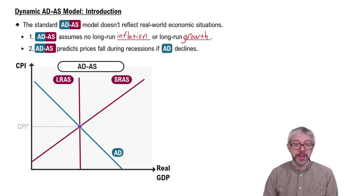
 04:59
04:59