 뒤로
뒤로Chapter 1: The Nature of Economics – Structured Study Notes
스터디 가이드 - 스마트 노트
 자료에 맞춘 맞춤형 노트, 핵심 정의, 예시, 맥락을 확장해 제공합니다.
The Nature of Economics
Introduction to Economics
Economics is the study of how individuals, businesses, and societies allocate limited resources to satisfy unlimited wants. It provides a framework for understanding decision-making processes and the consequences of those decisions in various contexts.
Key Point: Economics analyzes choices made due to scarcity of resources.
Key Point: The discipline is divided into microeconomics (individual and firm decisions) and macroeconomics (economy-wide phenomena).
Example: Decisions about marriage, education, and career are influenced by economic incentives and constraints.
Microeconomics vs. Macroeconomics
Microeconomics focuses on the behavior of individual households and firms, while macroeconomics examines aggregate outcomes such as national unemployment, inflation, and total output.
Microeconomics: Studies individual choices, e.g., a family's decision to buy a car.
Macroeconomics: Studies aggregate phenomena, e.g., the national unemployment rate.
Modern Theory: Blends micro and macro concepts for comprehensive analysis.
The Three Basic Economic Questions
Every economic system must answer three fundamental questions:
What and how much will be produced?
How will items be produced?
For whom will items be produced?
There are two main types of economic systems:
Centralized Command and Control: Decisions made by a central authority.
Price System (Market System): Decentralized decisions based on price signals.
Mixed Systems: Most nations combine elements of both systems.
Rational Self-Interest and Incentives
Economists assume individuals act in rational self-interest, responding predictably to incentives. Rationality means not intentionally making decisions that leave one worse off.
Positive Incentives: Rewards, such as higher income or gold stars.
Negative Incentives: Penalties or punishments, such as fines.
Example: The increased payoff for earning a college degree incentivizes more people to pursue higher education.
Economics as a Science
Economics is a social science that uses models to explain and predict real-world phenomena. Models are simplified representations that focus on essential relationships.
Assumptions: Models are based on specific circumstances.
Ceteris Paribus: The assumption that all other factors remain constant except those being studied.
Empirical Science: Real-world data is used to test models.
Behavioral Economics: Considers psychological limitations and bounded rationality.
Positive vs. Normative Economics
Economics distinguishes between positive (descriptive) and normative (value-based) statements.
Positive Economics: Describes what is, e.g., "If A, then B."
Normative Economics: Prescribes what ought to be, e.g., "The government should reduce unemployment."
Appendix A: Reading and Working with Graphs
Graphs are essential tools in economics for visualizing relationships between variables.
Independent Variable: Determined outside the equation under study.
Dependent Variable: Changes in response to the independent variable.
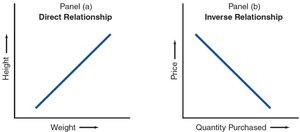
Direct and Inverse Relationships
Variables can be related directly or inversely:
Direct Relationship: Both variables increase or decrease together.
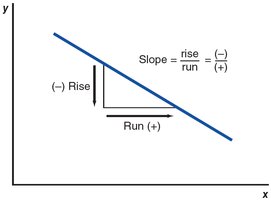
Inverse Relationship: One variable increases as the other decreases.
Constructing a Graph
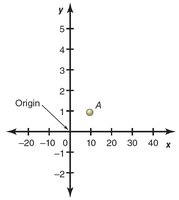
Graphs are constructed using number lines, axes, and the origin.
y axis: Vertical axis
x axis: Horizontal axis
Origin: Intersection of x and y axes
Graphing Numbers in a Table
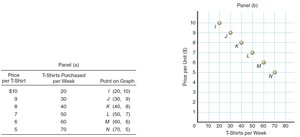
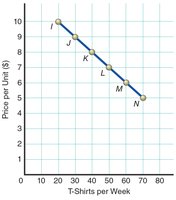
Data from tables can be plotted as points on a graph to visualize relationships.
Example: Price and quantity of T-shirts purchased
Positively Sloped Curve
A positively sloped curve indicates a direct relationship between variables.
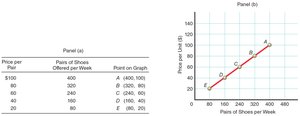
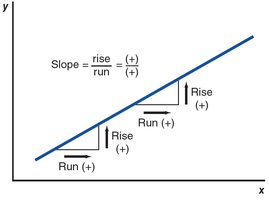
The Slope of a Line (Linear Curve)
The slope measures the "rise over run" or the change in y divided by the change in x.
Formula:
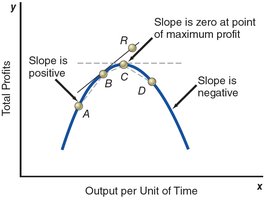
The Slope of a Nonlinear Curve
For nonlinear curves, the slope changes along the curve. At maximum or minimum points, the slope is zero.
Summary of Key Concepts
Direct and Inverse Relationships: Direction of change between dependent and independent variables.
Constructing Graphs: Visualizing economic relationships with axes and coordinates.
Slopes: Linear curves have constant slopes; nonlinear curves have variable slopes.
Additional info: These notes expand on the original content by providing definitions, examples, and formulas to ensure clarity and completeness for exam preparation.
