 뒤로
뒤로Chapter 14: Monetary Policy in Canada
스터디 가이드 - 스마트 노트
 자료에 맞춘 맞춤형 노트, 핵심 정의, 예시, 맥락을 확장해 제공합니다.
Monetary Policy Objective and Framework
Monetary Policy Objective
The primary objective of monetary policy in Canada is to control inflation and promote economic stability. This objective is established by the Bank of Canada Act (1935) and is implemented through the relationship between the Bank of Canada and the Government of Canada.
Inflation Control: The Bank of Canada aims to keep inflation low, stable, and predictable, primarily by targeting the Consumer Price Index (CPI).
Inflation Target: The current target is the 2 percent midpoint of a 1 to 3 percent inflation-control range, as agreed upon in the 2021 joint statement between the Bank and the Government, effective until December 31, 2026.
Core Inflation: The Bank uses core inflation as an operational guide, as it better predicts future CPI inflation.
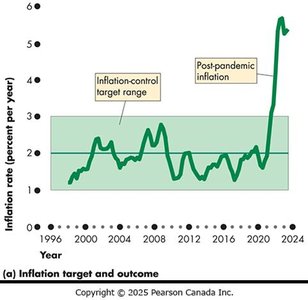
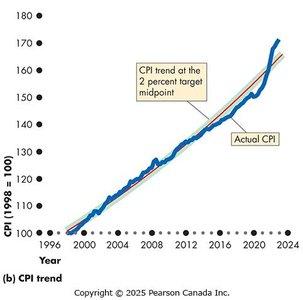
Performance: The Bank maintained inflation within the target range until 2021, when post-pandemic pressures caused inflation to exceed the upper limit.
Benefits and Controversies of Inflation Targeting
Benefits:
Reduces uncertainty for savers and investors.
Anchors expectations about future inflation.
Criticisms:
May lead to higher unemployment or slower GDP growth if the Bank focuses too narrowly on inflation.
Risk of recession if the Bank tightens policy when inflation exceeds the target.
Supporters' Response: Argue that low and stable inflation is essential for full employment and sustained growth, and that the Bank has balanced inflation control with employment concerns since the 1990s.
Responsibility for Monetary Policy
The Bank of Canada’s Governing Council, composed of monetary policy experts, is responsible for policy decisions.
The Governor and the Minister of Finance must consult regularly; in case of disagreement, the Minister can direct the Bank’s actions.
The Conduct of Monetary Policy
Monetary Policy Instruments
The Bank of Canada uses two main instruments to conduct monetary policy:
Bank Reserves: The sum of currency held by banks and their reserve balances at the Bank of Canada. The Bank adjusts reserves through open market operations (buying or selling government securities).
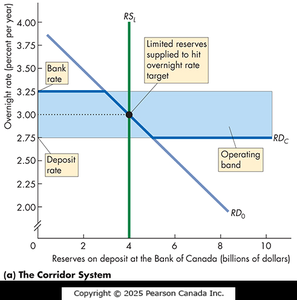
Interest Rates: The overnight rate (rate at which banks lend to each other overnight), the deposit rate (paid on reserves), and the bank rate (charged on loans from the Bank of Canada).
The Operating Band (Corridor)
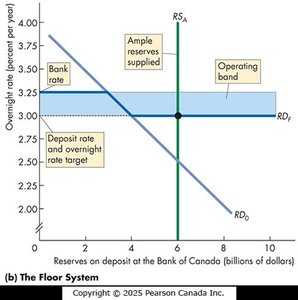
The Bank sets a target for the overnight rate, with the bank rate as the ceiling and the deposit rate as the floor, forming the operating band.
Banks will not borrow at rates above the bank rate or lend below the deposit rate.
Policy Decision Process
The Bank analyzes economic data and uses models (such as the Aggregate Supply–Aggregate Demand model) to set the overnight rate and communicate its decisions publicly.
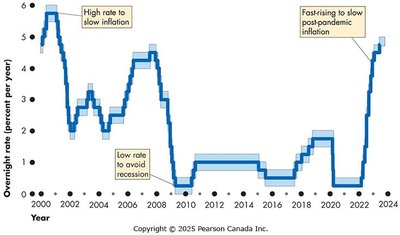
Since 2000, the Bank announces the interest rate target for the next six weeks, typically adjusting by 0.25 percentage points.
Bank Reserves and Open Market Operations
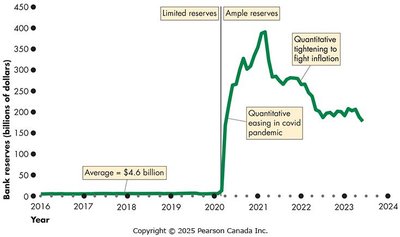
Before 2020, the Bank operated with limited reserves, adjusting them to hit the overnight rate target.
During crises (e.g., 2008–2009 in the U.S., 2020 in Canada), central banks used quantitative easing (QE) to create ample reserves by purchasing large quantities of government bonds.
When inflation risk rises, the Bank may use quantitative tightening (QT) to reduce reserves.
Corridor vs. Floor System
Corridor System: Used until March 2020, the Bank supplied limited reserves to keep the overnight rate near the center of the operating band.
Floor System: Since March 2020, the Bank supplies ample reserves, keeping the overnight rate at the floor of the operating band.
Monetary Policy Transmission
Transmission Mechanism
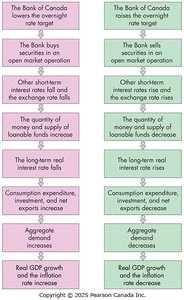
Changes in the overnight rate by the Bank of Canada set off a chain of events that ultimately affect inflation, real GDP, and employment.
Lowering the overnight rate increases reserves, lowers other short-term rates and the exchange rate, increases money supply and loanable funds, reduces long-term real interest rates, and boosts consumption, investment, and net exports. This raises aggregate demand, real GDP, and inflation.
Raising the overnight rate has the opposite effects, reducing aggregate demand, real GDP, and inflation.
Interest Rate and Exchange Rate Effects
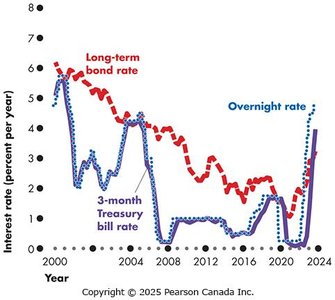
Short-term interest rates move closely with the overnight rate; long-term rates are less tightly linked.
The exchange rate responds to changes in the Canadian interest rate relative to other countries, but is also influenced by other factors.
Aggregate Expenditure and Demand
Changes in the overnight rate affect consumption, investment, and net exports, shifting aggregate demand and influencing real GDP and the price level.
The Bank uses these effects to close output gaps and keep inflation on target.
Fighting Recession and Inflation
To fight recession, the Bank lowers the overnight rate and increases reserves, stimulating aggregate demand and restoring full employment.
To fight inflation, the Bank raises the overnight rate and decreases reserves, reducing aggregate demand and restoring price stability.
Financial Crisis: Cure and Prevention
Central Bank Actions in Crisis
When the overnight rate reaches its lower bound, central banks may use unconventional tools such as quantitative easing.
During the 2008–2009 crisis, the U.S. Fed provided ample reserves, extended deposit insurance, and purchased troubled assets to stabilize the financial system.
Macroprudential Regulation
Macroprudential regulation: Aims to reduce systemic risk in the financial system by regulating the balance sheets of banks and other institutions, adjusting requirements based on the macroeconomic environment.
Microprudential regulation: Focuses on the safety of individual institutions.
In Canada, the Bank of Canada, the Office of the Superintendent of Financial Institutions, and the Canada Deposit Insurance Corporation share responsibility for financial stability.
The Bank of Canada acts as lender of last resort, manages the payment system, and conducts financial system stress tests.
Policy Strategies and Long-Run Effects
In the short run, monetary policy creates a tradeoff between inflation and unemployment.
In the long run, monetary policy determines the inflation rate but not the unemployment rate, which is set by the natural rate of unemployment.
Inflation targeting helps anchor expectations and supports full employment and sustained growth.
