 뒤로
뒤로Chapter 15: Monetary Policy – Study Notes for Macroeconomics
스터디 가이드 - 스마트 노트
 자료에 맞춘 맞춤형 노트, 핵심 정의, 예시, 맥락을 확장해 제공합니다.
Monetary Policy
Introduction to Monetary Policy
Monetary policy refers to the actions undertaken by a nation's central bank—in the United States, the Federal Reserve (the Fed)—to manage the money supply and interest rates in pursuit of macroeconomic objectives. These objectives include price stability, high employment, stability of financial markets and institutions, and economic growth. The Fed's role has evolved over time, especially in response to major economic crises.
What is the Role of the Federal Reserve?
It was created in 1913, its main responsibility was to prevent bank panics.
After the Great Depression of the 1930s, Congress gave the fed. the responsibility to "promote effectively the goals of maximum employment, stables prices and moderate long-term interest rates."
The Goals of Monetary Policy
Price Stability: Maintaining low and stable inflation is crucial because rising prices erode the purchasing power of money. High inflation, as seen in the 1970s and again in 2021, can destabilize the economy.
This inflation was due to monetary and fiscal policy actions
Once, the annual inflation surpasses the 10% benchmark thats how you know when an economy has a high rate of inflation
Policymakers often use price stability as a primary goal to control inflation
High Employment: The Employment Act of 1946 established the federal government's responsibility to promote maximum employment, production, and purchasing power. The Fed's dual mandate refers to its goals of price stability and high employment.
Stability of Financial Markets and Institutions: The Fed acts as a lender of last resort, providing funds to banks and, in times of crisis, to other financial institutions to maintain confidence and prevent systemic collapse.
In 2008, the Fed temporarily made these discount loans available to investment banks also, to ease their liquidity problems.
In 2020, the Fed did the same during the Covid-19 pandemic, in addition to some new lending facilities.
Economic Growth: Stable economic growth encourages long-run investment, though the Fed's influence on long-run growth is limited compared to its other goals.
Congress and the president may be in a better position to address this role
The Federal Funds Rate and Conduct of Monetary Policy
The Federal Funds Rate
The federal funds rate is the interest rate banks charge each other for overnight loans. It is a key tool for the Fed to influence aggregate demand and, ultimately, real GDP. The Fed wants steady economic growth by adjusting interest rates, but it controls short-term rates more easily than the long-term rates that matter most for spending and investment.
Aggregate demand will affect the level of money supply in the economy
The interest rates that have the most effect on AD are the real interest rates (Long-term interest rates) on: mortgage loans, corporate bonds and U.S Treasury bonds
The Importance of the Federal Funds Rate
Federal funds rate: the interest rate banks charge each other for overnight loans
While banks are no longer required to hold substantial reserves, they still do so because:
The interest they earn on reserves is risk-free.
Large banks must maintain enough high-quality liquid assets to comply with regulations.
When banks need additional reserves, they borrow in the federal funds market, paying the federal funds rate on these very short-term loans—often just overnight.
How the Fed Controls the Federal Funds Rate
The Fed sets a target range for the federal funds rate and uses various tools to keep the actual rate within this range.
In October 2023, the target was 5.25 to 5.5 percent
Type of Monetary Policy
🟢 Expansionary = Lower the target for the federal funds rate → AD ↑, Real GDP ↑, Employment ↑
🔴 Contractionary = Raise the target for the federal funds rate → AD ↓, Real GDP ↓, Employment ↓
Controlling the Federal Funds Rates
The Fed uses different tools to control the federal funds rate depending on the level of reserves banks choose to keep
Situation: Banks keep as few reserves as regulations allow
Name: Scarce-reserves regime
Method: Adjust the supply of reserves
Situation: Banks keep more reserves than required
Name: Ample-reserves regime
Method: Adjust the interest rate on reserve balances (IORB) and the interest rate on overnight reverse repurchase agreements (ONRRP), to set a floor under the federal funds rate.
Look at notes
Administered Rates and the Floor System
The fed sets these two interest rates and therefore are called the administered rates
Interest on Reserve Balances (IORB): The Fed pays interest on reserves held by banks, setting a floor for the federal funds rate.
Overnight Reverse Repurchase Agreements (ONRRP): The Fed borrows funds overnight from financial firms, providing a true lower bound for the federal funds rate.
Under a reverse repurchase agreement, the Fed sells a security to a financial firm with the promise to buy it back the next day.
Risk-free
These administered rates allow the Fed to tightly control the federal funds rate, a system known as the floor operating system.
Quantitative Easing and Forward Guidance
Recession → Fed wants LOWER interest rates → Increase AD.
But interest rates can't go below 0% → This is the Zero Lower Bound.
When the federal funds rate approaches the zero lower bound, the Fed uses quantitative easing (QE)—buying long-term securities to lower long-term interest rates and stimulate aggregate demand.
Forward guidance involves communicating future policy intentions to influence expectations and economic behavior.
Summary of the Fed’s Monetary Policy Tools
The Fed's two most important tools:
Interest on reserve balances (IORB): to manage the federal funds rate
Interest rate on overnight reverse repurchase agreements (ONRRP): for a lower bound on the federal funds rate
The Tools the Fed uses when faces with a zero lower bound:
Quantitative easing: when the Fed faces the zero lower bound on the federal funds rate
Forward guidance: to signal the Fed’s intent to keep the federal funds rate close to zero for a prolonged time
The Fed's three traditional tools
Open market operations:
What it is: The Fed buys or sells U.S. Treasury securities.
Purpose: Change the amount of bank reserves to control the federal funds rate.
Key fact: This was the Fed's main tool in a scarce-reserves regime.
Memory Trick:
Buy securities → More reserves → Federal funds rate ↓
Sell securities → Fewer reserves → Federal funds rate ↑
Discount rate
What it is: The interest rate the Fed charges banks that borrow directly from it.
Purpose: Provide emergency loans when banks need money (lender of last resort).
Key fact: The discount rate is higher than the federal funds rate, so banks only use it when necessary (it's called the penalty rate).
Memory Trick:
Discount rate = Emergency loan from the Fed.
Reserve requirements (no longer actively used since March 2020):
What it is: The minimum percentage of deposits banks had to keep in reserve instead of lending out.
Key fact: Since March 2020, the Fed no longer uses reserve requirements (required reserve ratio = 0%).
Memory Trick:
Reserve requirements = Minimum reserves banks must keep (not used anymore).
Monetary Policy and Economic Activity
Transmission Mechanism
The effectiveness of monetary policy depends on the Fed’s ability to influence long-term real interest rates, which affect aggregate demand through consumption, investment, and net exports.
Consumption: lower interest rates encourage buying on credit, which typically affects the sale of durables. Lower rates also discourage saving.
Investment: Lower rates reduce the cost of borrowing for firms and make stocks more attractive, encouraging capital investment.
Net Exports: Lower U.S. interest rates can weaken the dollar, boosting exports and reducing imports.
Look at notes
Expansionary vs. Contractionary Monetary Policy
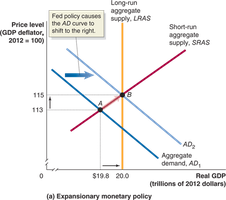
Expansionary monetary policy: The Fed decreases interest rates to stimulate aggregate demand when real GDP is below potential GDP.
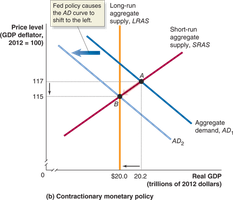
Contractionary monetary policy: The Fed increases interest rates to reduce inflation when the economy is overheating.
Potential GDP use the LRAS
If the fed keeps the interest level too low -> real GDP will surpass Potential GDP leading to inflation
Limitations of Monetary Policy
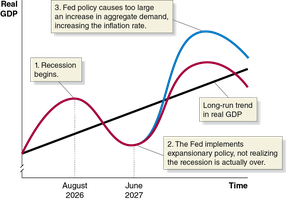
There are lags in recognizing economic conditions and implementing policy, making it difficult to perfectly time interventions.
Poorly timed policy can exacerbate economic fluctuations rather than smooth them.
Dynamic Aggregate Demand and Aggregate Supply Model
Dynamic AD-AS Model
The static AD-AS model is a simplified version that shows the economy at one point in time.
The dynamic AD-AS model is more realistic because it recognizes that the economy changes every year.
What changes each year?
📈 Potential GDP increases because of long-run economic growth (more workers, better technology, more capital).
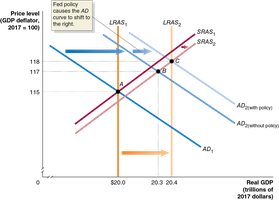
📈 Aggregate Demand (AD) usually increases because consumers, businesses, and the government spend more over time.
📈 Short-Run Aggregate Supply (SRAS) also increases, but more slowly than AD.
📈 As a result, the price level usually rises, causing inflation.
Expansionary policy: Used when aggregate demand is expected to grow too slowly, preventing real GDP from reaching potential.
Contractionary policy: Used when aggregate demand is expected to grow too quickly, risking excessive inflation.
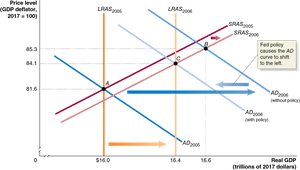
The Fed’s Setting of Monetary Policy Targets
Targeting the Federal Funds Rate vs. Money Supply
Monetarists, led by Milton Friedman, believed the Fed should control the money supply by following a steady growth rule, but because the relationship between money supply, GDP, and inflation became unreliable after the 1980s, the Fed now focuses on targeting interest rates instead..
The Taylor Rule
The Taylor rule provides a formula for setting the federal funds rate based on the equilibrium real rate, the inflation gap, and the output gap:
where:
The equilibrium real federal funds rate is the estimate of the inflation-adjusted federal funds rate that would be consistent with maintaining real G D P at its potential level in the long run.
Inflation gap is the difference between current inflation and the Fed’s target rate of inflation (could be positive or negative)
Output gap is the difference between current real G D P and potential G DP (could be positive or negative)
The Taylor rule works well during high inflation, but during recessions it may suggest lowering interest rates below 0%, which is impossible because of the zero lower bound, so the Fed must use other tools instead like quantitive easing.
Inflation Targeting and Average-Inflation Targeting
Inflation targeting:is a monetary policy framework where the central bank announces a specific inflation goal and uses its policies to try to keep inflation near that target.
BUT during severe recessions the Fed may allow inflation to move away from this target to support economic recovery, which is why some critics argue that a strict target could limit the Fed’s flexibility.
Average-inflation targeting: The Fed aims for inflation to average 2% over time, allowing for temporary deviations above or below the target.
Should the Fed Target Nominal GDP?
Some economists propose targeting nominal GDP growth (real GDP growth plus inflation), but as of 2023, no central bank has adopted this approach.
How the policy works:
📉 If real GDP growth slows below expectations:
Nominal GDP growth falls.
The Fed uses expansionary monetary policy (lower interest rates) to increase demand.
📈 If real GDP growth is faster than expected:
Nominal GDP grows too quickly.
The Fed uses contractionary monetary policy (raise interest rates) to slow the economy and control inflation.
Nominal GDP growth = real GDP growth + inflation rate
Should the Fed Worry about the prices of food and gas?
Which inflation rate does the Fed actually pay attention to?
Not the CPI: it is too volatile and probably overstates inflation.
The Fed focuses on core PCE (personal consumption expenditure) inflation (PCE excluding food and energy) because it is more stable and better reflects long-run inflation trends.
Fed Policies During the 2007–2009 and 2020 Recessions
Terms:
A bubble in a market refers to a situation in which prices are too high relative to the underlying value of the asset.
Bubbles can form due to:
Herding behavior: Failing to correctly evaluate the value of the asset and instead relying on other people’s apparent evaluations; and/or
Speculation: Believing that prices will rise even higher and buying the asset intending to sell it before prices fall.
The Financial Crisis of 2007–2009
A housing bubble, fueled by risky lending and mortgage-backed securities, burst, leading to widespread defaults and a credit crunch.
The Fed and Treasury took unprecedented actions to stabilize the financial system, including lending to non-bank institutions and creating new lending facilities.
Main Concept: Leverage
Leverage means using borrowed money to increase your potential return on an investment.
A mortgage allows you to control a large asset with a small amount of your own money.
✅ Small down payment + rising home prices = huge returns
❌ Small down payment + falling home prices = huge losses
Big down payment = safer but lower returns
Small down payment = riskier but higher potential returns.
The Covid-19 Recession
The Fed cut the federal funds rate to zero and introduced new liquidity and credit facilities to support businesses and governments, preventing a deeper credit crunch.
The Fed used two types of lending facilities:
Liquidity facilities: expanding its role as lender of last resort to firms in the shadow banking system, and aggressively lending in the repurchase market
Credit facilities: allowing the Fed to provide funds directly
Online Appendix: The Money Market and the Fed
The Money Market Model
The money market model explains how the Fed can influence short-term nominal interest rates by changing the money supply. The demand for money is negatively related to the interest rate, as higher rates increase the opportunity cost of holding money.
Managing the Money Supply
Open market operations: Buying securities increases the money supply and lowers interest rates; selling securities does the opposite.
The Fed cannot simultaneously target both the money supply and the interest rate due to the money demand curve.
The central bak and the fed control the money supply of the economy
Comparison of Interest Rate Models
Loanable funds model: Focuses on the long-term real interest rate, relevant for investment decisions.
Money market model: Focuses on the short-term nominal interest rate, which the Fed can directly influence.
Summary Table: Key Monetary Policy Tools
Tool | Description | Purpose |
|---|---|---|
Interest on Reserve Balances (IORB) | Interest paid on bank reserves held at the Fed | Sets a floor for the federal funds rate |
Overnight Reverse Repurchase Agreements (ONRRP) | Fed borrows funds overnight from financial firms | Provides a lower bound for the federal funds rate |
Open Market Operations | Buying/selling Treasury securities | Adjusts reserves and influences the federal funds rate |
Discount Rate | Interest rate for loans to banks | Lender of last resort |
Reserve Requirements | Minimum reserves banks must hold | Rarely used since 2020 |
Quantitative Easing | Purchasing long-term securities | Lowers long-term interest rates |
Forward Guidance | Communicating future policy intentions | Influences expectations |
Additional info: The study notes above are based on Chapter 15 of a leading Macroeconomics textbook and are structured to provide a comprehensive yet concise overview of monetary policy, its tools, and its effects on the economy. All images included are directly relevant to the concepts discussed and reinforce the explanations provided.
