 뒤로
뒤로The Solow Growth Model: Steady State, Transition Dynamics, and Cross-Country Growth
스터디 가이드 - 스마트 노트
 자료에 맞춘 맞춤형 노트, 핵심 정의, 예시, 맥락을 확장해 제공합니다.
The Solow Growth Model
Introduction to the Solow Model
The Solow Growth Model is a foundational framework in macroeconomics for understanding long-run economic growth, capital accumulation, and differences in income across countries. It emphasizes the roles of capital, labor, technology, and savings in determining the steady-state level of output and growth rates.
Steady State in the Solow Model
Definition and Properties
Steady State: The steady state is a condition where key economic variables such as capital per worker (k), output per worker (y), and consumption per worker (c) remain constant over time because net investment is zero.
Capital Law of Motion: The evolution of capital per worker is given by , where is the savings rate, is the depreciation rate, and is the population growth rate.
Solving for Steady State: At steady state, , so , where is the per-worker production function.
Output and Consumption: Once is found, steady-state output and consumption are and .
Example: If the savings rate increases, the steady-state capital and output per worker rise, but due to diminishing returns, the increase is less than proportional.
Transition Dynamics
Adjustment to the Steady State
When an economy is not at its steady state, capital and output adjust over time toward their steady-state values.
The principle of transition dynamics states that the further an economy is from its steady state, the faster it will grow (if below steady state) or shrink (if above steady state).
As the steady state is approached, growth slows and eventually stops.
Example: A country with low initial capital will experience rapid growth as it accumulates capital, but this growth slows as it nears the steady state.
Comparative Statics: Parameter Changes
Effects of Changes in Parameters
Technological Improvement (A): A permanent increase in technology raises the steady-state levels of capital, output, and consumption per worker.
Increase in Savings Rate (s): Raises steady-state capital and output per worker, but not the long-run growth rate.
Increase in Depreciation Rate (δ): Lowers steady-state capital and output per worker.
Population Growth (n): Increases aggregate output but reduces output per worker in the steady state due to capital dilution.
Example: If a country increases its savings rate from 20% to 30%, steady-state output per capita rises, but the exact proportion depends on the production function's parameters.
Empirical Evidence and Cross-Country Growth
Growth Rates and Steady State Predictions
The Solow model predicts that countries further below their steady state will grow faster than those near or at their steady state. This is supported by empirical evidence in developed countries but less so globally, where persistent differences in parameters (like savings rates and technology) explain income gaps.
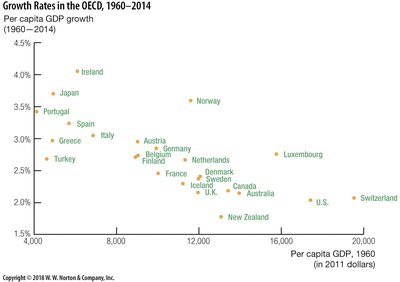
Figure: OECD countries with lower initial income in 1960 tended to grow faster, consistent with transition dynamics.
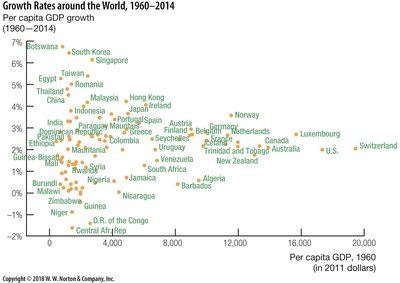
Figure: Globally, the relationship is weaker, indicating that differences in parameters (not just initial conditions) matter for long-run income differences.
Case Study: South Korea vs. Philippines
Explaining Divergent Growth Paths
South Korea grew rapidly from a low base, increasing its income relative to the U.S., while the Philippines remained stagnant.
The Solow model explains this by differences in investment rates and technology.
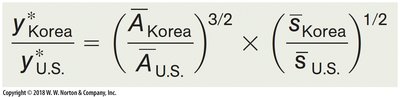
Equation: The steady-state ratio of per capita incomes depends on the ratio of total factor productivity (TFP) and investment rates:
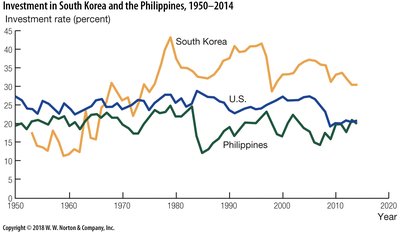
Figure: South Korea's higher investment rate contributed to its rapid growth and convergence toward higher income levels.
Strengths and Weaknesses of the Solow Model
Strengths
Explains long-run differences in income across countries based on savings, population growth, and technology.
Transition dynamics clarify why growth rates differ across countries and over time.
Weaknesses
Does not explain the sources of technological progress (TFP).
Cannot account for sustained long-run growth in output per worker without exogenous technological change.
Does not endogenize the savings/investment rate.
Solow Model with Population Growth
Population Growth and Output
Population growth increases aggregate output but not output per worker in the steady state.
With population growth, the steady-state condition becomes .
Example: If population grows at 2% per year, the steady-state capital per worker is lower than without population growth, all else equal.
Summary Table: Effects of Parameter Changes on Steady State
Parameter Change | Effect on k* | Effect on y* | Effect on c* |
|---|---|---|---|
Increase in s | Increases | Increases | Increases (to a point) |
Increase in δ | Decreases | Decreases | Decreases |
Increase in n | Decreases | Decreases | Decreases |
Increase in A | Increases | Increases | Increases |
Conclusion
The Solow model provides a powerful framework for understanding the determinants of long-run economic prosperity and the process of convergence across countries. However, it highlights the importance of technology and investment rates, and points to the need for further models to explain sustained growth and the sources of technological progress.
