 뒤로
뒤로Trade-offs, Comparative Advantage, and the Market System – Study Notes
스터디 가이드 - 스마트 노트
 자료에 맞춘 맞춤형 노트, 핵심 정의, 예시, 맥락을 확장해 제공합니다.
Chapter 2: Trade-offs, Comparative Advantage, and the Market System
2.1 Production Possibilities Frontiers and Opportunity Costs
The Production Possibilities Frontier (PPF) is a fundamental model in economics that illustrates the trade-offs and opportunity costs faced by producers when allocating scarce resources between two goods. The PPF shows the maximum attainable combinations of two products that can be produced with available resources and current technology.
Scarcity: The condition where unlimited wants exceed the limited resources available to fulfill those wants. Scarcity forces individuals, firms, and governments to make choices, leading to trade-offs.
Trade-off: Choosing more of one good or activity means having less of another due to limited resources.
Opportunity Cost: The highest-valued alternative that must be given up to engage in an activity. For example, if Ford shifts resources to produce more electric vehicles, it must produce fewer gasoline-powered trucks.
PPF as a Positive Tool: The PPF describes what is possible, not what should be done (positive, not normative analysis).
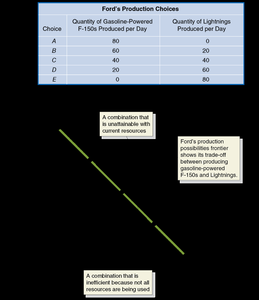
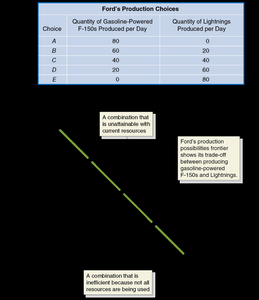
Points on the PPF: Efficient and attainable combinations of goods.
Points inside the PPF: Inefficient use of resources.
Points outside the PPF: Unattainable with current resources and technology.
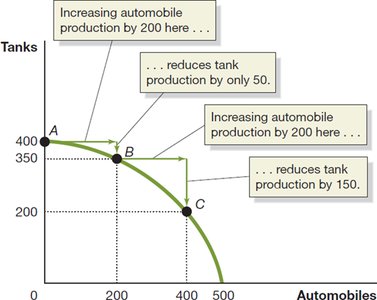
Constant vs. Increasing Opportunity Costs: If resources are equally suited for both goods, opportunity costs are constant (straight-line PPF). If not, opportunity costs increase as more resources are shifted (bowed-outward PPF).
Economic Growth: An outward shift of the PPF, representing an increase in an economy's capacity to produce goods and services. This can result from more resources or technological improvements.
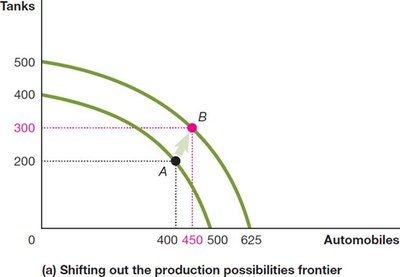
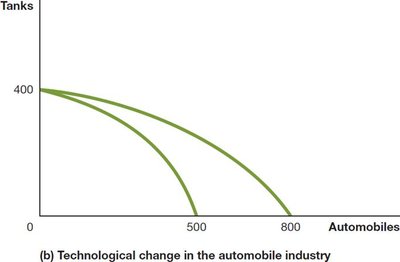
Example: Allocating study time between two exams (Economics and Accounting) also creates a PPF, typically bowed outward due to increasing opportunity costs.
2.2 Comparative Advantage and Trade
Comparative advantage is the foundation of trade. It explains how individuals, firms, or countries can benefit by specializing in the production of goods for which they have the lowest opportunity cost and trading for others.
Absolute Advantage: The ability to produce more of a good or service than competitors using the same amount of resources.
Comparative Advantage: The ability to produce a good or service at a lower opportunity cost than competitors.
Specialization: When each party specializes in the good for which they have a comparative advantage, total production and consumption increase for all parties involved.
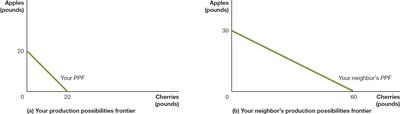
Example: If you and your neighbor can each pick apples and cherries, but your neighbor is better at both, you can still both benefit from trade if you specialize according to comparative advantage.
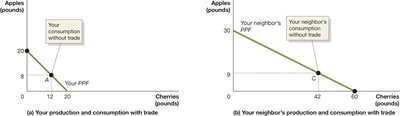
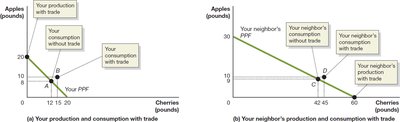
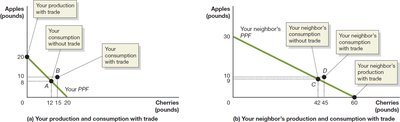
You: Apples (lbs) | You: Cherries (lbs) | Your Neighbor: Apples (lbs) | Your Neighbor: Cherries (lbs) | |
|---|---|---|---|---|
Production and consumption without trade | 8 | 12 | 9 | 42 |
Production with trade | 20 | 0 | 0 | 60 |
Consumption with trade | 10 | 15 | 10 | 45 |
Gains from trade (increased consumption) | 2 | 3 | 1 | 3 |
Opportunity Cost Table:
Opportunity Cost of 1 lb Apples | Opportunity Cost of 1 lb Cherries | |
|---|---|---|
You | 1 lb cherries | 1 lb apples |
Your Neighbor | 2 lbs cherries | 0.5 lb apples |
Application: Comparative advantage can be used to divide household chores efficiently, even if one person is better at everything.
2.3 The Market System
The market system is the network of buyers and sellers who exchange goods and services, guided by prices and self-interest. It is the foundation of modern economies.
Market: Any arrangement that brings buyers and sellers together to exchange goods or services.
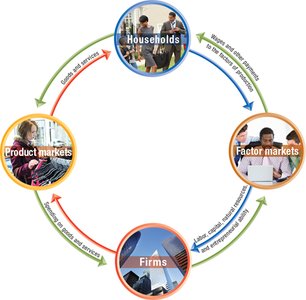
Households: Provide factors of production (labor, capital, natural resources, entrepreneurial ability).
Firms: Purchase factors of production from households and use them to produce goods and services.
Factor Market: Where resources (labor, capital, etc.) are bought and sold.
Product Market: Where finished goods and services are bought and sold.
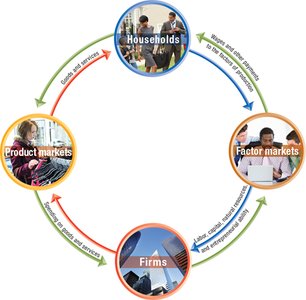
Circular-Flow Diagram: Illustrates the flow of resources, goods, services, and money in an economy. Households sell resources to firms in factor markets and buy goods/services in product markets; firms do the opposite.
Free Market: An economic system with minimal government intervention, where prices are determined by supply and demand.
Market Mechanism: The process by which prices adjust to reflect the relative scarcity of goods and services, guiding resources to their most valued uses ("invisible hand").
Knowledge in Markets: Markets efficiently process both general and local knowledge, allowing rapid adaptation to changing conditions.
Entrepreneur: An individual who organizes the factors of production to create goods and services, often innovating and taking risks.

Legal Basis for Markets: Successful markets require protection of private property and enforcement of contracts, typically provided by government and independent courts.
Property Rights: The rights to use, buy, or sell property, essential for economic incentives.
Socialism vs. Social Democracy: Socialism (in the Marxist tradition) involves government ownership of resources. Social democracy involves a larger government role in the economy, but not full ownership of resources.


Key Equations and Concepts
Opportunity Cost Formula:
PPF Equation (linear):
Economic Growth: Outward shift of the PPF.
Additional info: These notes expand on the textbook slides by providing definitions, examples, and equations for key macroeconomic concepts. Tables and diagrams are included to reinforce understanding of opportunity cost, comparative advantage, and the market system.
