 뒤로
뒤로Cost Concepts and Classifications in Managerial Accounting
스터디 가이드 - 스마트 노트
 자료에 맞춘 맞춤형 노트, 핵심 정의, 예시, 맥락을 확장해 제공합니다.
The Nature of Cost
Definition and Importance
Understanding the nature of cost is fundamental in managerial accounting, as costs are central to decision-making processes. Costs are incurred to produce goods or services and are classified in various ways to aid in planning, controlling, and evaluating business operations.
Cost: The economic value sacrificed to achieve a specific objective, such as producing a product or providing a service.
Key Elements: Cost classification, cost behavior, and cost allocation are essential for effective management decisions.
Direct and Indirect Costs
Direct Costs
Direct costs are those that can be easily and accurately traced to a specific product, service, or department.
Direct Materials: Raw materials that become an integral part of the finished product and can be directly traced to it.
Direct Labor: The wages of employees who are directly involved in the production process.
Example: The cost of wood in furniture manufacturing.
Indirect Costs
Indirect costs cannot be directly traced to a specific product or service. Instead, they are allocated across multiple products or services.
Manufacturing Overhead: Includes indirect materials, indirect labor, and other indirect costs such as utilities and depreciation.
Example: The salary of a factory supervisor overseeing multiple production lines.
Factors Affecting Cost Classification
Several factors influence how costs are classified within an organization:
Materiality: The significance of the cost in relation to the total cost.
Available Technology: The ability to gather and trace cost information.
Design of Operations: The complexity and structure of production processes.
Manufacturing Costs
Components of Manufacturing Costs
Manufacturing costs are the costs incurred to produce a product. They are classified into three main categories:
Direct Materials
Direct Labor
Manufacturing Overhead
Each component plays a vital role in determining the total cost of production.
Prime Costs and Conversion Costs
Classification of Manufacturing Costs
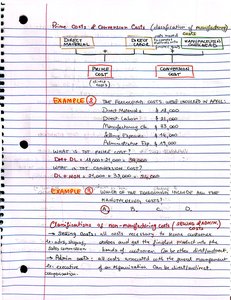
Prime costs and conversion costs are two important classifications in manufacturing:
Prime Cost | Conversion Cost |
|---|---|
Direct Materials + Direct Labor | Direct Labor + Manufacturing Overhead |
Prime costs focus on the primary inputs, while conversion costs focus on the costs required to convert raw materials into finished goods.
Classification of Non-Manufacturing Costs
Non-manufacturing costs include selling, administrative, and general expenses. These costs are not directly tied to the production process but are necessary for overall business operations.
Selling Costs: Costs incurred to market, distribute, and service products.
Administrative Costs: Costs related to the overall management of the organization.
Cost Behavior: Variable and Fixed Costs
Variable Costs
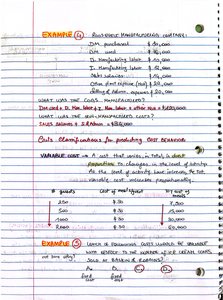
Variable costs change in total in direct proportion to changes in the level of activity or volume.
Formula:
Example: Direct materials cost increases as more units are produced.
Fixed Costs
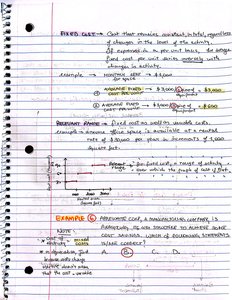
Fixed costs remain constant in total regardless of changes in the level of activity within a relevant range.
Example: Factory rent remains the same even if production increases or decreases.
Formula:
Relevant Range
The relevant range is the level of activity within which fixed costs remain constant and variable cost per unit remains unchanged.
Comparison of Cost Classifications by Behavior
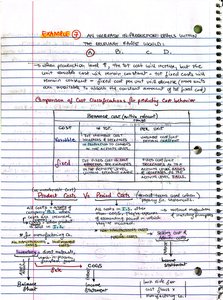
Behavior | Variable Cost | Fixed Cost |
|---|---|---|
Total Cost | Changes with activity | Remains constant |
Per Unit Cost | Remains constant | Changes with activity |
Product Cost vs. Period Cost
Definitions and Examples
Product Costs: Costs that are assigned to goods produced and included in inventory until the goods are sold (e.g., direct materials, direct labor, manufacturing overhead).
Period Costs: Costs that are expensed in the period in which they are incurred (e.g., selling and administrative expenses).
Product costs are matched with revenues when the goods are sold, while period costs are expensed on the income statement in the period incurred.
Cost of Goods Manufactured and Income Statement Preparation
Steps in Calculating Cost of Goods Manufactured (COGM)
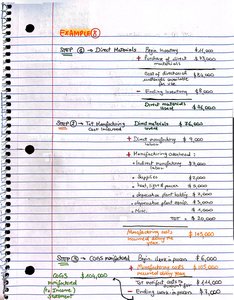
Step 1: Calculate direct materials used.
Step 2: Compute total manufacturing costs (direct materials, direct labor, manufacturing overhead).
Step 3: Determine cost of goods manufactured by adjusting for beginning and ending work-in-process inventory.
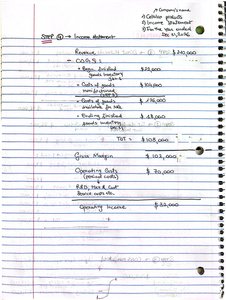
Step 4: Prepare the income statement, including cost of goods sold and operating income.
Additional info: These notes provide a comprehensive overview of foundational cost concepts, classifications, and calculations essential for Managerial Accounting students. They include definitions, examples, formulas, and step-by-step procedures for cost accounting and financial statement preparation.
